Floor Scrubber and Natural Stone: The Right Pad and Product for an Automatic Machine
The daily cleaning of large stone floors such as hotel lobbies, shopping centers, hospital corridors, and terminals is largely done with automatic floor scrubbers. These machines wet the floor, scrub it with a brush or pad, and recover the dirty water in a single pass; when used correctly, they save time and clean the floor more evenly than mopping. However, the same machine, when used with the wrong pad, too much product, or a poorly maintained squeegee, can strip the polish from natural stone within months and leave a slippery film on the surface. In this article, we look at natural stone in terms of the difference between walk-behind and ride-on machines, brush and pad selection, product dosing, water and speed settings, and the machine's daily maintenance habits.
In short: When working with a floor scrubber on natural stone, what matters is not the size of the machine but the pad or brush that touches the stone, the product put in the tank, and how well the water is recovered. Use soft pads on polished stone, brushes of suitable stiffness on textured stone, a neutral product at the correct dose, and a squeegee in good condition; the machine should be cleaned at the end of every shift.
What Does a Floor Scrubber Do to Stone?
An automatic floor scrubber does four jobs at the same time: it dispenses cleaning solution from the clean water tank onto the floor, scrubs the floor with a rotating brush or pad, collects the dirty water with the rubber squeegee behind it, and draws that water by vacuum into the recovery tank. Each of these affects the stone in a different way. The solution relates to the stone's chemistry, the pad or brush to the polish of the surface, and the squeegee to the dryness of the floor and the risk of slipping.
The machine's effect on stone is mechanical. The pad or brush scrubs the same surface every day; the more abrasive this scrubbing is, the faster the polish wears away. With mop cleaning this effect is very slight, but because the machine passes over the same surface every day, even a small difference in abrasiveness turns into noticeable dulling over time. For this reason, machine cleaning is not just cleaning for the stone but also a continuous surface treatment, and it should be set up accordingly.
Walk-Behind, Ride-On, and Compact Machines

Floor scrubbers can generally be divided into three groups. Walk-behind machines are medium-sized machines operated by walking behind them, and they are commonly preferred for corridors, lobbies, and medium-sized halls. Ride-on machines are larger machines on which the operator sits or stands; they are efficient on wide, unobstructed surfaces such as shopping centers, terminals, and large exhibition halls. Compact machines are small, lightweight machines designed for narrow spaces, elevators, restrooms, and small offices.
For natural stone, there is no fundamental difference between these three groups; all work on the same principle. The difference lies in how well they suit the layout of the space. In a hotel lobby with many columns, pieces of furniture, and narrow passages, a large ride-on machine cannot reach every corner, and the edges have to be cleaned with a mop. In that case, a difference in appearance can develop over time between the center and the edges of the floor. In a large, unobstructed hall, on the other hand, a small machine has to pass over the same area many times, which means lost time and uneven cleaning.
When choosing a machine, the building's elevators, door widths, and the possibility of moving it between floors should also be considered. Battery-powered machines are safer in occupied buildings because they need no cable; corded machines are not limited by charging time but create a tripping hazard along the walking route.
Brush or Pad?
On floor scrubbers, the part that touches the stone is either a brush or a pad attached to a pad holder. Which one to use depends on the surface texture of the stone. On a polished or honed flat surface, a pad makes smooth, even contact with the floor; a brush, on the other hand, makes less contact than needed on a flat surface, and the tips of its bristles can leave fine scratches over time.
On textured surfaces the situation is reversed. On flamed granite, brushed travertine, split-face stone, or floors with deep joints, a pad cannot reach into the hollows of the surface, and dirt stays in them. On these surfaces, a brush of suitable stiffness lifts the dirt out of the texture. The stiffness of the brush must be chosen according to the stone; a brush that is too stiff can wear down the texture of a soft stone over time. We also covered the cleaning of rough surfaces separately in our article on cleaning flamed granite steps .
If a building has both polished and textured stone, the machine should be used with separate brush and pad sets for each surface. These sets should be stored separately, and it should be marked which area each belongs to.
Pad Selection and the Risk of Abrasion
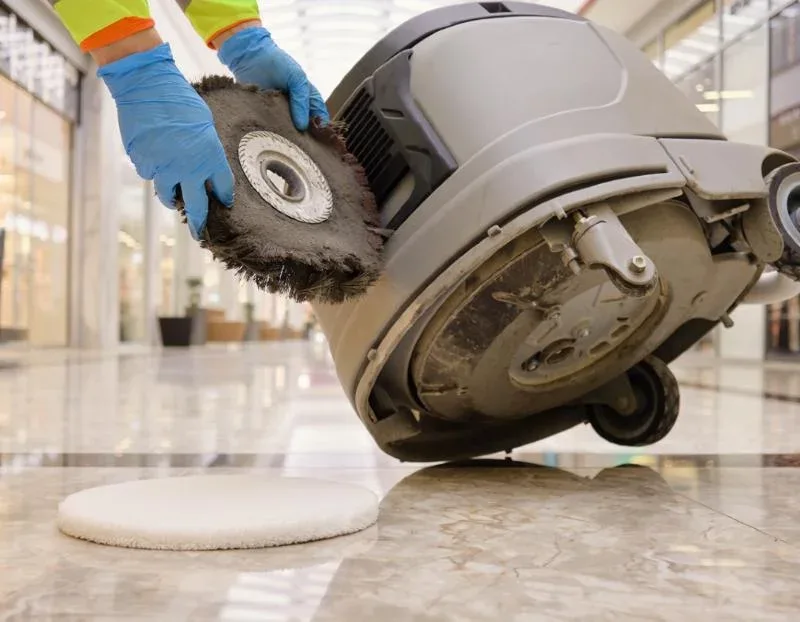
Pad selection is the most important decision determining the effect of a floor scrubber on natural stone. Pads are produced in different colors according to their level of abrasiveness; however, these colors vary from manufacturer to manufacturer, and the same color can have a different hardness in two different brands. So when choosing a pad, you should look not at the color but at the intended use and abrasiveness level stated by the manufacturer. We also explained the meaning of pad colors in our article on cleaning equipment and pad colors .
The softest pads should be used for daily cleaning of polished natural stone. Dark-colored abrasive pads are designed to strip old layers of finish from vinyl or concrete floors; when used on polished marble, they quickly remove the stone's shine. Some manufacturers also offer special maintenance pads with very fine diamond particles embedded in them; when used with water, these aim to refresh the shine while cleaning the floor. The suitability of such pads for the stone and how often to use them should be determined together with the company that maintains the building's stone.

The table below shows a general selection logic by surface type:
| Surface | Preferred for daily cleaning | To avoid |
|---|---|---|
| Polished marble and limestone | Softest pad, neutral product | Dark abrasive pad, acidic product |
| Honed marble and travertine | Soft pad, neutral product | Abrasive pad, excess water |
| Polished granite | Soft pad, neutral product | Film-leaving product, overdosing |
| Flamed or brushed stone | Brush of suitable stiffness | Pad, very stiff wire brush |
| Jointed and textured floors | Brush, low water volume | Slow passes that let water pool in the joints |
The choices in the table are a general guide. The final choice should be made according to the type of stone, the surface finish, and the type of soiling, after first testing in a small, inconspicuous area.
Chemical Dosing: More Is Not Better
The product put into the clean water tank of floor scrubbers is spread over the entire floor with every pass. For this reason, the type and dose of the product have a much greater effect than with mop cleaning. For daily cleaning of natural stone, a pH-neutral product stated to be suitable for stone should be used. Acidic products dissolve the surface of calcite-based stones; strong alkaline products, when used with stiff pads, can dull polished stone and damage the sealer.
The most common mistake in dosing is putting in more product than necessary. Excess product does not clean better; product that the squeegee cannot fully recover leaves a thin, sticky film on the floor. This film holds dirt, soils the floor faster, and can increase slipperiness when wet. Many machines have dosing systems that automatically mix the product at a set ratio; when set correctly, these give much more consistent results than dosing by eye. If dosing is done by hand, a measuring container should be left by the tank and the ratio should be written on the tank. We explained what to look for on a product label in our article on reading cleaning product labels .
In areas with heavy grease contamination, for example corridors near a restaurant kitchen, a stronger degreaser may occasionally be needed. In that case, the product should be chosen together with the stone care company, used diluted, and the floor should then be passed once more with clean water.
Water Volume, Speed, and Squeegee
On a floor scrubber, the water volume, the machine's travel speed, and the condition of the squeegee must be considered together. Too much water, especially on jointed floors and porous stone, can seep in through the joints and tile edges; over time, darkening of the joints, darkening at the tile edges, and problems with the adhesive underneath may appear. Too little water leads to dry friction of the pad and insufficient loosening of the dirt.
The machine's travel speed is also important. A machine that moves very slowly or is left standing in one spot leaves extra scrubbing and water at that spot. At edges, at the base of columns, and in turns, the machine should not be left standing and should move at a steady, even speed.
The squeegee is the most neglected part of the machine. The rubber blades dragging on the floor at the back wear, nick, or warp over time. A worn squeegee cannot recover the water fully; it leaves wet streaks, water marks, and a slipping risk on the floor. Checking the squeegee blades regularly and rotating the worn edge or replacing the blade directly affects both the machine's cleaning quality and its safety.
Machine Maintenance Habits

A poorly maintained floor scrubber can dirty a clean floor. Water left sitting in the recovery tank smells and breeds bacteria; a clogged filter weakens suction; dried dirt on the pad holder rubs against the surface. For this reason, cleaning the machine after every use should be seen as part of floor cleaning.
The basic tasks to do at the end of every shift are as follows:
- Empty and rinse the tanks: The recovery tank is emptied and rinsed with clean water; no leftover solution is left in the clean water tank either, and the tank is dried with its lid left open.
- Clean the filters: The suction and water filters are removed and washed; a clogged filter both weakens suction and leaves wet marks on the floor.
- Check the squeegee: The squeegee blades are wiped down and checked for wear and nicks; damaged blades are replaced before the next use.
- Clean the pad and the brush: The pads are removed, washed and left to dry, and the brushes are rinsed; the machine should not be left standing with the pad attached, because the pad gets crushed and loses its shape.
- Put the battery on charge: Battery-powered machines are charged as the manufacturer recommends; a machine that is only half charged may stop in the middle of the job during the next shift.
When these steps are carried out regularly every day, the machine runs trouble-free for a long time and the floor gives the same result with every cleaning. On a weekly or monthly basis, hoses, gaskets and wheels should also be checked.
What to Look For When Choosing a New Machine
When buying or renting a new floor scrubber, in addition to the specifications on paper, it is very useful to test the machine on the building's own floor. Many suppliers offer to demonstrate the machine on site before purchase. During this trial you can see how close the machine can get to the edges, how well it picks up water when turning, its noise level and how easy it is for the operator to use.
The main questions to ask with regard to natural stone are: can the machine work with soft pads, is the pad pressure adjustable, can the water flow be reduced in steps, is there a dosing system, and can the squeegee blades be replaced easily? High-speed machines used to refresh the shine are a separate category and are not a substitute for a floor scrubber; we have covered the effects of these machines on stone in our article on high-speed polishing .
If you would like to review the pads, products and settings of your machines together with us in light of the stones in your building, you can reach us through the service request form with photos of your floors and a list of the equipment you use; let us plan an on-site adjustment and training day.
Edges the Machine Cannot Reach

Because of their circular brush or pad design, floor scrubbing machines cannot fully reach the areas along walls and in corners. Over time these sections start to look different from the central area; dirt builds up along the edges, or conversely, extra rubbing with a mop creates a different level of shine.
- Edge strip: After the machine pass, the areas along walls and around columns are cleaned by hand or with a small edge machine, using the same product and a soft pad.
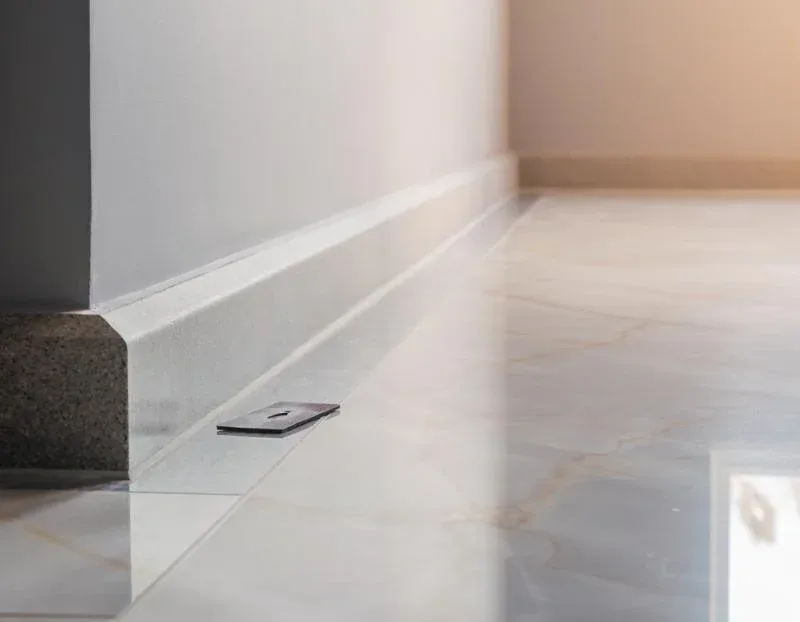
- Baseboard protection: The machine body is driven so that it does not hit the baseboards; impact marks cause chips and scratches on stone baseboards.
Changing the Pads in a Shopping Mall

Imagine the polished marble corridors of a shopping mall, where the shine has dropped noticeably within just a few months. On site, the first thing we usually check is the pad under the machine. A common cause in cases like this is that the night crew has also used a more abrasive pad, bought for vinyl floors, on the stone corridors.
We replace the pads with soft pads suitable for stone, readjust the tank dosage, and give the team a short briefing. Then we schedule maintenance polishing for the dulled areas. Measurements taken in the following months show that the loss of shine slows down markedly.
Once a month, flip over the pad under the machine and take a look; a pad whose surface has hardened with dirt will scratch the stone like an abrasive pad, no matter how soft its color may be. — Expert Tip
Frequently Asked Questions About Floor Scrubbers
01Can a floor scrubber be used every day?
02Can the same machine be used on both ceramic and natural stone floors?
03Why are there white marks on the floor after using the machine?
04Can diamond maintenance pads be used on every type of stone?
05What should be done if the machine leaves scratches on the floor?
Related Articles
Mop, Microfiber, and Pad Colors: A Cleaning Equipment Guide for Institutions, What Is High-Speed Burnishing? When Should It Be Used on Natural Stone?, Natural Stone Training for Cleaning Staff: Which Product, Which Pad, Which Area, Choosing a Natural Stone Cleaning Product: A Guide to Reading Labels, Natural Stone in Shopping Mall Floors: Maintaining Shine Under Heavy Foot Traffic