Gravestone Care and Cleaning: Marble and Granite Headstones
A gravestone is a stone that a family visits for years, and every letter on it carries meaning. Rain, sun, damp in the shade, leaves falling from trees and irrigation water bring about a slow but steady change on its surface. Many people try to clean the stone with a bucket of water and detergent when they visit before a holiday; however, some well-intentioned practices can cause permanent damage to the stone and its inscriptions. In this article, we explain the types of soiling found on gravestones, the difference between marble and granite, how to protect inscriptions and gilding, and when to consult a specialist.
In short: First determine the type of dirt on the gravestone; algae and lichen, limescale, rust and general darkening each require a different method. Cleaning is done by soaking with plenty of water, using a soft brush and products suitable for the stone; bleach, acidic cleaners, wire brushes and high-pressure washing must not be used on a gravestone.
Why Do Gravestones Get Dirty and Darken?
A cemetery is a rather harsh environment for stone. The stone is outdoors all year round, often stands in the shade of a tree, the soil around it is constantly damp, and water poured to water the flowers collects at the base of the stone. Surfaces that stay in the shade and dry slowly are where biological growth starts fastest. A stone that receives sun collects less algae, but its surface becomes rough over time from sun and rain.
Part of the darkening also comes from the air. In cemeteries within cities, soot from traffic and heating settles into the pores and rough surface of the stone. Hard water used for irrigation leaves a white crust on the lower part of the stone. If there is an iron railing, an old oil lamp or a flower holder around the grave, brown rust marks are carried onto the stone with the rain. Since each has a different source, the cleaning method is also different.
Identifying the Type of Dirt: Algae, Lichen, Limescale and Rust
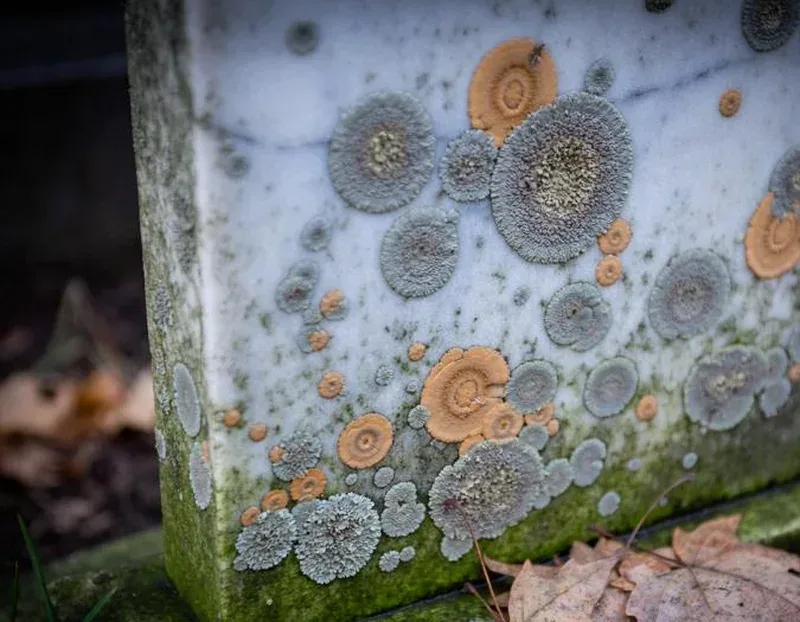
Before starting to clean, taking a close look at the stone's surface is half the job. A green, soft layer is usually caused by moss or algae; it breaks up easily when rubbed with a finger. Gray, yellowish, orange or black patches that cling tightly to the stone and spread out in circular edges are mostly lichen. Lichen is a symbiosis between a fungus and an alga or bacterium, and it attaches to the surface of the stone with root-like structures.
You can tell the common types of soiling on stone apart as follows:
- Moss and algae: They form a green, soft and slippery layer; they concentrate especially on the north face of the stone, on the lower part close to the ground and in the shade.
- Lichen: It leaves gray, yellow or orange circular patches that stick firmly to the stone; trying to scrape it off can also pull off the stone's surface.
- Limescale crust: It appears as a white, hard and slightly raised layer in the lower section where irrigation water evaporates, and is more noticeable on granite.
- Rust marks: They appear as brown and orange streaks running downward beneath iron railings, screws or metal ornaments.
- Soot and general darkening: A gray or black dullness spreading over the whole stone; it is mostly caused by city air and long periods without cleaning.
When diagnosing, also check the soundness of the stone. If sugar-like grains crumble off a marble surface when you touch it with a finger, if there are cracks, or if the edges of the inscriptions are crumbling, the stone is already weakened. On such a stone even brushing can cause damage; it should be shown to a stone restoration specialist before cleaning.
The Difference Between Marble and Granite Gravestones
Two stones are most often used for gravestones: marble and granite. Marble is a relatively soft stone made of the mineral calcite and is sensitive to acids. An acidic cleaner, lemon or vinegar chemically dissolves the marble surface; the shine disappears, the surface becomes rough and over time the sharpness of the inscriptions diminishes. One reason the inscriptions on old marble gravestones left outdoors for years become faint is the mild acidity of rain.
Granite, on the other hand, is made of hard minerals such as quartz and feldspar; it is far more resistant to acids and keeps its polish for a long time. Black and dark gray granites are often preferred for gravestones. This durability does not mean granite can withstand everything: limescale and water marks on dark granite look very conspicuous, and the paint or gilding inside the inscriptions is much more delicate than the granite itself. We covered how these stones behave differently in detail in our article on the Mohs hardness scale

The table below summarizes how the same problem is approached differently on the two stones:
| Condition | Marble gravestone | Granite gravestone |
|---|---|---|
| Moss and lichen | Stone-safe biocide, soft brush, patience | Same method; the surface is more durable |
| Limescale crust | Absolutely no acid; soften when wet and use a plastic scraper | A diluted, stone-safe limescale remover can be tried, protecting the inscriptions |
| Rust marks | Stone-safe rust-removing poultice, with a test area | Rust-removing poultice; the result is usually faster |
| Darkening and soot | Neutral soap, plenty of water, poultice if necessary | Neutral soap and water; polished surfaces are easy to clean |
| Loss of gloss | Can be renewed with on-site honing and polishing | Polish renewal is long-lasting but requires skill |
Cleaning Steps That Do Not Damage the Stone
The most important rule in gravestone cleaning is to start with the gentlest method. Often plenty of water, a soft brush and a little patience give better results than strong chemicals. Starting cleaning on a cool morning or late afternoon, rather than at midday when the sun heats the stone, prevents the water and the product from drying immediately.
The order we follow in practice is as follows:
- Remove loose dirt: Clear leaves, soil and dry grass from the top and base of the stone by hand or with a soft brush; cut weeds at the base of the stone instead of pulling them out by the roots.
- Soak the stone thoroughly: Wet the stone with clean water for a few minutes; a wet stone does not draw the cleaning product into its pores, and the dirt softens more easily.
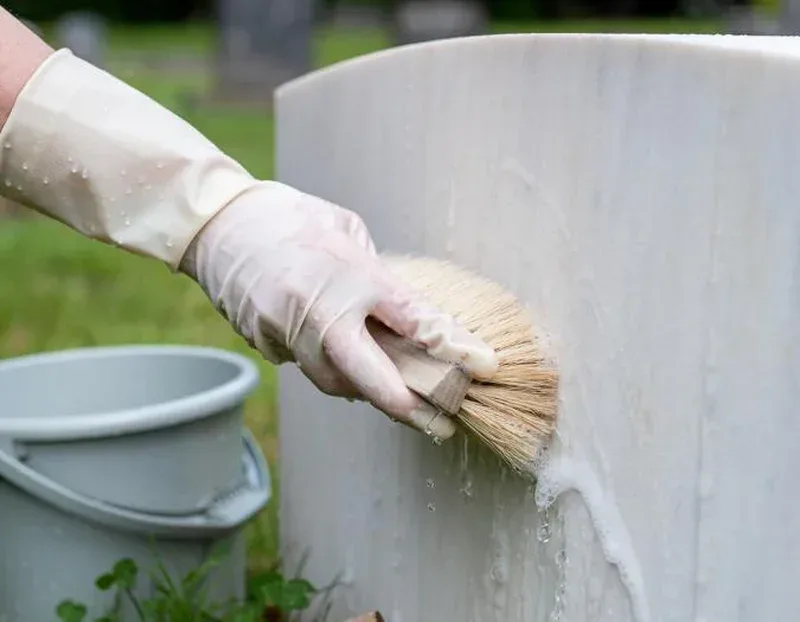
- Work from the bottom up with a soft brush: Move the brush lightly in small circles; starting from the bottom prevents dirty water running down from above from leaving streaks on the dry stone.
- Apply a stone-safe product if needed: A neutral soap or a biological cleaner recommended for gravestones is used, following the dilution and waiting time on its label.
- Rinse with plenty of water: If product residue stays inside the stone, it can form stains and salts over time, so the stone is rinsed generously for several minutes.
The choice of brush matters too. Soft brushes with natural or nylon bristles are enough; wire brushes, scouring pads and hard abrasive paper scratch the stone surface and wear down the edges of the lettering. A soft toothbrush can be used for dirt inside inscriptions and carvings, and a wooden or plastic stick for lichen that is stuck fast. Because these tools are softer than the stone, they do not scratch the surface.
Algae and Lichen Take Patience
Lichen does not come off completely with a brush in one go; scraping it off by force also tears away the topmost layer of the stone. In stone conservation, biological cleaners developed for gravestones that leave no salt residue in the stone are recommended. These products are applied and left for a short time, then the stone is lightly brushed and rinsed. The real effect shows in the following weeks: the lichen gradually lightens and is washed away by the rain. If the stone still looks stained after the first cleaning, waiting a few weeks before a second attempt is often enough.
To slow the return of biological growth, the surroundings also need to change. Pruning branches that hang over the stone, preventing water from collecting at its base, and pouring water onto the soil rather than the stone when watering flowers all extend the time until the next cleaning. We covered the subject of lichen and black mold on outdoor stone in our article on lichen and black mold in more detail.
What to Do About Limescale, Rust and Darkening
Limescale that builds up under a granite gravestone is first softened by wetting it with water and then carefully removed with a plastic scraper. If the crust is stubborn, a diluted descaler suitable for granite can be tested on a small area; however, these products must not touch the paint and gilding inside the lettering, and must never come into contact with a marble base or marble letters. Acidic products are not used on limescale on marble; wet softening, a plastic scraper and, if necessary, professional cleaning are preferred.
Rust marks usually do not come out with a brush because they have penetrated into the stone. Here, a poultice prepared with a rust remover suitable for the stone is applied: it is mixed with an absorbent powder and spread over the stain, covered, and as it dries it draws the stain out of the stone. This process may need to be repeated several times. We explained step by step how the poultice is prepared in our article on stain-removing poultices . If the iron part that is the source of the rust remains in place, the stain will form again; for this reason, painting the rusting part or replacing it with a rustproof one should also be considered.
The practices to avoid also need to be stated clearly. Bleach can leave salts in the pores of the stone and over time cause staining and crumbling on the surface. Muriatic acid, vinegar and limescale removers dissolve marble. A high-pressure washer tears off the surface of weakened stone and opens up the joints; only a low-pressure hose is sufficient. Sandblasting, on the other hand, permanently destroys the surface of the stone and the sharpness of the lettering.
Protecting Lettering, Gilding and Paint
The most valuable part of a gravestone is the inscription on it. The inside of the engraved letters is mostly painted or gilded; these layers are much more delicate than the stone itself. During cleaning, you should not brush hard over the letters, should not let chemical products seep into the inscription, and should clean the inscription area last, using the gentlest method.
There are two ways to restore erased or flaking inscriptions:
- Repainting: The inside of the letters is carefully cleaned of the old paint, then filled in with a fine brush using an outdoor-grade paint that adheres to the stone; any paint that spills onto the stone surface is wiped off immediately.
- Regilding: For lasting results outdoors, real gold leaf is usually applied over an oil-based adhesive; paints containing gold powder can tarnish over time and therefore have a shorter life.
Re-engraving the inscription is a separate matter. Deepening faded letters removes material from the stone that cannot be restored and may change the form of the original inscription. For this reason, re-engraving is not recommended on gravestones of historical value; other methods under expert supervision are preferred to improve legibility.
Historic Gravestones and Cemetery Rules
Ottoman-era gravestones in old cemeteries are cultural assets in their own right, with their inscriptions and ornamentation. Some of these stones are protected, and any intervention on them requires permission and expertise. The surface of aged marble is often weakened; even well-intentioned brushing can cause inscriptions to be lost. To clean such a stone, you need to consult the relevant cemetery administration or conservation boards and work with a team experienced in restoration. We have also explained the principles of cleaning historic surfaces in our article on historic marble surfaces .
For new gravestones, municipalities and cemetery directorates may have their own rules. Some cemeteries restrict the products that may be used, working hours or the use of machinery. For tasks such as renewing the polish of the stone on site, gluing a broken piece or straightening the base, getting information from the cemetery administration first prevents problems later.
Regular Maintenance and Protection
The way to keep a cleaned gravestone clean for a long time is small but regular maintenance. Washing the stone with water and a soft brush a few times a year prevents a thick layer of dirt from forming. The choice of flowers and plants matters too: ivy leaning against the stone and constantly watered pots keep the base of the stone damp.
On polished granite, a protective impregnating sealer can reduce the adhesion of water and dirt to the surface to some extent. For marble, products suitable for outdoor use that allow the stone to breathe should be chosen; polishes and varnishes that form a film on the surface are avoided, because they yellow in the sun and peel. For a stone that has become dull, whose inscriptions have begun to fade, or that has cracked, an on-site assessment is the best starting point; you can reach us with a few photos of the stone via the service request form .
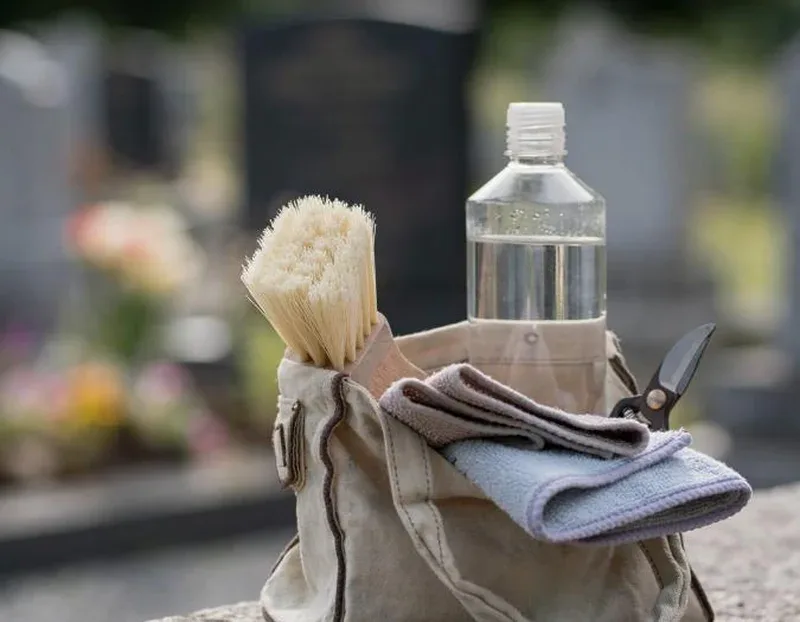
Quick Care During a Grave Visit

A few minutes of care at each visit noticeably slows the darkening of the stone over the years. Keeping a small care kit with you makes the job easier.
- Water and a soft brush: A bottle of clean water and a soft-bristled brush are enough to remove leaves, dust and bird droppings before they settle into the stone.
- Microfiber cloth: On polished granite, drying the surface after washing prevents the white water spots left by hard water.
- Garden shears: Cutting back branches and weeds that lean against the stone helps it dry quickly and slows biological growth.
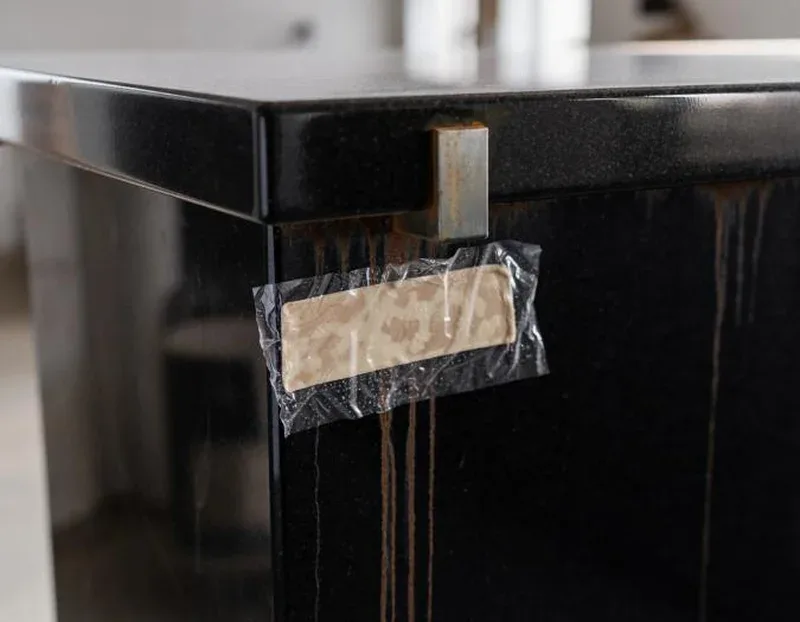
A Granite Headstone with Rust Stains

On the side of a black granite headstone, rust streaks ran down from the screw of an iron flower holder. First we replaced the rusted screw with a stainless steel one; if the source isn't eliminated, cleaning is wasted after just a few rains. Then we protected the lettering with tape, applied a poultice prepared with a rust remover suitable for granite over the stains, and covered it. After two applications, the stains had lightened considerably.
In the final step, we washed the surface with neutral soap and restored the dulled areas of the granite polish on site.
Don't try to scrape lichen off a gravestone in one go; softening it with a stone-safe product and waiting for it to fall off on its own over a few weeks protects the surface of the stone. — Expert Tip
Frequently Asked Questions About Gravestone Care
01How often should a gravestone be cleaned?
02Can dish soap be used on a gravestone?
03Why does a black granite gravestone look stained with white?
04Can a broken or toppled gravestone be repaired?
05Does applying polish to a gravestone protect it?
06Can I clean a historic gravestone myself?
Related Articles
Lichen and Black Mold on Exterior Stone, How to Prepare a Stain-Removal Poultice: Choosing Materials and Chemicals, Cleaning Historic Marble Surfaces: Conservation Principles and What Not to Do, Black Granite Care: Fingerprints, Water Marks, and the Painted Slab Trap, How Does Air Pollution Darken Stone? Black Crust Formation in Cities