Lichen and Black Mold on Outdoor Stone
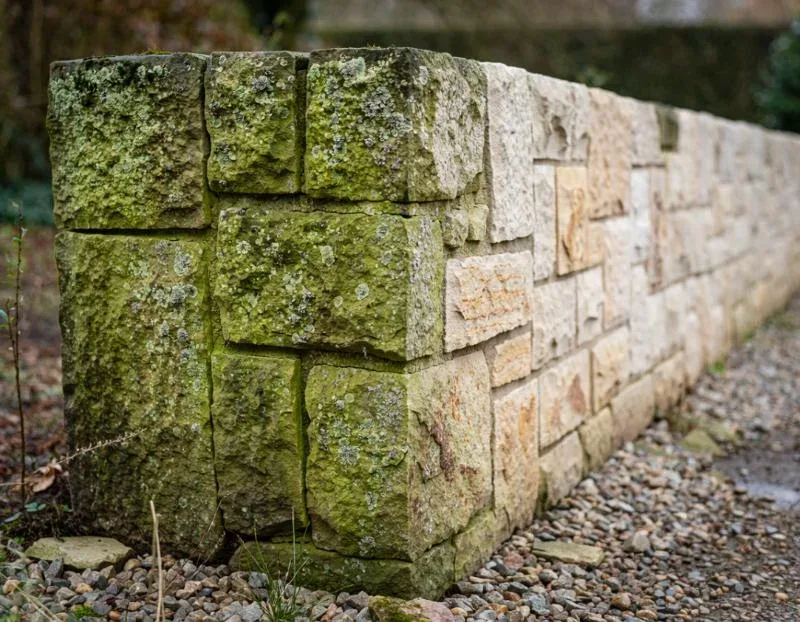
A north-facing garden wall, a courtyard under a tree, or a coping stone where rainwater constantly runs will change color within a few years. First a greenish film appears, then round gray and yellow patches, and finally black dots that look as if they were sprinkled over the stone. Although they all look like dirt, they are in fact different living communities on the stone's surface, and each has a different relationship with the stone. In this article we explain how to tell algae, lichen and black mold apart on site, how they penetrate the stone, the order in which biocide cleaning is carried out, why pressure washing should not be the first solution, and how to delay their return.
In short: Algae is a green layer that lives on the surface and is easy to clean; lichen is a partnership of fungus and algae that clings to the stone and penetrates it with root-like filaments; black mold consists of dark-colored microorganisms that settle in the stone's micro-pores. A lasting result is achieved by applying a biocide suited to the stone type and letting it act, removing the dead layer with a soft brush and low-pressure water, and reducing the source of moisture.
Three Different Communities Living on the Stone

Thanks to rain, dew and dust, the surface of outdoor stone is a habitable environment for microorganisms. The first settlers here are usually green algae and cyanobacteria. These organisms multiply quickly in damp periods and form a slippery, green or brownish film on the stone. In dry weather it fades and takes on a dusty look, then revives with the first rain.
Lichens are a different way of life: partnerships in which a fungus and an alga or cyanobacterium live together and behave like a single organism. They appear on the stone's surface as round gray, greenish, yellow or orange patches and grow slowly. It can take years for a lichen patch to reach the size of a hand, which is why they are a sign of surfaces that have long been left undisturbed.
The black stains known as black mold are often the work not of a single species, but of a community made up of dark-pigmented fungi and cyanobacteria. These organisms are extremely resistant to sun and drought, and settle in the stone's micro-cracks and between its crystals. They appear as black dots or as dark streaks running along the path of rain runoff.
Identifying Them on Site: Which Is Which?
The right cleaning method depends on what you are dealing with. A light application is enough for algae, lichen requires patience and repetition, and with black mold the real challenge is reaching the micro-pores without damaging the surface.

The table below summarizes the clues that help distinguish the three communities on site:
| Feature | Algae layer | Lichen | Black mold and black biofilm |
|---|---|---|---|
| Appearance | Green, brownish film | Gray, yellow, orange round patches | Black dots or dark runoff streaks |
| Touch | Slippery when wet | Crust-like, hard or leaf-like | Smooth, powdery |
| Location | Shade, constantly damp surfaces | Surfaces left undisturbed for a long time | Rain runoff; can also be on sun-exposed surfaces |
| Attachment to the stone | On the surface | Penetrates the stone with its filaments | In micro-cracks and between crystals |
| Cleaning difficulty | Easy, returns quickly | Moderate to hard, requires patience | Hard, may leave a mark |
When making this distinction, it helps to scrape lightly with a fingernail or a wooden stick. The algae layer peels off easily and the stone underneath comes out clean. Lichen adheres tightly to the stone; when scraped, a lighter, sometimes slightly roughened stone surface remains underneath. Black mold, on the other hand, hardly changes with scraping, because the color is not on top of the surface but inside it.
How Deeply Do They Penetrate the Stone?
The fungal partner of lichens clings to the stone with root-like filaments. These filaments advance through the gaps between crystals; in calcite-based stones such as marble and limestone, research shows that this penetration can extend from less than a millimeter to a few millimeters. As the lichen body swells and shrinks with wetting and drying, these filaments loosen the grains at the stone's surface.
In addition to the physical effect, there is also a chemical one. Lichen fungi secrete oxalic acid; this acid reacts with calcite to form calcium oxalate crystals. In this intermediate layer between the stone and the lichen, the stone's surface becomes pitted over time. This is why small pits or a light-colored "shadow" remain after the lichen is cleaned off. In silicate stones such as granite and basalt, the chemical effect is slower, but mechanical loosening is still seen.
The microorganisms that form black mold settle between crystals and in micro-cracks. They break down the stone more slowly than lichen, but because their dark pigments remain inside the stone, a gray trace may remain after cleaning. For this reason, with such stains the goal is often not to "eliminate completely" but to reach an acceptable appearance without harming the stone.
Why Is Pressure Water Not a Shortcut?
When people see biological fouling, the first solution that comes to mind is the pressure washer. A change is immediately visible on the surface and the job seems done. However, high pressure does not remove the living stain at its root; it carries fragments of lichen and black mold communities to other places on the stone and pushes them into micro-pores. A few months later the stain may reappear over a wider area.
High pressure also directly damages the stone. On soft limestone, travertine and sandstone, surface grains are torn off and the stone becomes rough; a roughened surface holds more water and becomes more favorable for organisms to resettle. Joint mortars are hollowed out, breakage begins at the edges, and old repair fillings can come loose. On polished or honed outdoor stone, the surface finish is damaged in patches.
This does not mean water should never be used. The layer that has been killed and loosened by a biocide can be easily removed with low-pressure water close to garden hose pressure and a soft brush. We have also compiled a comparison of the cleaning methods used in stone restoration in our article cleaning methods in stone restoration separately.
Biocide Cleaning: Order and Patience

Biocide is the general name for products that kill organisms on the stone's surface. A significant share of the biocides used for natural stone are based on quaternary ammonium compounds; other active ingredients are added to some products. Whichever product is chosen, its suitability for the stone type, dilution ratio and waiting time should be taken from the product label and technical data sheet. The biocide's job is to kill the organism and loosen its grip; it is not expected to make the stain disappear on the spot.
In practice, we usually proceed in the following order:
- Dry pre-cleaning: Loose leaves, soil and thick lichen crusts are removed with a soft brush or a wooden spatula; this step lets the biocide reach the organisms directly.
- Test area: The biocide is applied to a small hidden area, left for a few days, and the stone is checked for any change in color or surface.
- Application: The product is applied by brush or low-pressure sprayer in dry weather, during a period when no rain is expected, and at the ratio recommended by the manufacturer.
- Waiting: Wait until the living layer dies and changes color; for lichen and black mold this can stretch from a few days to several weeks, and rain often helps along the way.
- Mechanical removal: The loosened layer is removed with a soft nylon brush and low-pressure water; stubborn areas get a second application.
The choice of season also affects the result. In mild, slightly humid periods the organisms are active and take up the biocide better; in scorching heat the product dries quickly on the stone, while in freezing cold its effect weakens and wet stone faces the risk of freezing. On a large courtyard or a long garden wall, dividing the job into sections makes it easy to monitor the waiting time of each one. Noting which section was treated and when is useful when deciding whether a second application is needed.
It should not be forgotten that biocides also require care with regard to the environment and health. In some countries, the use of quaternary ammonium compounds is increasingly restricted because of its environmental impact. During application you should wear gloves and eye protection, protect surrounding plants and standing water, and prevent runoff from reaching a storm drain or a pool. The product's safety data sheet is the binding source on this matter.
Shortcuts to Avoid
Several methods that come to mind at home for dealing with lichen and mold can do more harm to the stone than the organisms themselves. The main shortcuts are these:
- Bleach: It lightens black stains quickly but leaves salt inside the stone; as it dries, salt crystals can cause flaking and white efflorescence on the surface, and it also harms plants.
- Acidic cleaners: Muriatic acid and limescale removers dissolve calcite-based stones, etch the surface and enlarge the pits left by lichen; on granite they also damage calcite veins and the joint mortar.
- Wire brushes and grinders: Metal bristles scratch the surface and leave metal particles on the stone; when these particles rust, orange stains form.
- Hard scraping: Forcibly scraping off the lichen crust with a knife also tears away the surface grains loosened by the filaments and leaves a permanent rough mark on the stone.
Some of the black stains in cities are not living organisms at all but a crust formed by air pollution. This crust does not respond to biocide and requires a different cleaning method; we explained the difference between the two in the article on air pollution and black crust
Extra Care for Historic and Valuable Surfaces
When it comes to an old courtyard, a gravestone, a fountain or the facade of a listed building, the decision to clean is not made on appearance alone. On these surfaces, the stone's original surface texture, tool marks and the patina formed over the years are values that must be preserved. In some cases, leaving a thin lichen cover in place is less harmful than losing the surface while removing it.
Cleaning on historic surfaces should be planned with test areas and, if possible, the opinion of a conservator. Interventions on listed buildings may require permission from the relevant authorities; this should be checked before starting work. We covered the general approach in the article on principles of cleaning historic marble surfaces ; for points specific to gravestones, you can find them in the article on gravestone care
Delaying Regrowth
There is no permanent solution to biological soiling; as long as the stone is outdoors, the organisms will return. But moisture largely determines how quickly. To extend the life of the cleaning, you need to reduce how long the surface stays wet.
The main points to check for this purpose are:
- Water path: Clogged gutters, overflowing downpipes and copings without drip edges let water run over the stone; repairing these is often the most effective measure.
- Shade and airflow: Shrubs and climbers leaning against the wall keep the surface from drying; pruning and leaving a gap between the plant and the wall speeds up drying.
- Soil contact: When soil and the bottom of pots touch the stone, they carry constant moisture and nutrients; leave a gap of a few centimeters between planters and the stone.
- Regular light maintenance: Light brushing once or twice a year takes far less effort than waiting for the layer to thicken and penetrate the stone.
Water-repellent impregnations can slow regrowth on some surfaces by reducing the amount of water the stone absorbs. However, they are not suitable for every stone or every situation; if moisture comes from behind the stone, a water-repellent layer will not solve the problem and may even make drying harder. We explained when they work in the article on silane-siloxane water repellents
. If you are not sure whether a stain in your garden or on your building's exterior is algae, lichen or a pollution crust, making a diagnosis before cleaning protects the stone. You can reach us through the service request form with close-up and distant photos of the stains; we will get back to you with a test area and an application plan.
How Quickly Do Different Surfaces Get Dirty?

Even in the same garden, not every stone turns green at the same rate. The stone's porosity, surface texture and orientation determine how easily living organisms can take hold.
- Porous and rough stones: Sandstone, limestone and unfilled travertine hold water for a long time, so they provide a much more favorable surface for algae and lichen.
- North-facing and shaded sides: Walls that get no sun stay wet for days after rain, while the south-facing side of the same stone often stays clean.
- Horizontal surfaces: Wall copings, stair treads and window sills collect both water and dust, so they get dirty before vertical facades.
A Courtyard Cleaned Over Several Weeks

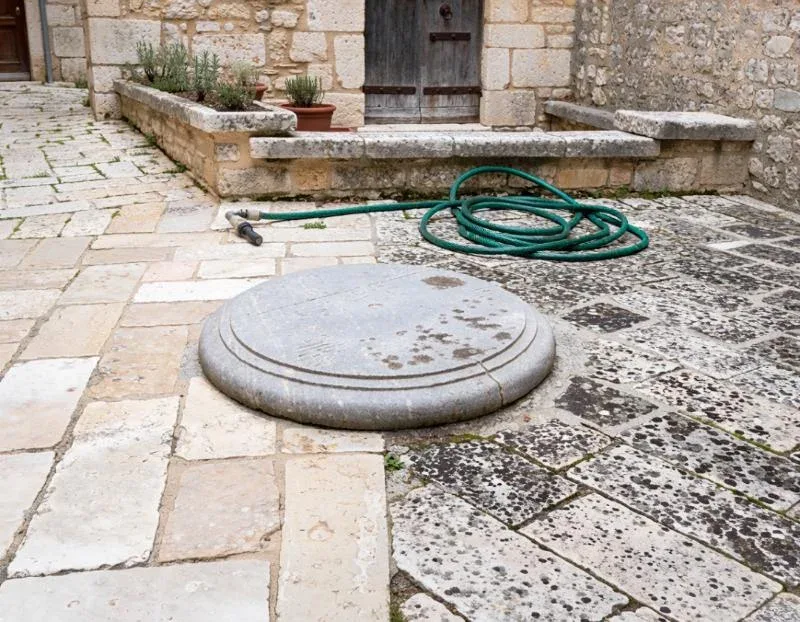
In the courtyard of an old stone house, the limestone paving around the cistern cover was covered in gray and orange lichens. The homeowner had tried pressure washing, but within a few months the stains came back over an even larger area.
On the first day we only did dry brushing and test applications in two separate spots. A week later the lichens in the test areas had turned dark; we applied biocide to the entire courtyard and waited three weeks, then removed it with a soft brush and hose water. The clogged drain that was blocking the water's path was also cleared the same day.
After applying biocide, don't expect the stain to disappear right away; the lichen dies first and changes color, but only loosens over a few weeks, and then it can be brushed off effortlessly. — Expert Note
Frequently Asked Questions About Lichen and Black Mold
01Does lichen actually erode stone, or is it just a cosmetic problem?
02There are light-colored marks left on the stone after cleaning. Will they go away?
03What happens if it rains after applying a biocide?
04Can biocide be used on stones around a pool?
05Does black mold form on granite too?
06Is it necessary to do this every year?
Related Articles
How Air Pollution Darkens Stone: Black Crust Formation in Cities, Cleaning Methods in Stone Restoration: Poultice, Micro-Abrasive Blasting and Laser, Cleaning Historic Marble Surfaces: Conservation Principles and What Not to Do, Water-Repellent Treatment on Exterior Façades: Silane, Siloxane and Stone Breathability, Gravestone Care and Cleaning: Marble and Granite Gravestones