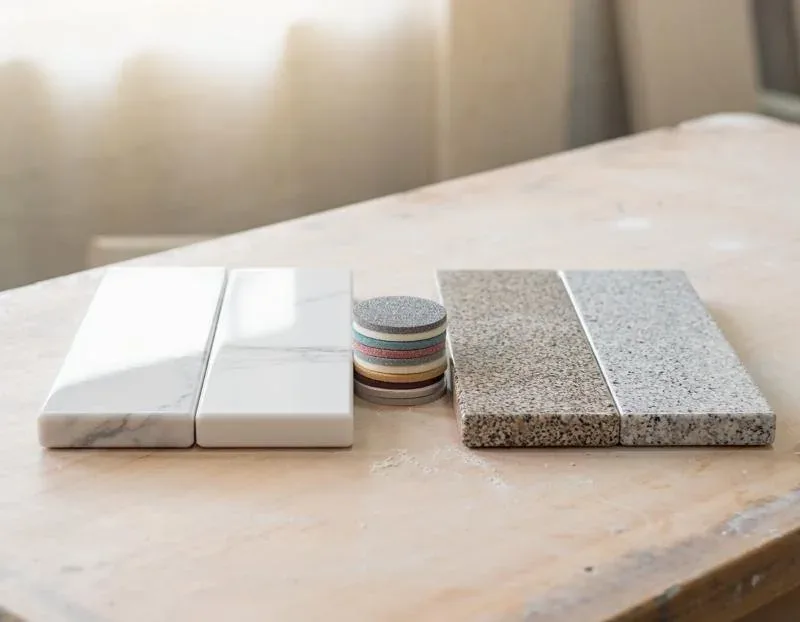
The Mohs Hardness Scale and Natural Stone: How Hardness Determines Care
For anyone with a marble floor, the most familiar disappointment is the fine scratches that a few grains of sand carried in on shoes leave on a polished surface. The same sand leaves almost no mark on a granite countertop or entryway. Behind this difference is the hardness of the minerals that make up the stones, and the best-known way to describe that hardness is the Mohs scale. In this article we explain how the scale works, why it is not evenly spaced, where the main minerals in natural stones stand, why sand scratches marble, and how hardness determines honing time, product choice and daily care.
In short: The Mohs scale ranks minerals from 1 to 10 according to their ability to scratch one another. Calcite, the main mineral of marble, has a hardness of 3, quartz in granite 7, and feldspar 6; this is why the quartz grains in sand scratch marble easily. The harder the stone, the longer honing takes and the more different abrasives are needed, but a hard stone is not more durable in every respect.
What Is the Mohs Scale? A Scratch Ranking
The Mohs scale was introduced in 1812 by the German mineralogist Friedrich Mohs. Its logic is extremely simple: if one mineral can scratch another, it is harder than that mineral. Mohs arranged ten readily available minerals in order according to this principle and gave each a number from 1 to 10. The hardness of a stone or mineral is determined by checking which of these reference minerals it scratches and which one scratches it.
The ten steps of the scale, from softest to hardest, are: talc, gypsum, calcite, fluorite, apatite, orthoclase feldspar, quartz, topaz, corundum and diamond. In this series, the three most important minerals for natural stone care are calcite, orthoclase feldspar and quartz, because these minerals make up most of marble, travertine and granite. Glass also sits on this scale at about 5.5, between apatite and orthoclase.
Because it is a practical method that requires no laboratory, the Mohs scale has been a reference tool in the hands of geologists, miners and stone masters for more than two centuries. Although there are now instruments that measure hardness far more precisely, the Mohs scale is still the clearest framework for understanding how stones behave relative to one another.
Why Is the Scale Not Evenly Spaced?
The Mohs scale is a ranking; the differences between steps are not equal. A mineral rated 6 is not twice as hard as one rated 3. The scale only tells you which scratches which, not how much harder it is.
The most striking example of this difference is at the top end of the scale. In a method that measures absolute hardness, corundum has a value of about 400 and diamond about 1500. In other words, the single step between 9 and 10 represents a leap far greater than the sum of many steps at the bottom of the scale. This is also why diamond is indispensable in stone processing: it is markedly harder than all natural stone minerals, including quartz, feldspar and corundum.
The meaning of this for care is as follows: the differences in hardness between stones can be much larger than the Mohs numbers suggest. The four steps between calcite and quartz correspond, in everyday life, to the difference between a marble floor dulling over the years and a granite floor remaining almost unchanged under the same traffic.
The Hardness of the Minerals That Make Up Stones
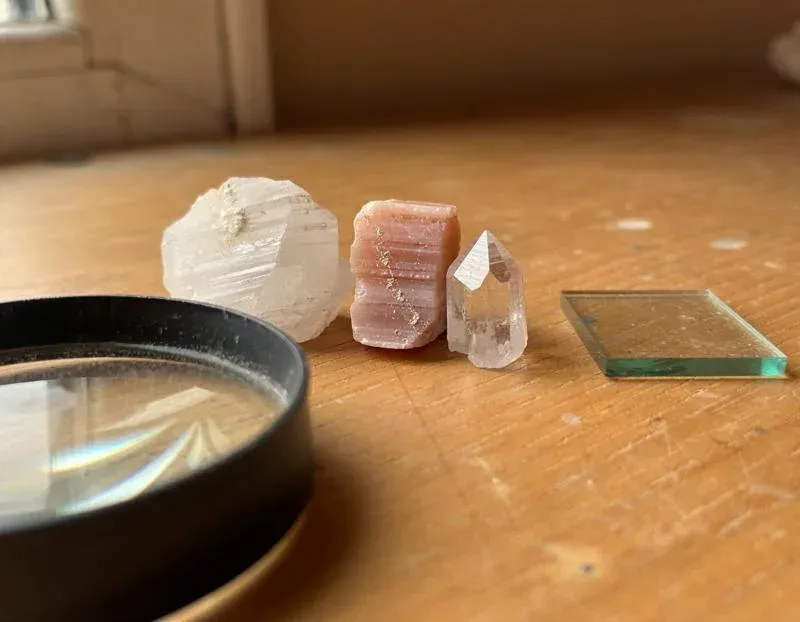
A natural stone usually consists not of a single mineral but of several different minerals combined. The hardness of the stone is therefore a blend of the hardness of the minerals in it. Marble is made largely of calcite, while dolomitic marble consists of dolomite, which is slightly harder than calcite. Travertine and limestone are also calcite-based. Granite, on the other hand, is a granular mixture of minerals such as quartz, feldspar and mica; mica is soft, while quartz and feldspar are hard.

The table below summarizes the Mohs values of minerals commonly found in natural stones and the stones in which they occur:
| Mineral | Mohs value | Main stones where found | Meaning for care |
|---|---|---|---|
| Calcite | 3 | Marble, travertine, limestone, onyx | Easily scratched by sand and hard dust, dulled by acid |
| Dolomite | Slightly harder than calcite | Dolomitic marble | Scratches less, but responds slowly to polishing |
| Glass | About 5.5 | For comparison | Scratches calcite, is scratched by quartz |
| Orthoclase feldspar | 6 | Granite, some volcanic stones | Resistant to scratching, takes long to hone |
| Quartz | 7 | Granite, quartzite, sandstone, sand | The main mineral in the sand that scratches marble |
The values in the table belong to the minerals; the stone itself behaves according to the proportion of these minerals and the strength of the bond between them. For example, in a granite, soft mica flakes may look like small pits on the surface, because during honing they wear away faster than the hard quartz around them. In a sandstone, even if the grains are hard quartz, the stone can wear easily if the binder holding them together is soft.
Why Does Sand Scratch Marble?
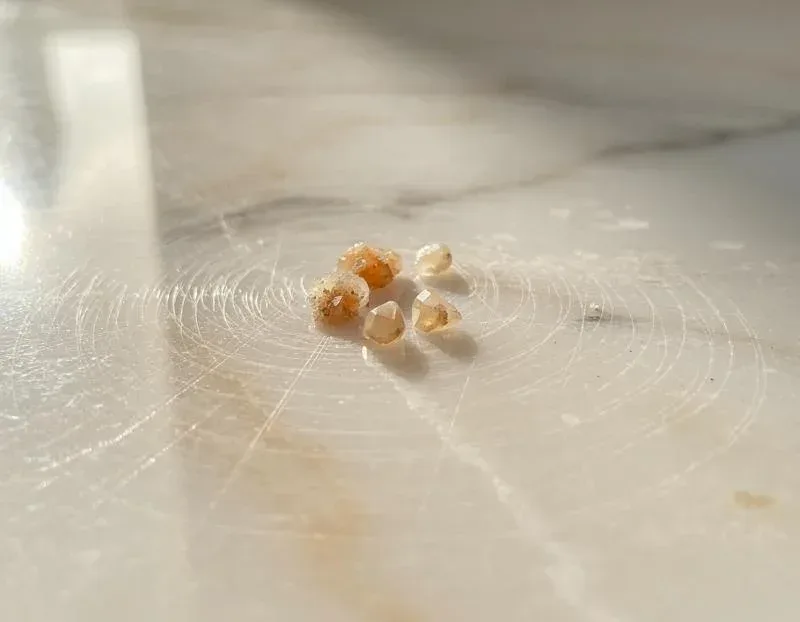
A significant portion of the sand carried into the home on shoe soles usually consists of quartz grains. Quartz is 7 on the Mohs scale, while the calcite in marble is 3. This difference is enough for a sand grain to act like sandpaper on the marble surface. Every step leaves microscopic scratches on the polished surface; over time these scratches merge and the surface dulls in the most heavily walked areas.
This is why the most worn places on marble floors are doorways, the middle of corridors and the nosings of stair treads. These are the places where sand is carried in most heavily and crushed the most. On a granite floor, the same quartz grains struggle to leave a noticeable scratch, because they have the same or nearly the same hardness as the quartz and feldspar grains on the surface.
We explained the types of scratches on marble and how they are removed in detail in the article marble scratches The point we want to emphasize here is this: the most effective measure against scratches on marble is not to try to change its hardness but to stop the sand before it reaches the floor. A sufficiently long mat area at entrances and regular dry sweeping are more effective at preserving the shine of a marble floor than any coating.
Hardness Is Not the Same as Durability
Hardness describes only resistance to scratching. A stone's durability against impact, breakage, acid or stains depends on other properties. Although diamond is the hardest natural mineral, it can split from a blow at a certain angle, because hardness and toughness are different properties. Similarly, a hard granite countertop can chip a small piece off its edge when a hard object falls on it.
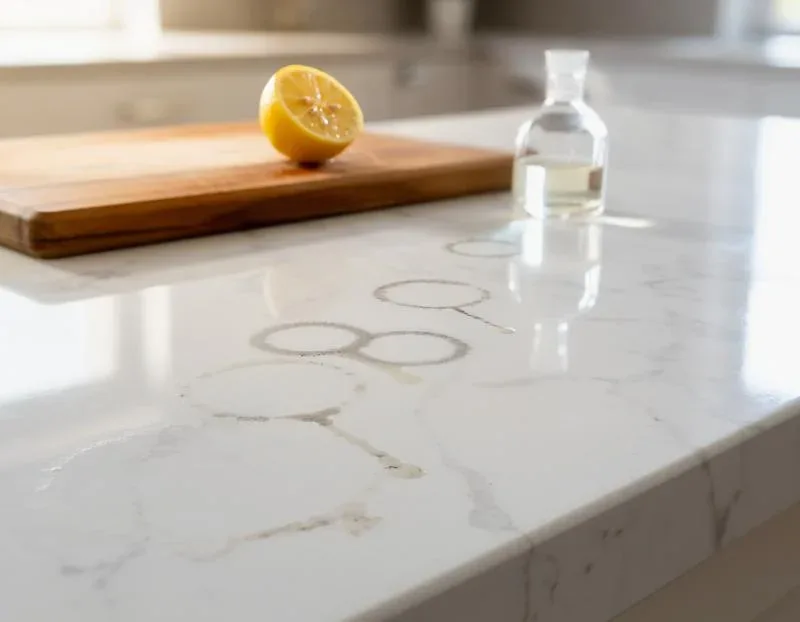
Acid resistance is also independent of hardness. Marble dulling from acid results from calcite reacting chemically with the acid; this is not a scratch but a dissolution. Granite does not react with acid in the same way. So it would be wrong to explain the dull mark lemon juice leaves on marble by hardness; distinguishing these two different mechanisms allows both the stain and its solution to be understood correctly.
Staining, in turn, relates to the stone's porosity and water absorption. A very hard but porous stone can draw oil in, while a softer but dense stone may stay stain-free on the surface for longer. When evaluating a stone, hardness, porosity and chemical composition must be considered together.
How Does Hardness Determine Honing Time and Product?
Honing is the process of working the stone surface step by step with diamond abrasives. The harder the stone, the longer it takes to reach the desired surface at each step. A step that is completed in a few passes on marble demands much more time and patience on granite. On hard stones the abrasives also wear faster and more heat is generated; that is why water and machine speed are adjusted accordingly.
Abrasive selection also varies with hardness. On a granite floor where lippage will be removed, high-strength metal-bond diamonds are needed; on marble, softer-bond abrasives can do the same job. We explained the logic of the step sequence in the article diamond pad numbers and we covered the particulars of honing and polishing granite separately in the article granite honing and polishing
In the final polishing stage, the chemistry of the stone matters more than hardness. Crystallization products used on calcite-based stones react chemically with calcite to form a shinier and somewhat more resistant layer on the surface; these products have no effect on granite. On granite, shine is achieved with very fine diamond steps and polishing powders specific to granite. We explained the chemistry of crystallization in the article crystallization we explained in detail.
We can briefly summarize the effect of hardness on the grinding plan as follows:
- Time: On hard stone, each step takes longer; a granite floor of the same square footage requires noticeably more time than marble.
- Abrasives: On hard stone, more durable bonded diamonds are used and the abrasives are replaced more often; this affects the planning of the job.
- Heat and water: Grinding hard stone generates more heat; sufficient water and the right speed protect both the stone and the abrasive.
- Final polish: Crystallization can be used on calcite-based stone; on granite, fine diamond steps and suitable polishing powders are preferred.
Can a Simple Scratch Test Be Done at Home?
A simple comparison can be made at home to tell whether a stone is marble or granite, but you need to be careful. Glass has a hardness of about 5.5 on the Mohs scale. If a stone can be scratched by glass, it is most likely a calcite-based stone; if it can scratch glass, it contains hard minerals such as quartz or feldspar.
This test should only be done on an unseen corner of the stone, for example on the underside edge of a countertop or the back of a slab. A trial on a visible surface leaves a permanent mark. Also, since not every grain on the surface of granite has the same hardness, the result can be misleading if a soft mineral such as mica is present at the tested spot.
For a more reliable distinction, you should look at other clues along with hardness. A few drops of dilute acid applied to an unseen spot will fizz on calcite-based stone; on granite it will not. The texture of the stone, the appearance of the grains, and its weight also give an idea. When you cannot be sure, especially if a decision on maintenance and grinding is to be made, having an expert see the stone on site is the best course.
Taking Hardness into Account in Daily Maintenance
Knowing the hardness of the stone also shows which habits matter more in daily maintenance. With soft stones such as marble and travertine, the priority is to keep anything that could scratch away from the floor. With hard stones such as granite, stains and edge impacts come to the fore more than scratches.
The main habits that help with soft stones are as follows:
- Entrance mat: Having a sufficiently long mat both outside and inside the door traps most of the sand before it reaches the floor.
- Dry sweeping first: Removing sand with a dry mop or broom before wet cleaning prevents the mop from dragging sand across the floor.
- Furniture felt pads: Attaching felt pads under chair and table legs prevents hard grains trapped under the leg from scratching the floor.
- Avoiding abrasive powders: Scouring powders containing quartz dust and hard fibrous sponges have the same effect on a marble surface as sand.
If you are unsure about the type of stone on your floor, or whether the dullness is caused by scratches or by acid, you can reach us with close-up and general photos via the service request form ; we will identify the stone and determine the appropriate grinding and maintenance method together.
The Relationship Between Hardness and Honing Time

One of the questions we get asked most often during site surveys is why a marble floor and a granite floor of the same size take different amounts of time to hone. The answer lies largely in hardness. On marble, the diamond abrasive cuts the calcite on the surface quickly, and the marks from one grit stage are removed in just a few passes.
On granite, however, the abrasive has to work against quartz and feldspar grains, which resist it far more. Each stage takes longer, the abrasives wear out faster, and intermediate checks require more attention. For this reason, when we plan the work schedule, we take the type and hardness of the stone into account first.
A Scratch or an Acid Stain in a Kitchen?

A homeowner thought the dull spots on their marble kitchen countertop were scratches and had started scrubbing them with a harsh polishing product. During the site inspection, we found that the spots were acid marks left by drops of lemon juice and vinegar, not scratches.
This distinction mattered: scratches and acid marks are removed with different methods, and the scrubbing product was dulling the surface even further. We honed and polished the countertop in the appropriate grit stages, then applied a sealer and advised the homeowner to wipe up acidic foods immediately.
The most effective investment for preserving the shine of a marble floor is not a harder polish, but a sufficiently long doormat placed on both sides of the door; if grit never reaches the floor, scratches never form. — Expert Tip
Frequently Asked Questions About the Mohs Hardness Scale and Natural Stone
01Does crystallization make marble as hard as granite?
02Why are quartz composite countertops resistant to scratches?
03Why does onyx scratch so easily?
04Do harder stones require less maintenance?
05Does the Mohs scale show how long a stone will last?
06Can't stone be honed without diamond pads?
Related Articles
How to Remove Scratches from Marble: Choosing the Grit Stage by Scratch Depth, Diamond Pad Grit Numbers: The Logic of Stages from Coarse Grinding to Polishing, Granite Grinding and Polishing: Why Does Hard Stone Require More Stages?, Marble Crystallization: Its Chemistry, Application, and Limits, Technical Values of Natural Stone: Water Absorption, Compressive Strength, and Abrasion