Overnight Stone Polishing in a Hotel Lobby: A Work Plan That Doesn't Disturb Guests
A hotel lobby never fully closes. At midnight a late guest checks in, before dawn a group leaves for the airport, the security officer makes his rounds, and the reception lights are always on. So when the lobby's stone floor needs polishing, the work is done in the quietest hours of the day and split into small sections. In this article we look at how you can plan overnight polishing in a hotel lobby without disturbing guests: preliminary planning with the hotel, dividing the lobby into sections, managing noise, odor and light, coordination during the night, and the morning handover inspection.
In short: Overnight polishing means dividing the lobby into sections that always leave the guest path open and treating one or a few sections each night with the full sequence of grits. Noisy tasks are left to the quietest hours, and strongly scented products to periods of good ventilation; constant communication is kept with reception and security, and every morning the floor is handed over dry, safe and approved.
The Particular Challenges of Night Work
Polishing in an apartment during the day and polishing in a lobby at night go through the same grit stages technically, but the conditions are very different. Night work is limited in time: the crew can generally work from the hours when guest traffic drops until early morning, and this period includes preparation, drying and clean-up. So the area that can be done in one night is smaller than what could be done in the daytime.
Another challenge of night work is that guest presence is never zero. Guests sitting in the lobby, going to the bar or restaurant, or asking questions at reception pass near the work area. Noise, odor and wet floors affect these guests directly. Rooms facing the lobby or on the floors above it can also be affected by night noise. Every step of the plan is built on these two constraints: time and guests.
That is why a daytime trial area before starting night work is important. A small area in an out-of-sight corner of the lobby, for example behind a column or under a planter, is treated with the full sequence of grits, and the hotel management sees the target gloss in daylight and approves it. This sample becomes the reference standard for the handover inspection every morning and prevents a misleading assessment made under the dim light of night.
Preliminary Planning with the Hotel
Before starting overnight polishing, a planning meeting should be held with the hotel's front office, security, housekeeping and technical service managers. This meeting covers not only working hours but also the hotel's occupancy at that time, the intensity of night arrivals and departures, and the meeting and event calendar.
The main points to settle in the planning meeting are as follows:
- Working hours: It is written down when the crew will enter the area and when they will hand it over fully clean and dry; these hours are set according to the hotel's night traffic.
- Busy nights: Nights with group arrivals, early airport transfers and large events are marked on the calendar, and no work is done on those nights or it is limited to a small section.
- Rooms near the lobby: The rooms above or beside the lobby are identified, and if possible, measures are taken together with the front office regarding the sale of these rooms during the work period.
- Electricity and water: The sockets where the machines will be plugged in, the fuse capacity, and the points where clean water will be drawn and dirty water discharged are determined together with the technical service.
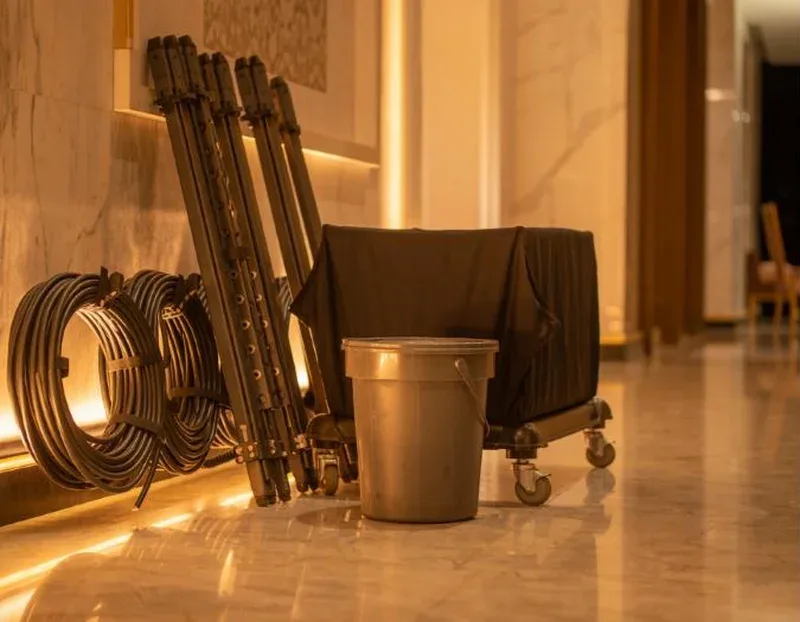
- Equipment storage: A storage place is set aside for machines, abrasives and products that will not be visible in guest areas during the day.
At the end of this meeting, a one-page work plan is prepared and also given to the night-shift reception and security staff. If the night staff don't know the plan, the crew spends its first hours seeking permission and explaining.
Dividing the Lobby into Sections
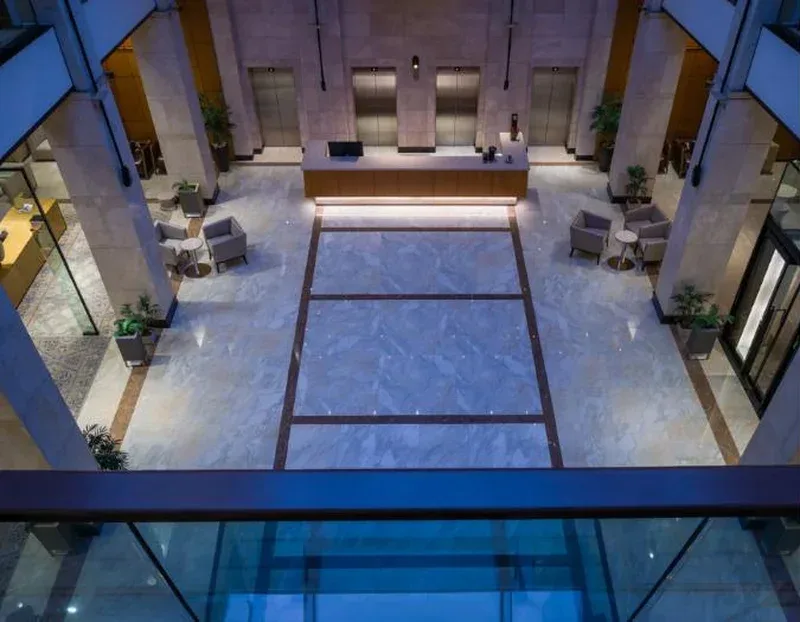
The basic principle of overnight polishing is that the guest path is never closed. That is why the lobby is divided into sections, taking into account the walking routes from the entrance door to reception, from reception to the elevators, and on to the restaurant and bar. While one or a few sections are treated each night, the other sections are left as walkways.
A few points are watched when determining the sections. The section boundaries are, if possible, matched to natural lines such as tile joints, pattern lines or column lines; this way, a small tone difference that may arise between two nights is not noticeable. The busiest points, such as the area in front of reception and the elevators, are kept to a size that can be completed in a single night. Routes to fire exits and the area in front of emergency exit doors always remain open.
Lobby furniture is also part of the section plan. Armchairs, side tables, planters and decorative objects are removed from the section to be worked at the start of the night and put back in place in the morning. Heavy pieces are not dragged but moved with felt pads or wheeled carriers; otherwise a freshly polished section can be scratched when the furniture is brought back. Where the furniture will wait during the night is also determined in advance; the waiting place must not narrow the guest path.
So that the joint line between sections is not visible, each new section is started by slightly overlapping the edge of the previous one. The final polish is often applied to the whole lobby at once, within one or two nights after all sections are finished; this way the floor looks like a single whole.
Managing Noise
Polishing is not a quiet job. The motor noise of the machines, the abrasive grinding against the stone and the suction noise of the slurry vacuums are clearly audible in a quiet night lobby. Noise cannot be eliminated completely, but it can be managed with careful planning.
The first way to reduce noise is to sequence the tasks by noise level. The coarse stages that remove lippage are generally the noisiest and most vibrating phase; these tasks are scheduled for the hours with the least guest traffic. The fine stages, polishing and cleaning are quieter and can be placed at the beginning or end of the night. Equipment choice also matters: well-maintained, balanced machines produce both less sound and less vibration.
Physical measures also help. Keeping the doors opening onto the lobby closed, especially the restaurant, bar and meeting room doors, limits the spread of sound. Informing reception before starting a noisy operation ensures that staff are prepared when a guest complains. When a complaint comes in, the crew must be able to stop the noisy work and switch to a quieter task; this flexibility should be built into the plan from the start.
Managing Odor and Air
Some stone care products leave a distinct odor. Solvent-based impregnators, some polishing products and solvents can be felt for hours in an enclosed lobby and may disturb guests. That is why product choice and application timing must be considered together.
In enclosed, continuously used areas, water-based and low-odor products are preferred wherever possible. If a strongly scented product must be used, the application is scheduled for the hours when ventilation is most effective, and the hotel's ventilation system is adjusted accordingly together with the technical service. The safety data sheets of the products are shared in advance with the hotel's technical and occupational safety managers. If odor lingers in the enclosed area of the lobby, additional ventilation is provided for a short time in the areas where guests sit.
Light, Visibility and Safety
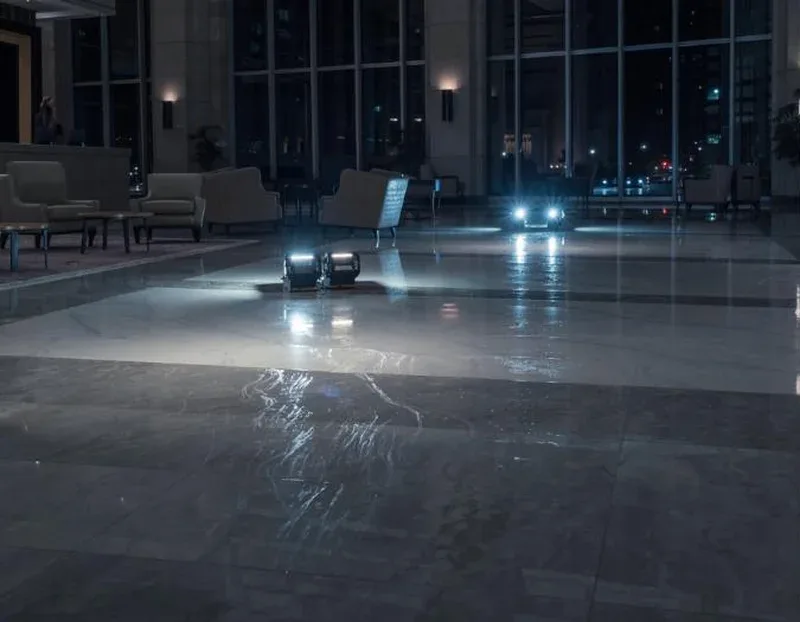
A night lobby usually operates with dim, calm lighting. The polishing crew, however, needs good light to see defects; especially during checks between grit stages, a strong light coming from the side is needed. The balance between these two needs is achieved by directing work lights only at the section being worked. Portable lights kept close to the floor don't dazzle guests but let the crew see the floor.
Visibility is also part of safety. The work area is surrounded with warning signs and tapes that guests can easily notice. Wet floors, cables and hoses may not be easily visible in dim night light; therefore cables are kept away from the walking path, and where they have to cross it, they are covered with cable protectors. We covered the general measures that prevent slipping on wet floors in our article on preventing accidents on wet floors
Coordination During the Night
Overnight polishing requires constant communication between the crew and hotel staff. For this, a person in charge is appointed in the crew, and this person stays in direct contact with reception and security throughout the night.

The table below summarizes the stages of a typical night's work and what is watched at each stage:
| Stage | Work performed | Coordination |
|---|---|---|
| Preparation | Bringing in materials, cordoning off the section, removing furniture | Notifying reception of the start |
| Noisy work | Coarse stages and leveling | When guest traffic is lowest, constant communication with reception |
| Intermediate and fine stages | Checks between stages, filling | Short pause for guest passage when needed |
| Polishing and protection | Buffing, impregnation if required | Ventilation adjustment with the technical service |
| Drying and collection | Collecting slurry, drying the floor, removing materials | Putting the furniture back |
| Morning handover | Inspection walk-through, short report | Front desk or housekeeping supervisor |
Unexpected situations can arise during the night. A late-arriving group, a guest complaint or an emergency may require the team to stop work immediately. A simple protocol agreed in advance for these cases, for example stopping the machine, clearing the walkway and notifying reception, prevents confusion. How the team will evacuate in an emergency, how the machines' power will be cut and keeping the fire exits open are also part of the plan.
Morning Handover Inspection
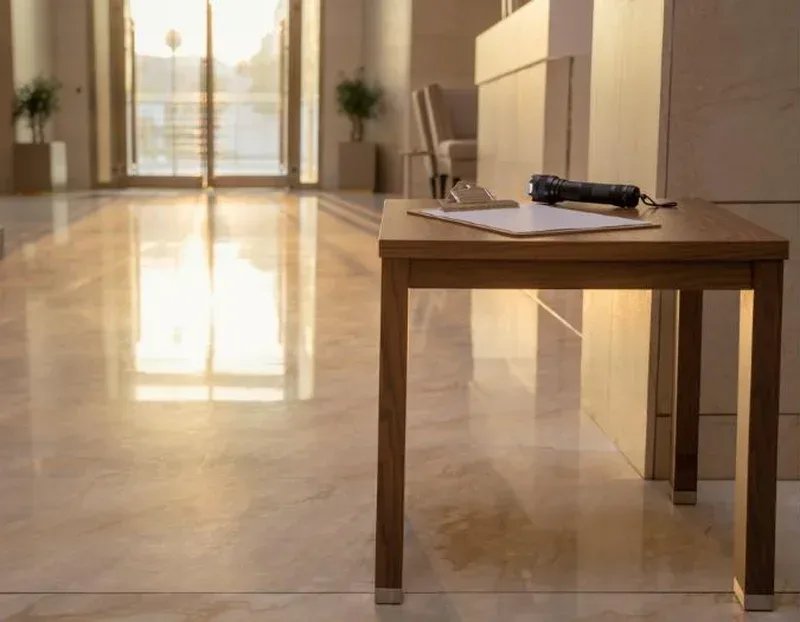
At the end of each night, the section that was worked on must be handed over completely dry, clean and safe before morning traffic begins. A wet floor can overshadow a night of good work with the risk of an accident. For this reason, the plan leaves enough time for drying and collection; rather than squeezing the final stage into the time available, the section is made smaller if necessary.
The morning handover inspection is carried out jointly by the team supervisor and the hotel's front desk or housekeeping supervisor. The main points checked during the inspection are as follows:
- Dryness and slip resistance: It is checked that the floor is completely dry, that no water remains especially at edges and corners, and that there is no slippery residue along the walking routes.
- Appearance: The treated section is examined with side lighting to confirm that it looks the same as the approved test area and that there are no stage marks or swirl rings.
- Joint line: The boundary between the previous night's section and the new section is viewed from different angles to see whether it stands out.
- Cleanliness and order: It is verified that no slurry is left on the skirting, under doors or around furniture legs, that the furniture has been put back, and that all equipment has been removed from the area.
At the end of the inspection, a short report is filled in and that night's work is recorded. If a defect is found, it is corrected first thing the following night. You can find a detailed list of the points to check at handover in our article on post-honing acceptance inspection
Aftercare of the Lobby After Honing
Once the night's honing is finished, the lobby should be used carefully for a few days. If an impregnating sealer has been applied, the floor should not be worn down with wet cleaning for the time the product needs to reach full effect, and spills should be wiped up immediately. We have also explained separately when and how to reopen the area for use after honing in our article on reopening for use
Honing does not end the lobby's maintenance; it restarts it. To keep the shine for a long time, you need daily dry collection, neutral cleaning, care of the entrance mats and regular polish refreshing on the walking routes. This regular maintenance is also mostly done at night, but it takes much less time. We covered how walking routes are refreshed with high-speed machines in our article on high-speed polishing If you would like to plan night honing in your lobby, you can send photos of the lobby and your hotel's occupancy calendar through the service request form
Code of Conduct for the Night Crew

The crew performing the night polishing looks like part of the hotel, even if only for a short time. It is just as important for every crew member who encounters a guest to handle the situation properly as it is to deliver technical quality.
- Quiet communication: The crew does not talk loudly among themselves, and radio or phone volumes are kept low, so no unnecessary noise is created in the quiet lobby.
- Making way for guests: When a guest approaches the work area, the crew briefly pauses the work and directs the guest to a safe walking path.
- Tidy appearance: Uniforms are clean and matching, and materials are not left scattered, so the work area also fits the hotel's orderly look.
A Lobby Finished in Four Nights

When working on the lobby of a large city hotel, we usually divide the area into four sections: the entrance and vestibule, the front desk area, the elevator hall, and the seating area. Over the first three nights, one section is processed per night with the full sequence of grinding stages, and a handover walkthrough is held every morning with the front office manager.
Once the seating area is finished on the fourth night, the final polish is applied to the entire lobby at once. This makes the transitions between sections disappear, and in the morning the lobby greets its guests as a single, uniform floor.
Don't squeeze the final stage into a tight schedule; a floor that is still wet in the morning can overshadow a whole night of good work with a slip risk. If necessary, reduce the size of the section. — Expert Note
Frequently Asked Questions About Night-Time Marble Polishing in Hotel Lobbies
01Does night-time polishing take longer than daytime polishing?
02Can the bar and restaurant stay open during night-time polishing?
03Can crystallization be done at night?
04When is the lobby fully open for use after polishing?
05Will there be differences in color or shine between sections?
Related Articles
Wet Grinding or Dry Grinding? The Right Method for an Occupied Building, Reopening the Area After Grinding: A Transition Plan for Institutions, What Is High-Speed Burnishing? When Is It Used on Natural Stone?, Floor Standards in Hotel Chains: The Same Quality Across Different Hotels, Managing Marble Floors in Plaza Lobbies: Daily, Weekly and Annual Plans