What Is High-Speed Burnishing? When Is It Used on Natural Stone?
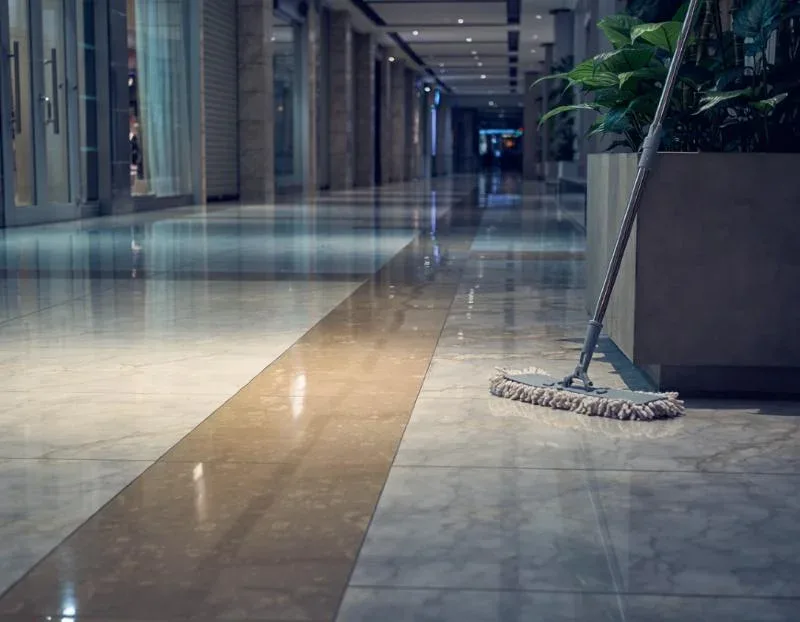
If you see a fast, humming machine pass through a large shopping mall or hotel lobby at midnight, it is most likely a high-speed burnisher. These machines do not grind the floor, meaning they do not remove any noticeable material from the stone; they refresh the surface in a short time with a pad that spins very fast. Known as burnishing, this method has long been used to maintain film-polished floors and has become increasingly common in natural stone care as well. However, it does not give the right result on every stone or in every situation. In this article, we explain how high-speed burnishing works, which pads are used on natural stone, how it is applied on crystallized and polished floors, the risk of heat build-up and marks, and the difference from film-polished floors.
In short: Burnishing means refreshing the top layer of a surface with a high-speed machine and a fine pad to restore its shine. On natural stone, it is useful as part of regular maintenance for polished or crystallized floors whose shine is still good and which have no deep scratches; it does not restore floors that have gone dull, are scratched, or have lippage. Heat build-up and the wrong pad choice can leave marks.
What Is Burnishing? Speed, Pad and Heat
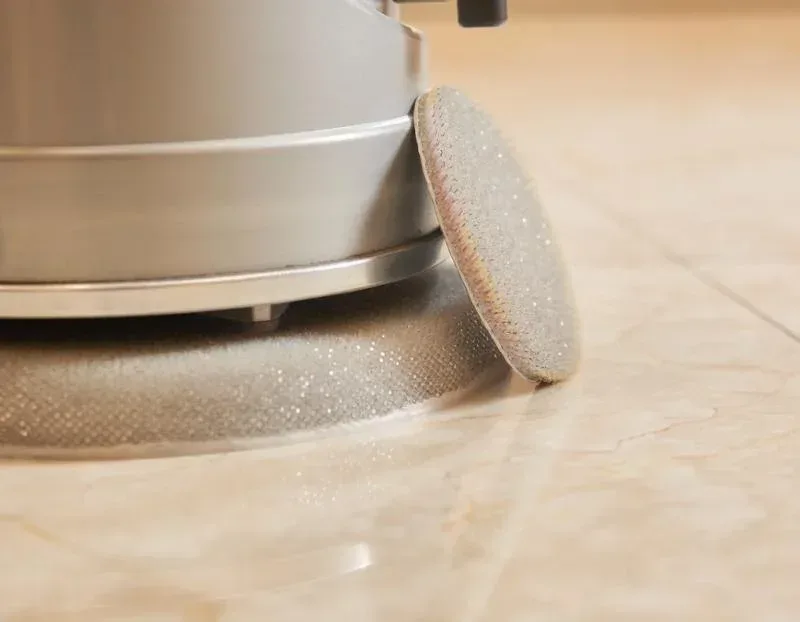
The machines used in floor care fall roughly into two groups. Standard single-disc machines run at relatively low speed with high pressure and are suited to scrubbing, cleaning, crystallization and honing/grinding work. High-speed burnishing machines, on the other hand, spin the pad much faster but apply less pressure to the floor. According to vendor information, common models run at roughly 1500 to 2000 rpm; some special machines go beyond that.
The purpose of this high speed is to give the surface a fine polishing effect through friction. As the pad glides over the surface, it lightly levels microscopic roughness and generates heat on the surface. On film-polished floors, this heat slightly softens the polish layer and re-shines it; on natural stone, the abrasive or polishing material inside the pad interacts with the surface. In both cases the process is short and makes it possible to refresh large areas in a single night.
The basic components of the method are as follows:
- Machine: The high-speed burnisher spins the pad quickly and must be kept constantly moving across the floor to achieve an even shine over a large area.
- Pad: Natural or synthetic fiber pads are used for film polish, and fine diamond-impregnated pads for natural stone; the choice of pad directly determines the result.
- Preparation: The surface must be completely clean and dry before the process, because grit and dirt left on the surface will scratch the floor at high speed.
Where Burnishing Comes From: Film-Polished Floors
High-speed burnishing first became widespread for maintaining acrylic polishes applied over vinyl and similar resilient floor coverings. On these floors, the shine comes not from the floor itself but from the polish film on top of it. The film gets scratched and dulled over time; the high-speed machine re-shines this film with heat and friction, thus postponing the need to apply new polish.
A similar film polish can also be used on natural stone; in some buildings, acrylic polish is applied to marble and granite floors and regularly burnished with a high-speed machine. However, this approach preserves not the stone's own shine but the shine of a plastic layer added on top. Over time the film can yellow, get dirty and blur the appearance of the stone; eventually it has to be stripped. We covered the pros and cons of film polish on stone in detail in our article on acrylic floor polish in detail.
Burnishing on Natural Stone: Diamond-Impregnated Pads
To preserve the stone's own shine, high-speed burnishing is carried out with fine diamond-impregnated pads instead of film polish. These pads contain very fine diamond particles embedded in a fibrous body. Spinning at high speed, they remove very fine scratches and dullness from the stone's surface and make it shiny again. This can be thought of as a very light repetition of the final stages of honing/grinding.
Diamond-impregnated pads are usually produced in different grits and used in a certain order in the maintenance program. A coarser pad is used periodically on dulled areas, while a finer pad is used for frequent refreshing. Pads can be used dry or very slightly damp; which method is suitable depends on the pad manufacturer's instructions and the stone. We explained the general logic of the diamond stages in our article on diamond pad grit numbers
The biggest advantage of this method is that it adds no layer to the floor. The shine comes from the stone itself; therefore problems such as yellowing, peeling or film build-up do not occur. The next major grinding/polishing does not require stripping a coating first, either.
Refreshing Crystallized and Polished Marble
On marble floors treated with crystallization, there is a harder, shinier layer on the surface that has reacted with the calcite. This layer also wears over time and dulls, especially in heavy-traffic areas. Reapplying crystallization every time is costly in terms of both product and time, and when repeated often it can create unwanted build-up on the surface. High-speed burnishing offers a lighter way to maintain shine in the period between two crystallizations.
The situation is similar for polished marble, that is, marble polished only with diamond pads. After honing/grinding the surface is shiny, and in busy areas this shine drops over time. Regular high-speed burnishing slows the decline and postpones the need for a full grinding for a long time. We also covered the chemistry and limits of crystallization in our article on crystallization separately.
For refreshing to work, the floor must still be in good condition. High-speed burnishing removes slight dullness, but it does not remove deep scratches, acid marks or lippage between slabs. If such problems exist, grinding with suitable stages should be done first, and high-speed burnishing should become part of maintenance only afterward.
Heat, Marks and Other Risks
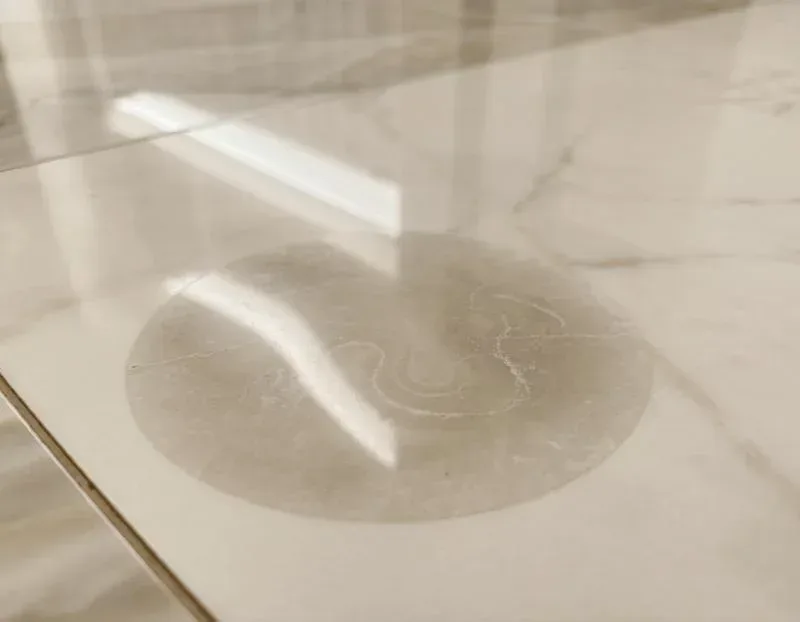
The most important risk of high-speed burnishing is heat. As the pad spins at high speed, frictional heat builds up on the surface. When the machine is kept moving constantly, this heat dissipates and causes no problem; but if the machine stays in one spot, the surface can overheat. On film-polished floors, this causes the polish to soften and smear. On natural stone, a local difference in shine, a slightly burnt look, or deterioration of the filler in resin-filled areas may be seen.
Other risks also mostly stem from incorrect application. On a floor whose grit has not been removed beforehand, a pad spinning at high speed drags the grit across the surface and leaves fine lines. An overly coarse pad unsuitable for the stone can create ring marks on the surface. If the edge of the machine presses on the floor at an angle, half-moon-shaped marks may be left. In addition, some high-speed machines run on gas; if they are to be used in enclosed spaces, the machine manufacturer's instructions regarding ventilation and exhaust gas must be followed.
The basic rules applied to reduce these risks are as follows:
- Clean first: The floor is cleaned with a dry mop and, if needed, a neutral product just before the process, then dried, because remaining grit leaves scratches at high speed.
- Constant movement: The machine is moved across the surface without ever stopping, in overlapping straight passes, and turns are made slowly.
- Right pad: The pad is chosen to suit the type of stone and the desired shine, and worn or dirty pads are replaced regularly.
- Sensitive areas: In areas that are resin-filled, repaired or have soft veins, work is done with shorter contact and lower pressure.
Film-Polished Floor vs. the Stone's Own Shine

Because high-speed burnishing is used with two different floor logics, it is important to know which logic is being applied. The table below compares the two approaches:
| Topic | Burnishing on a film-polished floor | Burnishing on the stone itself |
|---|---|---|
| Source of the shine | Acrylic polish film on the stone | The stone's own surface |
| Pad used | Fibrous polishing pad | Fine diamond-impregnated pad |
| Effect of heat | Softens the film and re-shines it | Too much can leave marks and uneven gloss |
| In the long term | The film builds up, may yellow, and has to be stripped | No layer builds up; the stone keeps its look |
| The natural look of the stone | A plastic-looking shine on top | The stone's own depth and color |
| Next grinding and polishing | The film has to be stripped first | Can be done directly with the grit steps |
As the table shows, for a lasting, clean result on natural stone, an approach that works on the stone's own surface is more suitable. Film polish, on the other hand, is usually preferred when gloss is needed in a very short time or when the stone cannot be polished sufficiently, and its removal must be factored into the long-term maintenance plan.
When to Use It and When Not To
When used in the right place, high-speed burnishing is an effective and fast way to maintain a floor's gloss. Used in the wrong place, it either does nothing or damages the floor. To decide, you need to look at the condition of the floor and the type of stone.
The method is generally suitable in the following situations:
- Post-restoration maintenance: On freshly ground and polished marble floors, it gives good results when applied at regular intervals to keep the gloss in high-traffic areas.
- Crystallized floors: In the period between two crystallizations, it can be used to refresh the gloss and reduce how often crystallization is needed.
- Large, flat areas: In large, open, unobstructed areas such as lobbies, corridors and shopping malls, the machine works efficiently and large areas are refreshed in a short time.
There are also situations where the method is not suitable. On a floor with deep scratches, acid etching or uneven levels, high-speed burnishing does not solve the problem; it only polishes the problem surface. On honed floors, meaning those deliberately left matte, burnishing spoils the intended look and may reduce slip resistance. On very hard stones such as granite, the effect of a fine diamond pad remains limited and good cleaning is often enough. In places where slip resistance is the priority, such as wet areas, ramps and stairs, increasing gloss is not always the right goal.
Building It into a Maintenance Program
High-speed burnishing gives its best results not as a one-off treatment but as part of a regular maintenance program. The program has three layers: daily cleaning, periodic high-speed burnishing, and comprehensive grinding and polishing when needed. Daily cleaning removes grit and dirt from the floor; high-speed burnishing refreshes the gloss in high-traffic areas; comprehensive restoration is carried out only when burnishing is no longer enough.
For the program to work, the person doing the burnishing must be trained. A high-speed machine requires different handling habits from a standard cleaning machine; slowing down on turns, never leaving the machine standing in one spot, and checking the condition of the pad often are skills gained with experience. If the cleaning team will take on this work, we recommend that the first applications be done together with the stone care team and that which pad to use in which area be set out in a written instruction. In addition, if the date and area of each burnishing are recorded in a simple log, it becomes clear over time how quickly the gloss drops in each area, and the frequency can be adjusted accordingly. The machine's pad-holding base and pad centering device should also be checked regularly; a pad that sits at an angle can leave marks on the surface even if the machine is used carefully.
The frequency of burnishing is determined by the traffic on the floor. It is applied more often in front of busy entrances and elevators, and less often along edges and corners. We explained how to set up maintenance frequency according to traffic in our article on maintenance schedules by traffic density If you would like to find out whether high-speed burnishing is suitable for your floor, you can reach us with photos of the floor and usage information via the service request form
Identifying an Old Film on the Floor

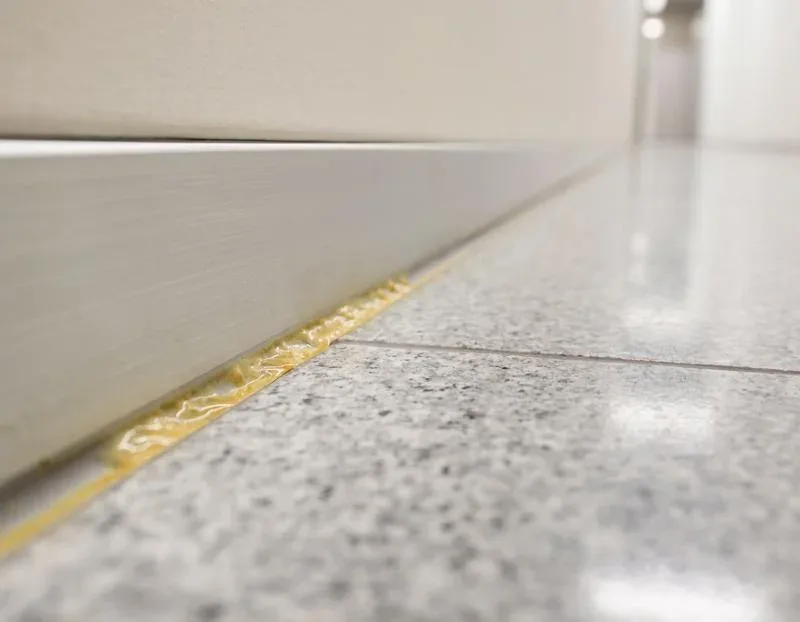
Before high-speed polishing is carried out in a building, it is necessary to know whether there is a film of finish on the floor. A stone floor with a film finish usually has a plastic or wet-looking shine, and yellowish buildup forms along the grout lines and at the base of the walls.
For a simple test, the surface is lightly scraped with a fingernail or a plastic card in an inconspicuous corner; if a soft layer lifts off, there is a film. In that case, diamond pad polishing, which works on the stone itself, is not applied until the film has been stripped; otherwise the pads clog and the surface looks stained.
Overnight Refresh in a Shopping Mall Corridor

Let's imagine that a few months after honing, the shine begins to fade at the store entrances of a shopping mall corridor. A full honing is not needed at this stage; instead, the floor is refreshed overnight after closing with a high-speed machine.
The crew first cleans the corridor with a dry mop and a neutral product. Once the floor is dry, the store entrances and the walking path are polished with a fine diamond-impregnated pad. The machine is moved forward in straight passes without ever being stopped, and at the end the surface is dry-mopped once more. The corridor is ready for use by the time the mall opens in the morning.
Think of high-speed polishing not as a procedure that rescues a floor, but as a habit that keeps a floor in good condition that way; on a dulled and scratched floor, grinding comes first, then polishing. — Expert Tip
Frequently Asked Questions About High-Speed Polishing
01Can high-speed polishing replace honing?
02Can high-speed polishing be done at home?
03Is burnishing applied to travertine?
04How often is burnishing done on crystallized floors?
05Does high-speed polishing make the floor slippery?
06How much noise does the machine make?
Related Articles
Marble Crystallization: Chemistry, Application, and Limitations, Are Acrylic Floor Polishes Suitable for Natural Stone? Risks of Film Coatings, Diamond Pad Grits: The Logic of Progression from Coarse Grinding to Polishing, Marble Maintenance Schedule by Foot Traffic: Lobby, Corridor, and Apartment, Choosing a Stone Grinding Machine: Weight, Speed, and Number of Heads