Polished Concrete Care: From Daily Cleaning to Repolishing
The most praised aspect of polished concrete is its ease of maintenance, and this praise is largely justified: there is no polishing film to renew on it, it does not dust out, and it does not require a cycle of stripping and repolishing. But low maintenance does not mean neglect. A washing machine with the wrong pad installed, a few cleanings with a descaler, or a fruit juice waiting overnight can erase the effect of months of care. In this article, we explain the maintenance of polished concrete starting from the delivery day; we address daily cleaning, pad selection in the machine, chemical traps, renewing the protector, dullness on traffic paths, and the moment when a re-wiping is really needed, in order. Finally, you will find a calendar table for the store, warehouse, and parking lot.
In short: Maintenance of polished concrete involves keeping sand away, washing with a neutral cleaner and the right pad, and timely renewing the worn protector. Dulled paths are often repaired with diamond care pads and high-speed polishing. Re-polishing comes into play when these steps cannot restore scratches and acid damage.
What Does "Low Maintenance" Mean? How Does a Surface Wear Without Film?
On an acrylic polished or epoxy-coated floor, traffic is first met by the film above; when the film wears off, it peels off and a new one is applied. There is no such buffer in polished concrete. The shine comes from the concrete itself, gradually thinned with diamond and condensed with a hardener; at the top, there is only a very thin protector that delays the absorption of liquids. Therefore, the purpose of maintenance is not to renew a layer but to protect the surface itself from wear and chemical attack.
There are three factors that wear down the surface. The first is abrasive particles: sand carried on the shoe sole, on the wheel, and under the track, causing invisible scratches on the surface with each pass. The second is chemical: acids dissolve cement paste, strong alkalis and solvents weaken the protector. The third is residue: a poorly chosen or overdosed cleaner leaves a thin layer on the surface, and the floor looks dull even when clean. A good maintenance plan responds to each of these three factors separately. What the hardener brings to the surface and what it does not In the concrete hardener article We explained.
Maintenance Starting Line: Delivery Day Record
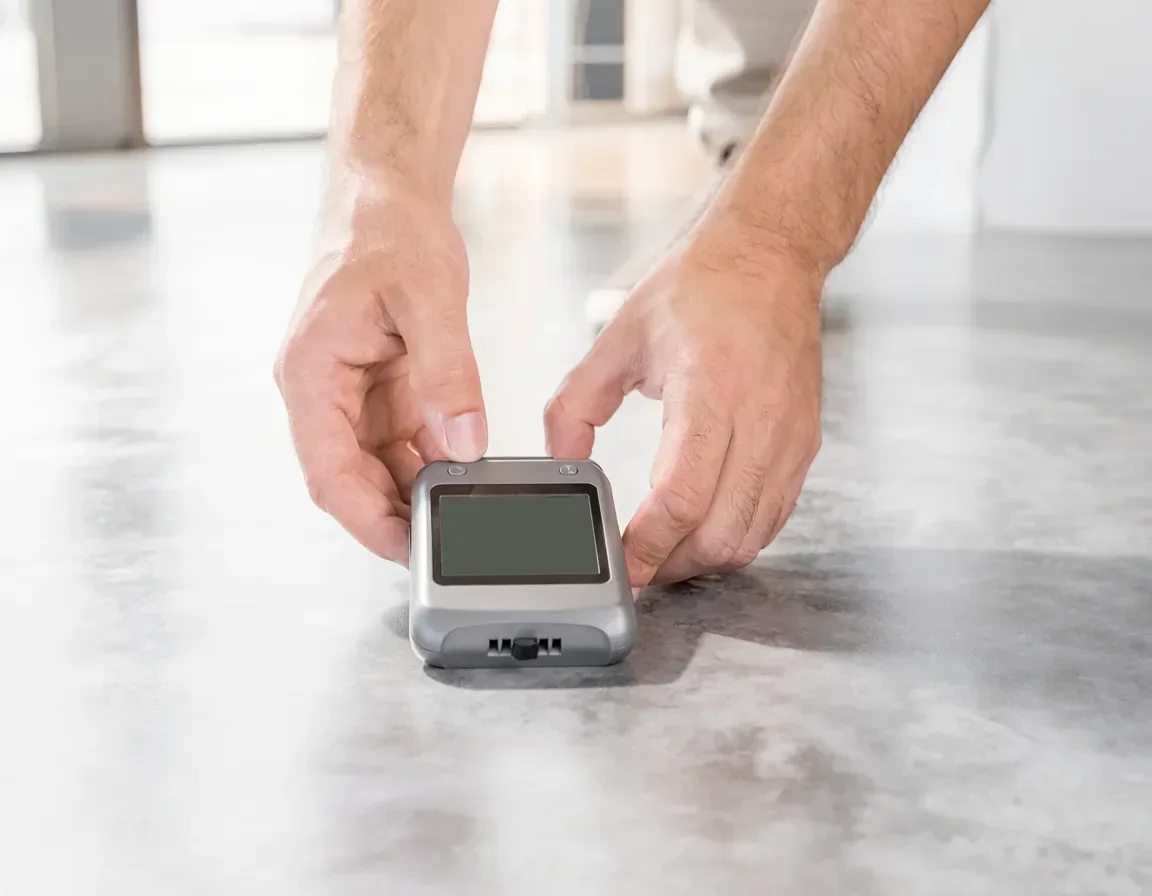
The most common problem in maintenance is not knowing how matte the floor has become. The eye does not notice slow changes; after a year, it is said "it doesn't shine like before," but no one knows what the old one was. Therefore, the registration made on the delivery day is the starting line of the maintenance. At delivery, we read with a brightness meter at several fixed points, photograph the same points from the same angle, and leave the hardener, protector, and finish stage in writing.
This recording serves two purposes. The first allows comparison with measurements to be made later: when the difference between the value on the traffic path and the value at the base of the wall begins to widen, it means the time for intervention is near. The second is to know which product the floor was used when the cleaning team or maintenance company changes; if a different product is applied to some protectors, adhesion problems may occur. Every intervention done without registration is an estimate.
Even if there is no brightness meter, photographing the same points in the same light and from the same angle, and looking at how clear a lamp or column edge appears reflected on the floor, provides a rough but useful comparison.
The Correct Sequence of Dry Dusting and Wet Cleaning
The first and most effective step in daily maintenance is dry dusting. A large microfiber dust mop or, in large areas, a sweeper collects sand and dust without getting wet. The order is important: if water is applied to the floor without collecting sand, it turns into mud, works like sandpaper under the pad, and adheres back as a gray layer when dry. Oil-impregnated dust cloths are not recommended on polished concrete because they can leave slippery and dirt-retaining marks on the floor.
The measure for wet cleaning is a pH close to neutral. Some cleaners produced for the care of polished concrete contain small amounts of preservatives or hardeners and nourish the surface with regular use; these should also be diluted at the ratio provided by the manufacturer. Increasing the dose does not improve cleanliness. When unrinsed detergent dries, it accumulates dust, leaves footprints, and dulls the floor. Washing many floors thought to have become matte several times with clean water shows that the shine has not faded but is only covered with residue.
Mats at entrances are also part of the cleaning plan. If most of the sand brought inside is kept on the threshold, it makes it easier to collect dry dust and slows down the mattening of walkways; a stuffed mat does not hold the sand but scatters it.
Pad Selection in the Machine: How to Use Diamond Care Pads?
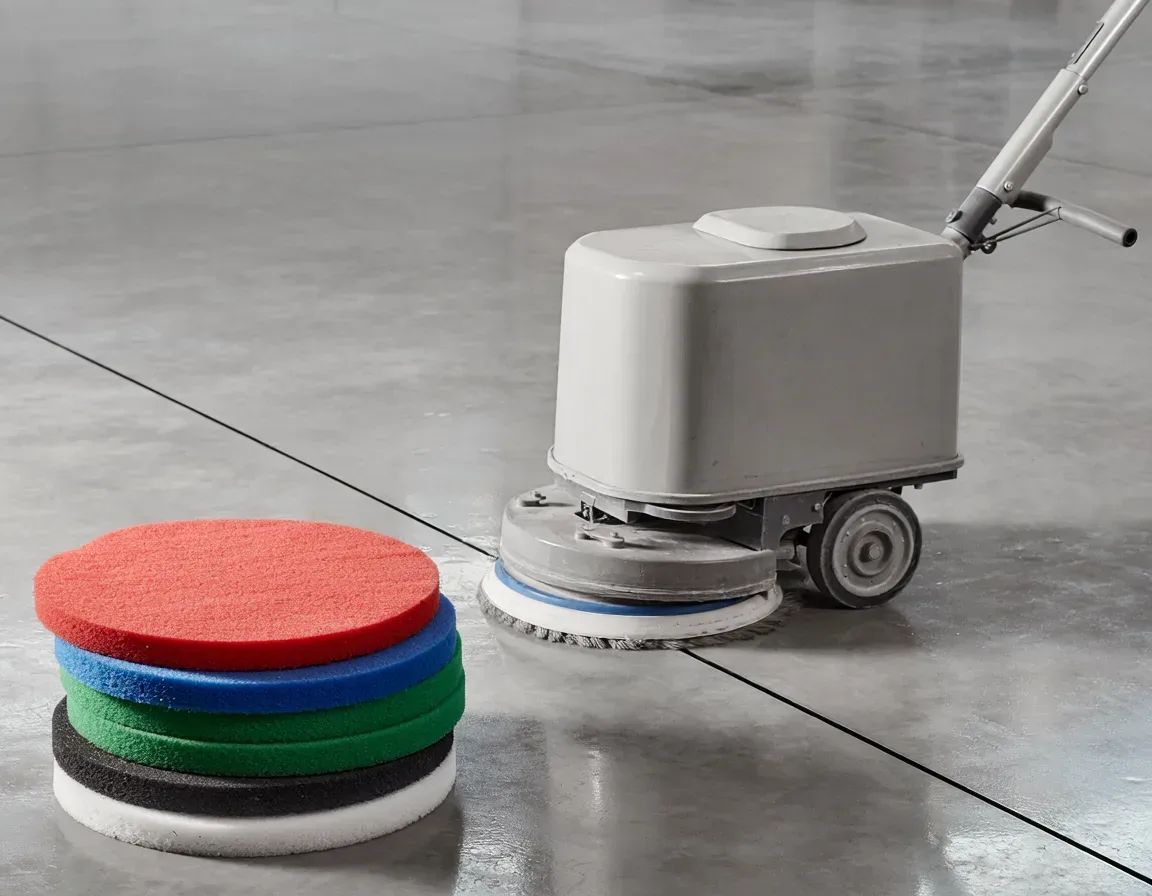
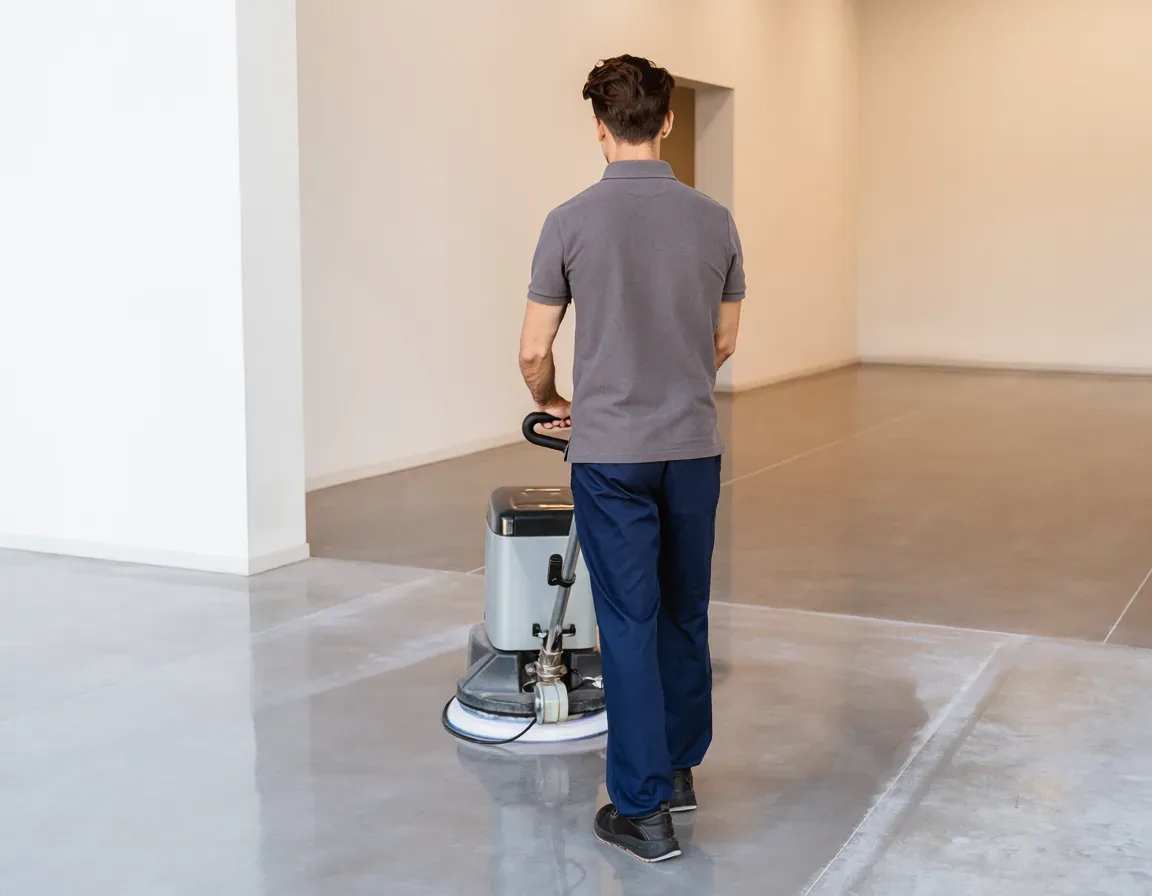
Washing over large areas is done with a floor washing machine that dispenses the solution and collects dirty water from behind. Whether the machine is friendly to polished concrete is largely determined by the pad underneath. Dark-colored pads and wire brushes for removal quickly scratch the surface; the pad logic valid in natural stone In the floor washing machine text As we explained, the same principle applies to polished concrete.
The tool specific to polished concrete is maintenance pads embedded with fine diamond particles. These pads lightly thin the surface during regular washing and remove fogging on traffic roads before it accumulates. Pads are used in different tasks according to their number:
- Thin-numbered pads: It is installed on a well-maintained floor during daily or weekly washing; it maintains shine while cleaning and takes a fine streak without scratching the surface.
- Medium size pads: On a surface that has been neglected for a while and walkways have become prominent, it is used for a few passes to tidy, then it is returned to a thin pad.
- Rough numbered care pads: It is used only in areas with obvious scratches and wear, short-term and controlled; if left in regular washing, it reduces shine.
Which number is suitable for which job depends on the product and the condition of the concrete; the manufacturer's recommendation and a small trial should be taken as the basis. Since the pads carry sand, they are washed regularly, and gravel stuck on the wheels and under the pad is checked before each job. A pebble that goes unnoticed draws a line along the entire corridor.
Chemical Enemies of the Floor: Acid, Strong Alkalis, and Polishes
Concrete consists of calcium compounds in cement, and acids dissolve these compounds. Although hardener tightens the surface, it is not a barrier against acid. Descalers, salt spirit, vinegar, and some bathroom and kitchen cleaners leave drop-shaped matte marks on polished concrete; these marks do not come out with cleaning because they are not dirty. Strong alkaline degreasers and solvents weaken the preservative, and with long-term use, the surface's resistance to staining decreases. The general logic of cleaning chemistry in the article on cleaning chemistry We explained about natural stone; the effect of acid on calcium compounds is similar in concrete.
The third trap is products sold under the name of polishes. Acrylic polishes and wax cleaners look shiny on the first day but create a film scratched under the rubber on the surface, which traps dirt and becomes slippery when wet. This film must be removed later, and removal can also damage the protector. The shine of polished concrete is protected not by a material applied on top but by treating the surface.
Time is the most important factor in spills. Coffee, wine, oil, fruit juice, and carbonated drinks exceed the preservative as long as you wait; the liquid is first pressed and absorbed, wiped off before spreading, then removed with water with a neutral cleaner. Methods for stubborn oil, rust, and paint stains Stains on the concrete floor in the text We collected them.
Lifespan and Renewal of the Protective Layer
A stain protector, also known in the industry as a guard, is a thin product applied at the end of the wipe. Some work by embossing into concrete, others by leaving a very thin film on the surface; both wear out over time in traffic. How long it lasts depends on the product, traffic, and the chemical used for cleaning; therefore, it is more reliable to look at the markings on the floor rather than the number of years. The first sign of a worn protector is that liquid spilled on walkways leaves a darker mark than before; if the same liquid is still on the surface at the base of the walls, the difference lies with the protector.
Renovation is a short task but requires preparation. The floor is deeply washed with a residue-free product, completely dried, and the protective layer is applied in a thin, even layer. Thickly applied or puddled product leaves blurred stripes and a sticky feel. In many products, the drying surface is polished with a high-speed machine and a fine diamond pad to tighten it. In regional renovation, the border is left not randomly but at a joint; this way, the transition is not noticeable.
The protector should be seen more as a time-saving measure than an insurance. It does not provide immunity to fat and acid, only giving time for intervention.
Matteing Traffic Roads: High-Speed Polishing
Even on a well-maintained floor, the most commonly used lines gradually separate from their surroundings: the path from door to cash register in stores, corners where forklifts turn in the warehouse, and the strip from the elevator to the corridor in the office. The source of this mattification is often not deep damage but fine scratches on the surface scattering light. The tool for this is a polishing machine that spins the pad at very high speed. A thin diamond pad attached underneath smooths the surface heated by friction, scratches shrink, and reflection becomes clearer. General logic of the method in high-speed polishing text We explained.
Polishing is done only on clean, dry surfaces; on sandy surfaces, the pad turns the sand into sand. On matte or satin-finished floors, the goal is not to create shine but to make the paths look the same as their surroundings; polishing a satin floor at a constant high speed can make it look shinier and more uneven over time. Scratches on the nail that polishing does not fix are signs of the next step.
Maintenance Schedule by Location

The same floor can be vacuumed for weeks in a warehouse while in a store sees machines every day. The table below is a starting recommendation for three types of medium-density spaces; frequencies should be adjusted according to traffic, products used, and finish at delivery:
| Work | Store and showroom | Warehouse and logistics | Indoor parking |
|---|---|---|---|
| Dry dusting | Every day before the opening | With a sweeper every day or at the end of a shift | Once a week, entry and ramp bottom more frequently |
| Machine washing | Every day or every other day, with a thin diamond pad | Once or twice a week, more frequently in busy corridors | Additional passes to return points once a month |
| Intervention in shedding | Immediately, press-on sucking | Immediately, absorbent material in oil and battery fluid | On the daily tour, in a drop of fresh oil |
| Wrapping with a mid-size pad | Periodic on the safe and entry road | Periodic periods at forklift turning points | If necessary, on driving routes |
| High-speed polishing | Regular maintenance item | Only in pedestrian and office areas | Usually not targeted |
| Protective inspection and renewal | Annual inspection, renewal according to sign | Once a year inspection, loading area first | Annual inspection, first parking pockets |
In the parking lot, the goal is dust-free and cleanable rather than brightness; from daily tours to annual damage tours, tasks, responsible persons, and registration procedures In the parking floor maintenance plan text We also explained. In warehouses, due to maintenance, forklift traffic, and shelf arrangement, corridor by corridor is planned; in stores, all work is arranged so that it finishes before opening time. For hotels and tourism-oriented stores in Antalya, placing intensive maintenance outside the season is often the choice that disrupts the business the least.
When is a re-deletion necessary?
When the floor does not meet expectations, the first thing that comes to mind is a re-wipe, whereas in most cases, a lighter step is sufficient. If the difference between the values in the delivery record and today's measurement does not close after washing, resetting pad, polishing, and protective replacement, the decision becomes clear. Situations that require re-wiping are generally as follows:
- Scratches on the nail: Scratches that do not shrink with the polishing and sealing pad indicate that wear has penetrated beneath the surface left by fine grades.
- Common acid traces: When matte rings left by limescale remover or acidic spills multiply, a regional maintenance wipe is required.
- Spots on the pores: Grease or color stains that do not open with cleaning and cloth can only be reduced by a fine cut from the surface.
- Rough wheel paths: If the surface texture has changed on forklift and pallet truck tracks, polishing is not enough and the grinding steps are reverted.
Re-sealing does not always mean starting over. In most maintenance mopings, only the last few resin layers are repeated, then a protector is applied; rough steps are only done if the surface is truly eroded. The work is often done only in the problem area, and the boundary is aligned with a joint. If you want to see which step your floor needs with measurement and testing in a small area service request form You can reach us through this channel.
Maintenance and Slipping: Caution on Wet Floors

Polished concrete does not cause slipping complaints when dry and clean; the problem usually starts with moisture and substances remaining on the surface. Residues of unrinsed detergent, acrylic polish, or oily dust cloth noticeably lubricate the surface when wet. Therefore, it is also important for safety that care products are residue-free.
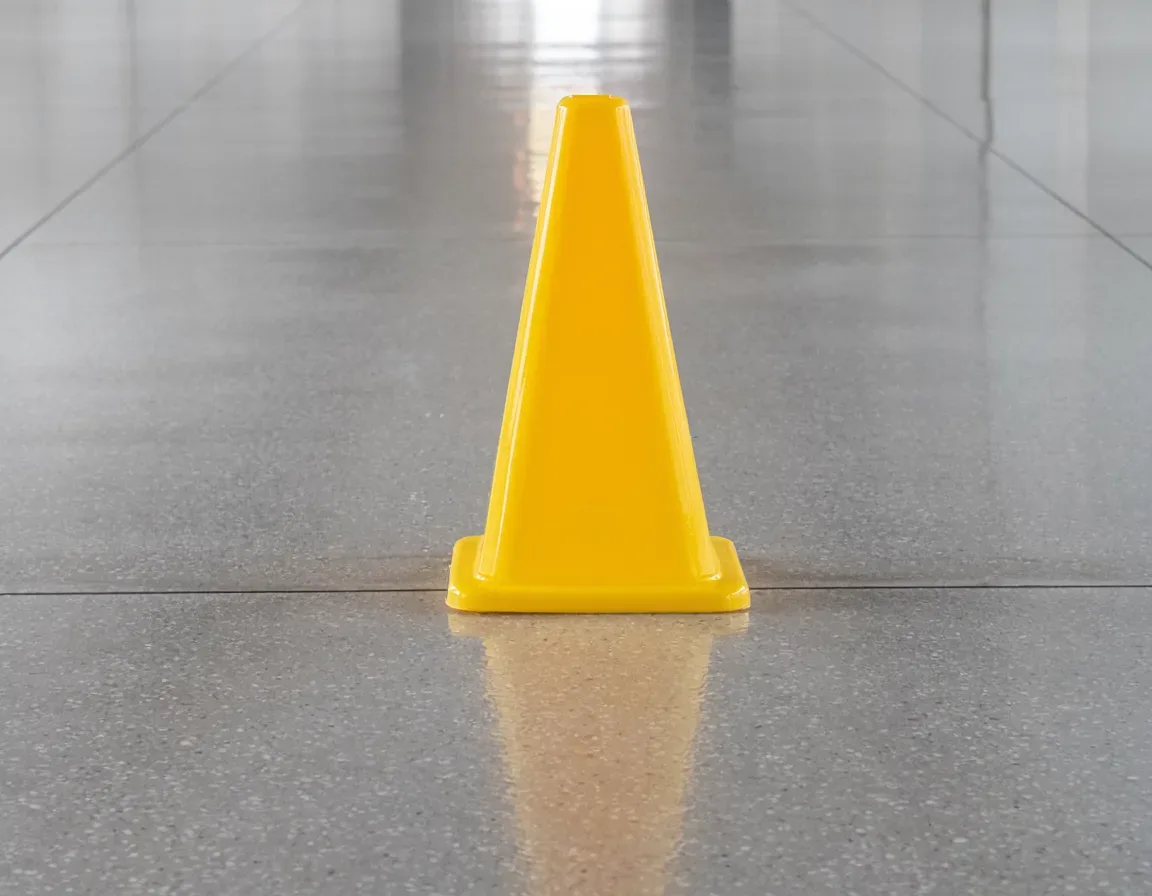
During wet washing, the area is marked with a warning cone, no water is left behind the machine, and absorbent mats are added to the entries on rainy days. Staying at a lower brightness in constantly wet areas is also an option.
First Year Metrics in a Showroom

In a furniture showroom we delivered, we measured and recorded brightness at the entrance, in front of the case, and in the back corner. Six months later, the back corner was almost identical, with a noticeable drop in front of the entrance and case.
The inspection showed that the cleaning team increased the dose on busy days and could not rinse the floor. First, several clean water washes were performed, then only the intake line was polished with a fine diamond pad. The values approached those on delivery, no wiping was needed again, and the dose instructions were rewritten.
Simply attaching the pad to the washing machine is not enough; check the underside of the pad and the wheels before every job. A small stuck pebble can scratch the surface in one pass that pays off months of maintenance. — Expert Note
Frequently Asked Questions About Polished Concrete Maintenance
01Can a steam cleaning machine be used on polished concrete?
02When should diamond care pads be replaced?
03Is it necessary to reapply the hardener at certain intervals?
04Should we do the maintenance ourselves by our own staff or outsource it to a company?
05What should be considered in the first days on newly delivered ground?
06What changes in care in winter and humid weather?
Related Articles
Parking Floor Maintenance Plan: Daily, Monthly, and Yearly Tasks, Oil, Rust, and Paint Stains on Concrete Floors: Method by Stain Type, What is a Concrete Hardening (Densifier)? Difference Between Lithium, Sodium, and Potassium Silicate, Aggregate Appearance and Gloss Level Selection in Polished Concrete, What is High-Speed Polishing (Burnishing)? When is it used in natural stone?