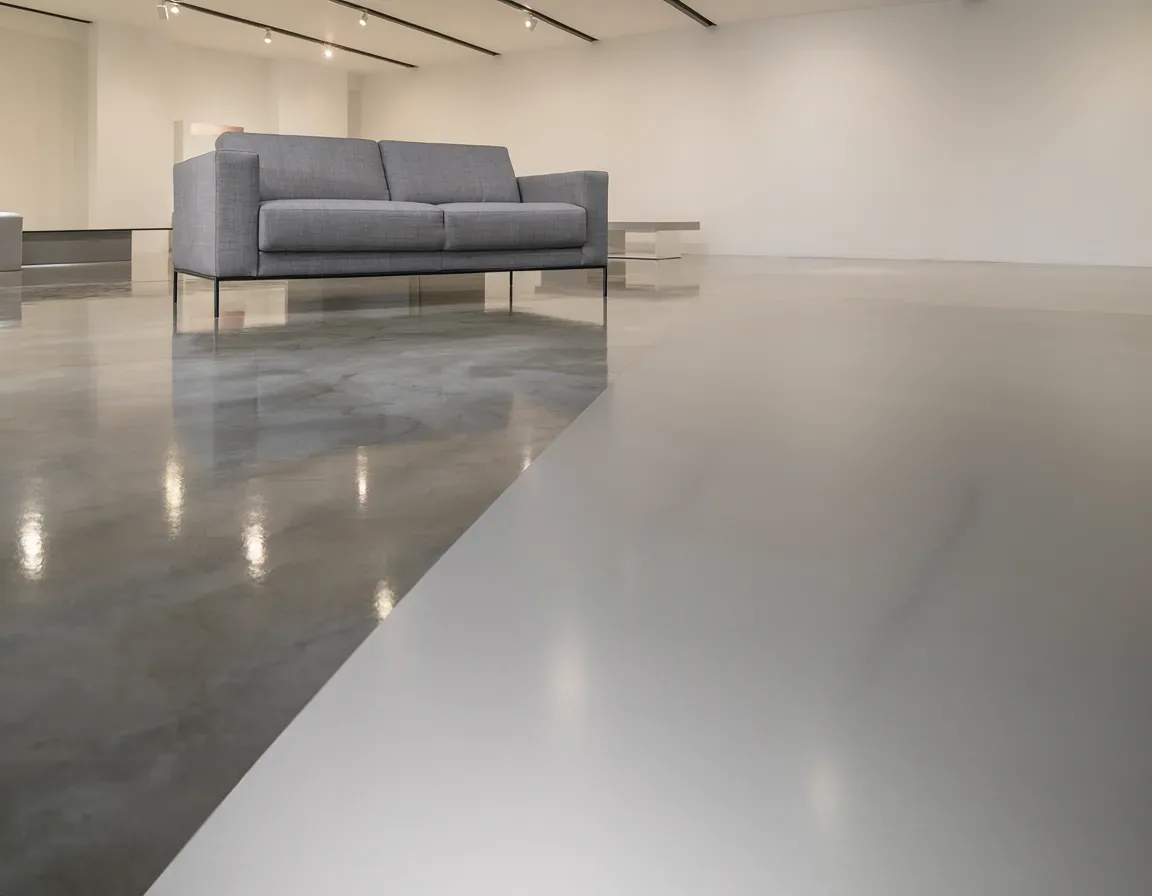
Polished Concrete in Store and Showroom: Design, Lighting, and Maintenance
In a parking lot, what is expected from polished concrete is to cut off dust and easily wash the floor; in a store, the floor is a quiet scene behind the product. In a car dealership, the vehicle's body is reflected on the floor; in a furniture store, the sofa reads along with the concrete tone; in a café, the floor reveals the character of the space at first glance. Therefore, polished concrete in a commercial space is not just a surface treatment; it is a design decision made together with the architect, lighting designer, and business owner. In this article, we explain how to live with traces of existing concrete, what light does on the floor, the possibilities and limits of coloring, what can be found under old cladding in a rental shop, its place on the opening schedule, and the risk of stains in daily maintenance.
In short: The success of polished concrete in commercial spaces depends less on the flawless concrete being discussed from the outset. Light should be designed together with the floor, and color and brightness should be chosen by testing the space's own concrete. Concrete is an alkaline material; if spills like coffee, wine, lemon, and oil are not removed without delay, they can leave marks despite the protective coating.
Why is the floor a design decision in a commercial space?

With the transfer of the industrial look to stores, cafes, and offices, gray concrete ceased to be a material hidden under carpets or ceramics for years. The place of polished concrete in the design language comes from being an honest material: no pattern is printed on it; what you see is the building's own flooring. When used together with raw ceilings, exposed plumbing, steel shelves, and wooden furniture, it forms a cohesive language. The same floor, in a white-walled and simple showroom, serves as a neutral floor that highlights the product.
The type of space changes expectations. In a car dealership, the floor carries both the heavy tire load and the reflection on the car's shiny body; here, reflection is a sales tool. In a furniture store, products often move and drag; scratch tolerance of the floor becomes important. In the market, cart wheels, condensation in front of refrigerators, and spilled products test the floor every day. In a café, chair legs, wet mats, and drink spills stand out. In the office, a quiet, eye-straining, and easy-to-clean surface is desired. The same method is used in all but the goal is different; the design decision should be determined by the daily life of the space.
The Story of Existing Concrete: Coming to Peace with Imperfections
On a floor designed for newly poured and fully polished concrete, the appearance can be largely controlled. In most commercial spaces, we have concrete poured years ago for another purpose and covered with other coatings. When this concrete is wiped off, its history is brought to the surface, and some of these are not ground by wiping. Before starting work, we clearly discuss the following matters with the business owner:
- Cracks and repairs: The filled cracks are at the same quota as the ground but remain visible as lines; instead of hiding them, the goal is to finish them as a neat and clean line.
- Patches and old holes: Areas broken and refilled for plumbing give a light or dark tone around the area because old anchors and shelf holes are sealed with a different mortar.
- Color and texture differences: Sections that fell on different days, old wall marks, and areas that have been covered with carpet for years can still be read as light cloudiness even after cleaning.
- Old coating traces: Dark stains may remain in areas deeply penetrated by the adhesive or primer; how much of these will come off is only understood during the trial area.
When these marks are accepted as "character" in the designer's language, polished concrete looks very good in commercial spaces. If a flawless, monochromatic surface is expected, expectations conflict with material from the start; in that case, another solution such as a coating or microconcrete on top of the concrete might be more appropriate. Whether the cracks are movable and how the repair is done In the article on crack repair on concrete floors We explained in detail. The most concrete tool for expectation management is to add a photo of the trial area and a "list of those who will remain visible" to the scope of the work.
Appearance and Brightness: A Brief Frame for the Space
How to select aggregate depth and brightness level in the article on aggregate view and brightness selection We explained in detail; here we touch on a few points specific to commercial spaces. High brightness is often requested in showrooms and car dealerships because the floor reflects the product and enlarges the space. However, a glossy surface also shows every footprint, every water stain, and every scratch; therefore, we only recommend high brightness in places that require regular maintenance.
In cafes and restaurants, a satin finish is generally more comfortable. Wet mopping, spilled drinks, and oil carried from the kitchen create both visibility and slipping risks on shiny surfaces. For a calm look in offices, a satin or semi-glossy finish with cream or fine aggregate gives good results. At building entrances and in front of wet doors, it is appropriate to keep the gloss one level lower and support it with an entrance mat; how to interpret adhesion values In the article on non-slip values You can find them.
Lighting and Reflection: Designing Light Together with the Floor

Polished concrete is a surface that reflects light, and this feature is both an opportunity and a design responsibility in commercial spaces. A light gray floor makes the space appear brighter compared to a dark finish; the same fixtures create a more spacious environment. On the other hand, a bright floor gives back every fixture on the ceiling as an image. Spotlights create bright spots on the floor, while linear fixtures in a row form long light lines. If these reflections are not planned as part of the design, they appear scattered rather than eye-catching.
Reflection also reveals the flatness of the floor. Light arriving as a straight line curls and reflects on a wavy floor; slight ripples that go unnoticed on a matte floor suddenly become visible on a bright floor. Daylight entering at a low angle through window and display glass highlights fine scratches, pad marks, and repair boundaries on the surface. Therefore, the floor decision should be made together with the lighting plan, not before it is finalized.
The color of the light also changes the tone of the concrete. Under warm white light, concrete shifts to beige, and under warm, cool white light, it shifts to a bluish and harsh gray. When evaluating the test area, it is important to have the space's own fixtures lit and, if possible, to look separately from in front of the display case and from the depths of the space. Designers who want to reduce glare often lower the brightness by one level or direct the light not to the floor but to the wall and product.
Coloring: Concrete Paint and Acid Paint in Brief
Gray may not be the tone every space is looking for. There are two common ways to add color to existing concrete, both applied between grind stages. The first is concrete paints; these water- or solvent-based products penetrate the pores of the concrete and produce vibrant, relatively even colors. Their weakness is sensitivity to light: most manufacturers recommend these paints for indoor spaces that do not receive sunlight; fading or color shifting may be observed over time in areas exposed to window and roof light. In sunny spaces, light-resistant formulas and the product's technical file must be checked.
The second is acidic paints. These react with free lime in the concrete to create color; the result is an earthy, variegated, and natural stone-like appearance. Since the color depends on the chemistry of the concrete, the same product appears at different thicknesses in different areas, making it difficult to predict the exact result in advance. Additionally, the wear caused by acid on the surface can make polishing difficult; therefore, acidic paint is less preferred than paint in polished concrete.
Whichever is chosen, the color fluctuates according to the concrete's absorbency: patches, old adhesive stains, and tightly polished areas take on different colors. An exception to the rule is new concretes where the color is added to the mix during pouring; this method cannot be applied on an existing floor. If a colored floor is targeted, we recommend not starting without a trial area.
What is under the old cladding in a rental shop?
In rental stores, the floor decision is both technical and contractual. When a tenant wants to dismantle epoxy, vinyl glue, or ceramic made years ago and turn it into concrete, the landlord's written consent must first be obtained, and the condition under which the floor will be delivered should be discussed at the end of the lease. Removal methods used according to the type of covering and possible surprises that may arise from below In the article on removing old epoxy and floor paint We explained.
There is another point to consider in shops where ceramics or tiles are removed: most of the time, the foundation of the ceramic is not the building's load-bearing concrete but a leveling screed or adhesive mortar with a high sand content. This layer is not designed as a wear surface and can spread under the diamond. After dismantling, first a small section is opened to check the hardness and thickness of the concrete; if the floor is not suitable for polished concrete, it is necessary to know this before spending the demolition budget. Which concrete is suitable for removal What is a concrete sieve in the article We summarized it in a table.
Placing the Floor on the Opening Calendar

The most common problem in store and showroom work is compressing the floor to the end of interior architectural applications. However, polished concrete is not a job that can be finished in one go; rough steps, repairs, and hardener are done early, while fine steps and protective steps yield healthy results when done late. Protecting the floor during the time between these two phases is also part of the job. The table below summarizes where common tasks stand relative to floorwork:
| Work | Location according to ground work | Why |
|---|---|---|
| Removal and breaking of old coatings | Before rough wiping | Removal dust and crushing damage damage damage the ground surface |
| Plumbing ducts and floor sockets | Before rough wiping | Broken areas should be repaired and passed through the same steps as the ground |
| Rough wiping, repair, hardening | Before plaster and painting work | Heavy machinery operates in empty space, weak surfaces are removed early |
| Plaster, paint, ceiling, and lighting | By preserving the ground | Paint drops and gypsum powder are done under cover without treating the concrete |
| Fixed shelf, countertop, and display case assembly | Before or after the thin stages, according to the plan | The bottom of fixed units is not processed; the boundary must be redefined from the beginning |
| Fine grades, protective, polishing | Just before the final cleaning | The final surface is finished with minimal damage and in true illumination |
There are rules that teams working above ground should know between the two phases. Hardened but not yet finished concrete easily absorbs paint, plaster, and oil; stair legs and drifting scaffolding leave scratches. The floor is covered with a breathable protective cover, the joints of the cover are taped, and care is taken not to glue the tape directly to the concrete, as some tapes leave marks. If the opening date is certain, the days allocated for thin steps should be scheduled to protect against delays by other teams.
Daily Care and Stain Risk: Coffee, Wine, and Oil
Polished concrete is an easy-to-maintain floor but is not immune to stains. The limescale in the structure of concrete is alkaline; acidic liquids such as lemon juice, vinegar, wine, fruit juice, carbonated drinks, and some cleaning products can react with the surface, leaving dull, slightly rough rings. Colored liquids like coffee and wine also penetrate pores, creating color stains. Although oil does not give color, it absorbs into the concrete and remains a dark shadow; therefore, the hinges and rails under greased hinges in cafe kitchen doors and furniture stores are risky.
The hardener itself is not a stain protector; it tightens the surface but does not protect the concrete against acidic spills. After the final stage, a thin stain protector is applied for this task. The preservative slows the infiltration of the spilled liquid and gives you time to intervene; however, it does not always stop a long-standing spill. We recommend giving your team these brief rules for what to do during spill:
- Take without waiting: The spilled liquid is removed without rubbing, pressing immediately from above with an absorbent cloth; rubbing spreads the stain over a wider area and pushes it into the pores.
- Wipe with a neutral cleaner: The area is wiped and rinsed with water and a neutral cleaner; using a descaler or acidic product enlarges the matte ring.
- Do not wait in oil: In oil spillage, the excess is first removed with absorbent powder or cloth, then the degreaser product is used only in the amount permitted by the manufacturer.
- Note the ring: If a matte mark remains after wiping, the area is marked; light wear can be repaired with care pads and high-speed polishing.
The rest of daily maintenance is simple: keeping sand on the door with a doormat for drying, dusting dry, wiping with a damp cleaner, and felting the display feet. Care schedule and pad selection according to the space in the article on polished concrete maintenance We examined it in detail.
To see whether the concrete of your store, showroom, or café is suitable for polished flooring, the floor plan, the lighting layout, and a few close-up photos of the floor service request form you can convey it through; during the discovery, we evaluate the trial area together in the light of the space itself.
Tire, Reflection, and Window Display Sun at the Car Dealership

The car dealership is the place that demands the most polished concrete among commercial spaces. The floor both supports the weight of the vehicles and reflects the shiny surface of the bodies. When vehicles are on display, tires can spin on the ground and leave marks; therefore, we recommend separating the maneuvered entrance area from the exhibition area and placing vehicles in the display area without rotating.
In large-glazed galleries, the window sunlight falls at a low angle to the floor during daytime hours, making scratches more pronounced. If colored concrete is desired, a light-resistant product should be chosen on the sunscreen strip.
A Nightly Trial Area in a Furniture Store

A business owner in a furniture store wanted to finish the entire space brightly. We prepared the trial area after the store closed, with the window lighting and ceiling spotlights on, in two separate brightnesses. In the bright section, the spotlights formed a series of white dots on the floor, and the shadows under the sofas hardened.
The satin section showed the products on a calmer background. Finally, the display area was satin, and the path between the entrance and the case was finished semi-glossy. The decision was made in a few minutes at night under the products themselves.
Do not think separately from the plan for lighting the floor in a commercial space. Look into the trial area both from the door and from the depths of the space while the venue's own fixtures are lit; the decision should be made in that light. — Expert Note
Frequently Asked Questions About Polished Concrete in the Store and Showroom
01Does polished concrete make noise in stores?
02What happens if the shelf and countertop locations change later?
03Can the floor be renewed while the store is open?
04Do chair legs scratch the floor in a cafe?
05Does polished concrete feel cold in winter?
06Does the floor change color?
Related Articles
Aggregate Appearance and Gloss Level Selection in Polished Concrete, Removing Old Epoxy and Floor Paint and Turning Into Concrete, Polished Concrete Care: From Daily Cleaning to Repolishing, What is Concrete Plastering? The Path from Dusty Screed to Polished Concrete, How to Read Anti-Slip Values? R Class, Pendulum Test, and Wet Ground