Covered Parking Floor Renewal: Dust-Free and Bright Parking with Concrete Cleaning
An indoor parking lot is the most frequently used but least maintained floor of a building. In a shopping mall, the first contact between a customer, a guest in a hotel, or a patient's relative in a hospital often starts not in the lobby but on the concrete floor below. If this floor is dusty, vehicles are covered with a gray layer; if it is dark, finding a parking spot becomes difficult; if it is filled with grease stains, the building looks older than it is. In this article, we explain why covered parking floors have become this way, what concrete wiping has changed and what it does not, and how the work is carried out while parking is still in use.
In short: In indoor parking, the source of dust is mostly the weak top layer of concrete; the slurry takes this layer, and the hardener tightens the solid surface underneath. The result is a dust-free, light-reflecting floor that is easier to wash by machine. The work is done by dividing the parking lot into sections and mostly at night; success is determined not only by the machine but also by details such as ventilation, driver orientation, column bottom, drain, and line.
Why Does the Floor of an Indoor Parking Lot Cause Problems?
Parking lot floors are often the fastest-pouring concrete in the structure. Water and fine material that rise to the surface during finishing harden form a thinner, weaker crust than the underlying concrete. Tires grind this crust a little more with each pass; the fine dust that forms is lifted by the airflow created by ventilation fans and settles on parked vehicles, pipes, and lighting fixtures. Sweeping the floor does not solve the problem because dust does not come from outside but is produced from the ground itself.
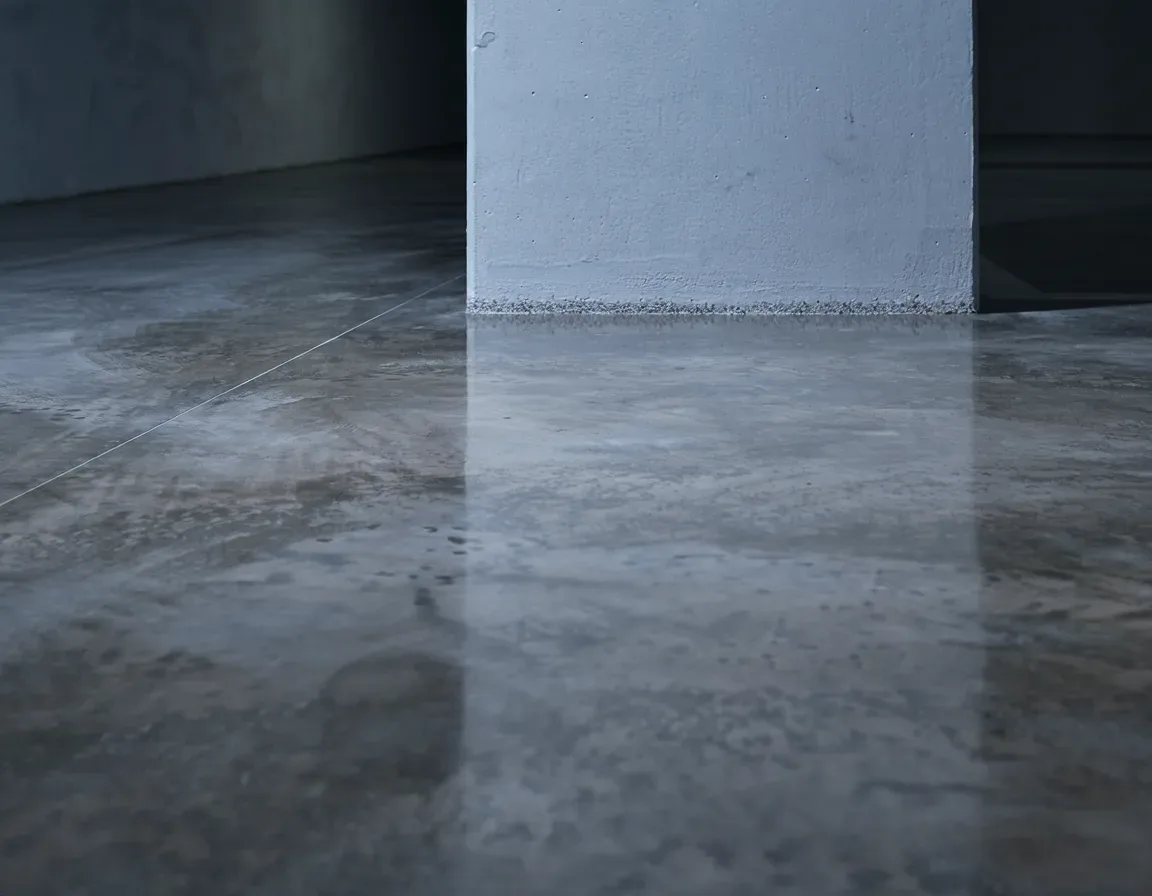
The second complaint is darkness. Dirty, matte, and darkened concrete absorbs most of the light falling on it; even if the fixtures work, the floor and column bottoms remain dim. The driver notices the parking line, while the pedestrian notices oil deposits or elevation differences late. Strengthening the lighting is a solution, but as long as the floor does not reflect light, the effect of each added fixture is limited.
The third problem is grease. Motor oil dripping into the middle of parking spaces settles into porous and dusty concrete within hours, leaving a dark ring that grows over the years. When wet, it is slippery and carried to elevators and floor corridors with shoes stepping on it. Every drop on an absorbent floor is destined to be permanent; so the stain problem is related to how absorbent the surface is before cleaning frequency.
Finally, there is noise. On painted or coated smooth surfaces, the screech produced by the tire when steering resonates in a closed volume and is especially a complaint in residences and hotels. The sound comes from the tire gripping and releasing on a smooth and clean surface; the surface texture and residue of cleaning products directly affect this behavior.
What Does Concrete Cleaning Change in the Parking Lot?
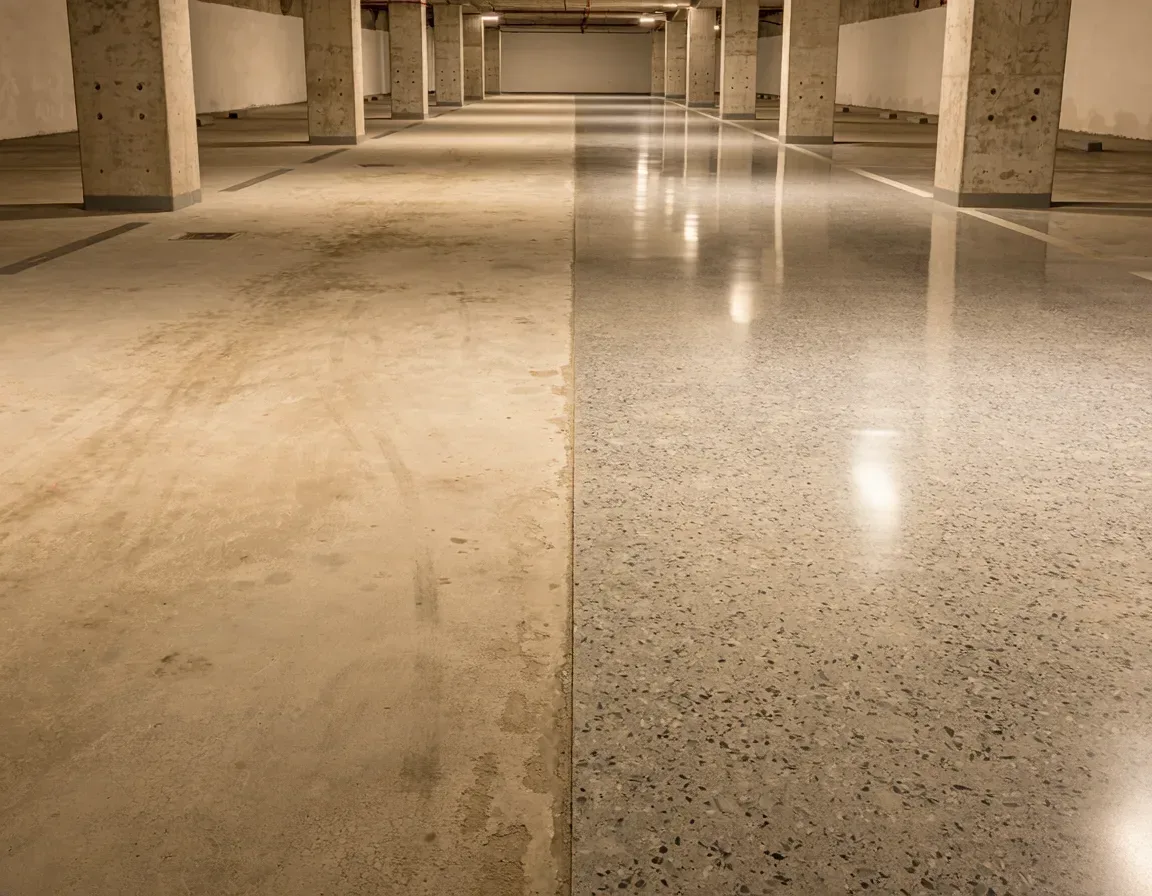
Concrete gloss does not add a new layer to the floor; it opens the concrete surface with diamond abrasives, tightens it with a silicate-based hardener, and polishes it to the desired level. From a parking perspective, this means there is no film to peel, bubble, or lift under the hot tire. The benefits of the method to parking can be summarized under four main headings:
- Cutting the powder at the source: The weak upper shell is removed by rough smoothing, and since it is hardened by the solid concrete hardener underneath, there is no loose material left to grind under the rubber.
- Surface that reflects light: Light gray, smooth, satin-finished concrete reflects light from fixtures onto the ceiling and columns; with the same lighting, the parking lot appears noticeably more spacious.
- Easy machine washing: Dirt and oil remain on the surface with tightened pores, and the rider-mounted floor washing machine collects much more dirt in the same pass.
- Integration of repairs with the ground: During crack, pothole, and joint edge repairs, the level is brought to the same level as the ground, eliminating the thresholds where the wheel gets stuck and water accumulates.
You also need to know the boundaries from the start. Screed does not make concrete stronger than it is; a screed that is weak in strength, crumbles when scratched with a wrench, or is not thick cannot be saved by screed, and this situation is understood during the inspection. Stains may appear in parking spaces that have absorbed oil for years, but shadows may remain. Lighting gain is real, but decisions like reducing the number of fixtures are the matter of the lighting project, not the ground; in this regard, numerical promises should be approached cautiously.
In places like the car wash section, battery charging area, or technical volume that remains constantly wet, a chemical-resistant coating may be more appropriate than bare concrete. Using two systems together in the same parking lot is not a contradiction but a distinction made according to the needs of each section.
Which Surface Finish Is Targeted in a Parking Lot?
A glossy surface like a mirror is not targeted in the parking lot. High brightness means more levels and longer duration; in turn, water and oil dripping from the vehicle increase the risk of slipping, the visibility of tire marks, and squeaking during turns. Therefore, on driveways and parking lots, a finish that reflects light by spreading light is mostly chosen between matte and satin, and polishing levels are left at this level.
The appearance of the aggregate is also a decision, but in the parking lot, it is determined more by the condition of the concrete than aesthetics. If the thin shell remains or the old paint and patch marks are deep, the cut deepens and fine aggregate appears in places. This should be read not as a defect but as a sign that solid concrete has been reached; still, the expected appearance should be clarified in a trial area of a few square meters before starting work.
Pedestrian paths, elevator and stair entrances, payment points, and ramp openings are considered separately. In these areas, people walk with wet shoes; the surface is left more matte than the driving path or a texture that increases slip resistance is preserved. The ramps themselves are different from flat floor floors; polishing is not done there and methods that increase grip are used. This Non-slip on parking ramps We explained this in detail in the article.
Working Without Closing the Parking Lot: Segmentation and Night Shift
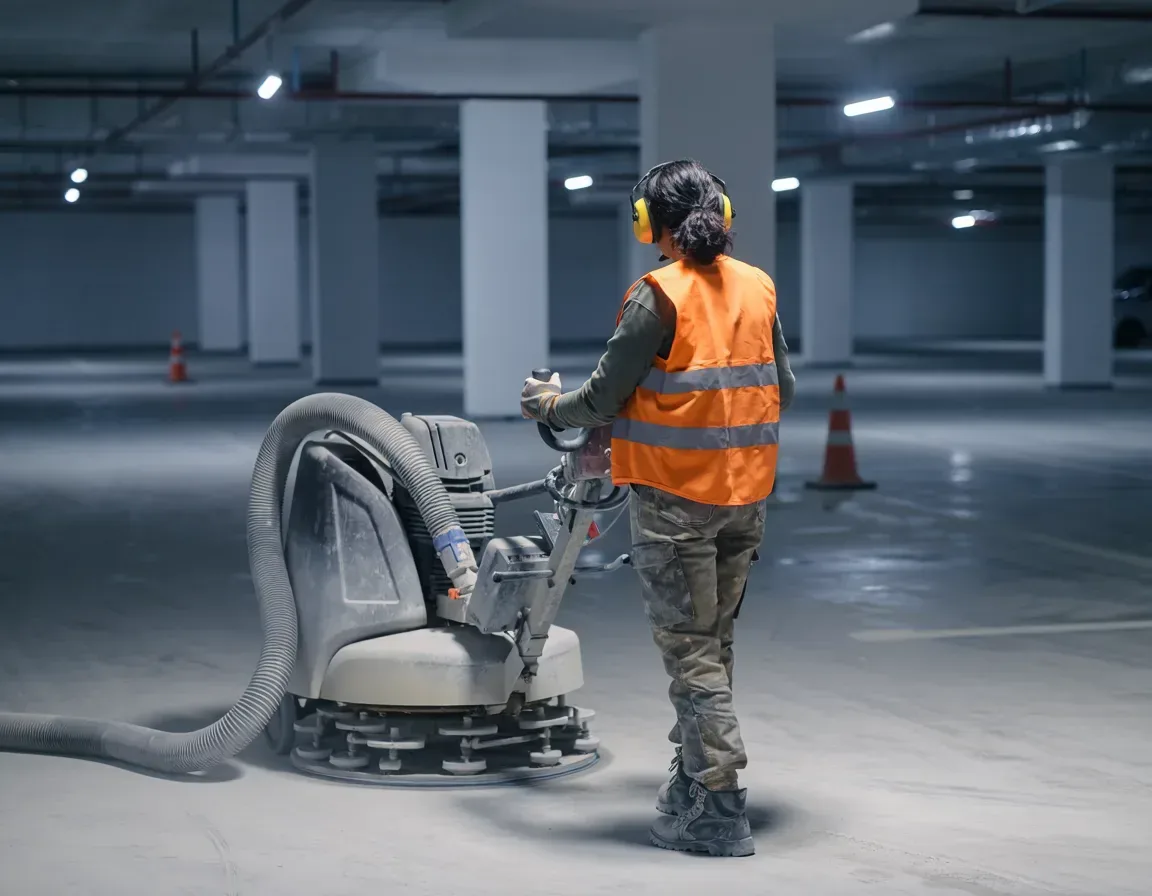
It is often impossible to close a shopping mall or hospital parking lot for days. Therefore, the work is carried out by dividing the parking lot into sections: one section is cleared of vehicles and worked, while the others continue to be used. The boundary of the section is not drawn randomly; the driving path is not cut, an entrance and an exit are always open, and water and electricity are accessible within the section, preferably along joint lines or column axes. Having the boundary on the joint also hides the possible tone difference between the two sections.
The choice of time depends on the rhythm of the building. The table below summarizes how the working window varies in different types of buildings:
| Building type | The calmest time | Attention paid to partitioning | Prominent constraint |
|---|---|---|---|
| AVM | Night from closing to opening | Folding or wing-to-wing closure | Dry and clean delivery for the morning opening |
| Hotel | Off-season months, daylight hours | Keeping the valet and service entrance open | Noise and vibration reaching the rooms |
| Hospital | Night and weekend, small episodes | Never cutting the emergency and ambulance routes | Low tolerance to dust and noise |
| Business center | After working hours and weekends | Temporary shifting of subscriber seats | Full capacity on Monday morning |
| Residence basement | Weekday day, when residents are at work | Block by block closure, backup parking space | Night noise limit, vehicles parked for long periods |
The decision and announcement process in residences and housing complexes can take longer than technical work; issues such as condominium owners' approval, budget, and vehicle clearance in the site and residence parking manager guide We also addressed it.
Work in a section usually proceeds in the following order:
- Discharge and inspection: The section is closed at the announced time; whether there are any remaining vehicles, drains on the ground, manhole covers, and joint profiles are reviewed one by one.
- Pre-cleaning and repair: Grease stains are removed with solvent, cracks and pits are filled; the filling is not covered with a grinding machine until it hardens.
- Rough and intermediate wiping: Weak shells and old paint are removed with metal-bonded diamonds, then gradually thinning them to cover rough scratches.
- Application of the hardener: The silicate-based hardener spreads over the surface until saturated, excess is collected, and the manufacturer's specified time is waited for the response.
- Final stages and cleaning: The targeted satin finish is achieved with resin-bound diamonds, dust and mud are removed, and the section is delivered dry and swept up.
In reality, not all these steps can fit into a single night. In most cases, rough wiping and repair are done overnight, while hardening and fine steps are done the following night; whether the intermediate daytime section will be opened is decided according to the condition of the surface. A floor that has been roughly cleared carries vehicle traffic, but since it can leave dust, if it is to be opened, it must be washed first.
Ventilation, Dust, and Mud: Rules of Enclosed Volume
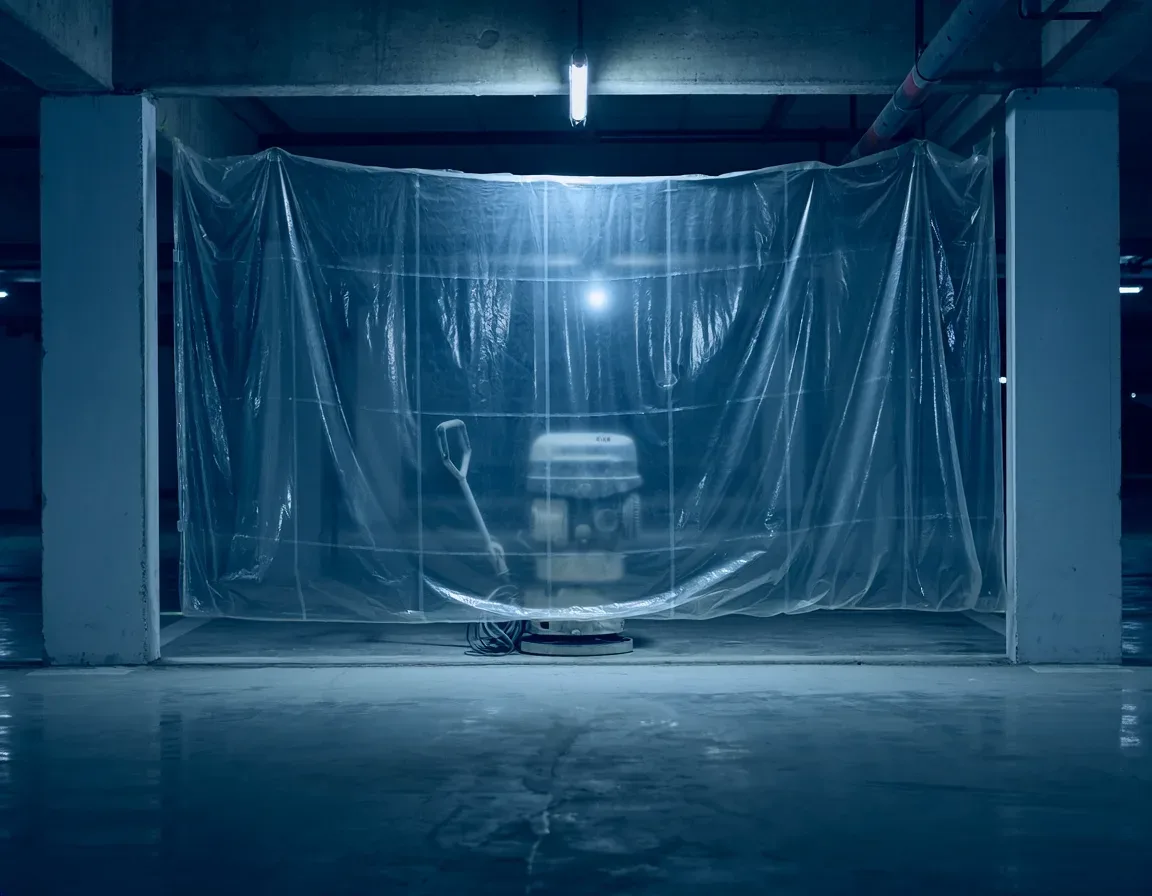
Unlike an open construction site, an indoor parking lot is a limited volume with air. Concrete powder contains respirable crystalline silica; therefore, dry grinding is only done with a high-efficiency industrial dust extraction system with a high-efficiency filter directly connected to the machine, and the operator uses appropriate respiratory protection. The health dimension of the issue silica powder in dry wiping We explained in the article. Wet silting dust binds to the mud but prolongs drying in the layers beneath the ground and requires the mud to be managed.
The machines themselves also affect the air. In closed parking lots, we prefer electrically powered cleaning machines; internal combustion engine equipment produces exhaust gases and can only be used by measuring ambient air while the ventilation system is running. The mechanical ventilation of the parking lot must remain active throughout the work. On the other hand, since the current generated by the fans can carry dust to unused areas, the dust curtain is stretched at the section boundary and the dust extraction power is selected accordingly.
A missed issue is the fire detection system. Dense dust can cause false alarms in smoke detectors; this means an evacuation announcement or a fire call at midnight. How the detectors in the area to be worked on will be protected during the work is decided in writing together with the building's technical team and the company responsible for the fire system; this is not a decision made by the extinguishing team alone.
In wet stages, sludge is prevented from reaching the drains. Cement-based sludge settles and hardens in the drain; it can clog the oil separator, pump pit, and drainage line. Therefore, the drain openings are closed before work, the sludge is collected with a wet vacuum, it is left to settle, and the solid part is removed from the building as construction waste.
Driver and Pedestrian Guidance
Segmentation is easy on paper; the real challenge on the ground is the driver who habitually parks in the same place every day. Diversion is a temporary traffic arrangement established before the job starts and is carried out with the following vehicles:
- Advance announcement: The section to be closed, the date and time range are announced several days in advance at the entry point, inside the elevators, and, if available, via subscriber messages.
- Physical separation: The working area is separated not only by a strip but also by cones and barriers that the vehicle cannot accidentally pass through; electrical cables and hoses are not allowed to pass through the driving path.
- Temporary directional signs: If the flow direction is temporarily changed, arrows and plates are placed before the driver decides and at eye level.
- Pedestrian route: The path to the elevator and stairs is marked and illuminated so that it can be walked from outside the work area, without stepping on wet or dusty ground.
An officer standing at the section boundary during peak hours is more effective than carefully prepared signs. Pedestrian access is completely closed during hours when the surface is wet and slippery; the section is reopened not unplanned but occurs after the ground dries and is checked. Steps to reopen the area in institutions Enable post-erase space We explained in the article.
Column Bottoms, Wheel Stoppers, and Drains

The quality of a parking lot job is understood not on wide driveways but where the machine cannot approach it. The large planet machine stops just a few centimeters before the column, wall, and curb; if this strip is not processed with a separate edge machine and the same row of steps, a dull, dusty frame remains around each column. Column corner protectors and plumbing pipes at the base of the wall also slow down edge work; this is why the number of columns is considered as much as square meters in exploration.
Wheel stops are the second detail. Leaving rubber or concrete stoppers in place means leaving unwiped islets underneath and around them. The correct approach is to remove the stops, treat them with the ground and resecure them after mopping; filling old anchor holes and opening new ones should also be included. The same applies to bicycle suspensions, barrier feet, and steering posts.
Metal elements on the floor also require attention. Expansion joint profiles, manhole covers, and grate frames damage the diamond abrasive material; the machine does not run over these elements; the surroundings are processed by hand. Drains are kept closed throughout the work and tested by opening and pouring water before delivery. Sweep can remove small ridges left high but does not change the slope of the floor; if there are areas where water carried by vehicles pools on rainy days, this is a separate issue that must be resolved before sweeping, and water accumulation in the parking lot This article is discussed.
Lines, Numbers, and Deployment
The erase also takes the old parking lines, arrows, and numbers on the floor. This is often a desired result because over-painted, raised lines look bad on a renewed floor. However, if the re-marking is not planned from the start, the section opens without lines and irregular parking begins on the first day. The adhesion of paint in tight, non-absorbent polished concrete is also different from that in bare concrete; preparation of line locations and paint selection Parking lines and floor marking We explained in the article.
Opening for use is the point where concrete wiping is comfortable compared to coatings: there is no film where curing is expected for days. Pedestrian traffic can be opened when the surface is dry and cleaned. For vehicle traffic, the hardener and, if any, the protector must wait for the time specified by the manufacturer; this period varies depending on the product, temperature, and basement humidity and must be stated in the quote. If line paint is used, the curing of the paint is often decisive.
Upon delivery, the section is visited with light from the side: column bottoms, stopper perimeters, joint edges, and repair points are checked one by one, and when rubbed on the floor by hand, it is checked whether dust has come into the palm. Any deficiencies are corrected before moving on to the next section; when the last section is finished, an acceptance report is prepared for the entire parking lot.
Protecting the Renovated Parking Lot
A wiped and hardened parking floor requires little maintenance but cannot remain unmaintained. The sand and fine gravel carried by the tires dull the surface like sandpaper; regular sweeping and washing with a rider machine using a neutral product preserve shine much longer than strong chemicals. Oil droplets are removed without delay, and tire marks at turning points are cleaned before they settle. Checking the condition of the traffic lanes at the end of the first year and renewing the protector if necessary postpones the need for re-wiping for years.
Several photos showing the area's plan, number of floors, current covering, and stain condition to see the correct coverage for your indoor parking service request form You can communicate it with the building. During the inspection, we look at the concrete's hardness, humidity, and repair needs; we prepare the partitioning and shift plan together with building management.
Why Does Tire Squeal?

The tire sound echoing in an indoor parking lot is the result of the tire sticking to and releasing on a smooth surface. The flatter, brighter, and more covered with cleaning residue the sound becomes; it increases in tight turns where the steering wheel is turned all the way at low speeds.
Leaving the finish satin on polished concrete on driving paths, keeping turning points a bit more matte, and washing the floor with a neutral product that leaves no residue reduces the sound. Still, it cannot be promised that the sound will be completely cut off; the tire's age, compound, and air temperature also affect the result.
Three-night Section in a Hospital Parking Lot

In a hospital parking lot where the emergency room entrance is from the same floor, we draw the sections according to the ambulance route: this path is never closed overnight, and the adjacent section is worked on last and as soon as possible. On the first night, grease stains and repairs are done; on the second night, rough and intermediate wiping are done; on the third night, the final steps are done with hardener.
For detectors, we correspond in advance with the technical directorate, set up the dust curtain away from the elevator hall, and deliver the section washed and dry every morning.
In the parking offer, look at the number of columns, stops, and drains before the square meters; the duration and quality of the work are determined not by wide driving lanes but by the points where the machine cannot approach. — Expert Note
Frequently Asked Questions About Covered Parking Floor Renovation
01Is there odor in the parking lot and building during work?
02When can tools enter the deleted section?
03Do sound and vibrations reach apartments or shops on the upper floors?
04Can you work in a humid indoor parking lot in winter?
05How to work around electric vehicle charging stations?
06If the floor has been previously painted or coated with epoxy, can concrete plaster be applied?
Related Articles
Site and Residence Parking Floor Renewal: A Guide for Managers, Non-slip and Wear on Parking Ramps, Water Accumulation in Parking Lot: Slope, Drain, and Pond Problems, Parking Floor Maintenance Plan: Daily, Monthly, and Yearly Tasks, Concrete Clearing Stages: Step-by-Step Process from Discovery to Delivery