Factory and Warehouse Concrete Floor Cleaning: Machine, Frequency, and Common Mistakes
A warehouse or factory produces its own dirt. Pallet chips, cardboard dust, plastic film pieces, rubber torn off forklift tires, oil dripping from benches, and sand entering through open doors all fall to the floor every shift. Therefore, cleaning concrete floors in industrial areas is not an occasional favor; it is a task that is part of production and shipping. When done well, dust does not get on the product or machine, the forklift does not slip, and the floor lasts for years; when done poorly, cleaning itself becomes one of the factors that wear the floor. In this article, we explain sweeping and floor washing machines, brush and pad selection, detergent dosage, oil and rubber marks, common mistakes, frequency according to area type, shift schedule, and wastewater.
In short: Cleaning concrete floors in factories and warehouses is the work of two machines: the sweeper collects dust and sand dry, the floor washing machine scrubs stuck dirt and pulls back dirty water; the grease stain is handled manually before the machine. For daily work, a near-neutral cleaner and a soft brush are enough; acidic products and constantly worn abrasive pads dust the floor. If the machine collects gray mud with every pass, the problem is not dirt but worn concrete.
Two Machines, Two Separate Jobs: Sweeping and Washing
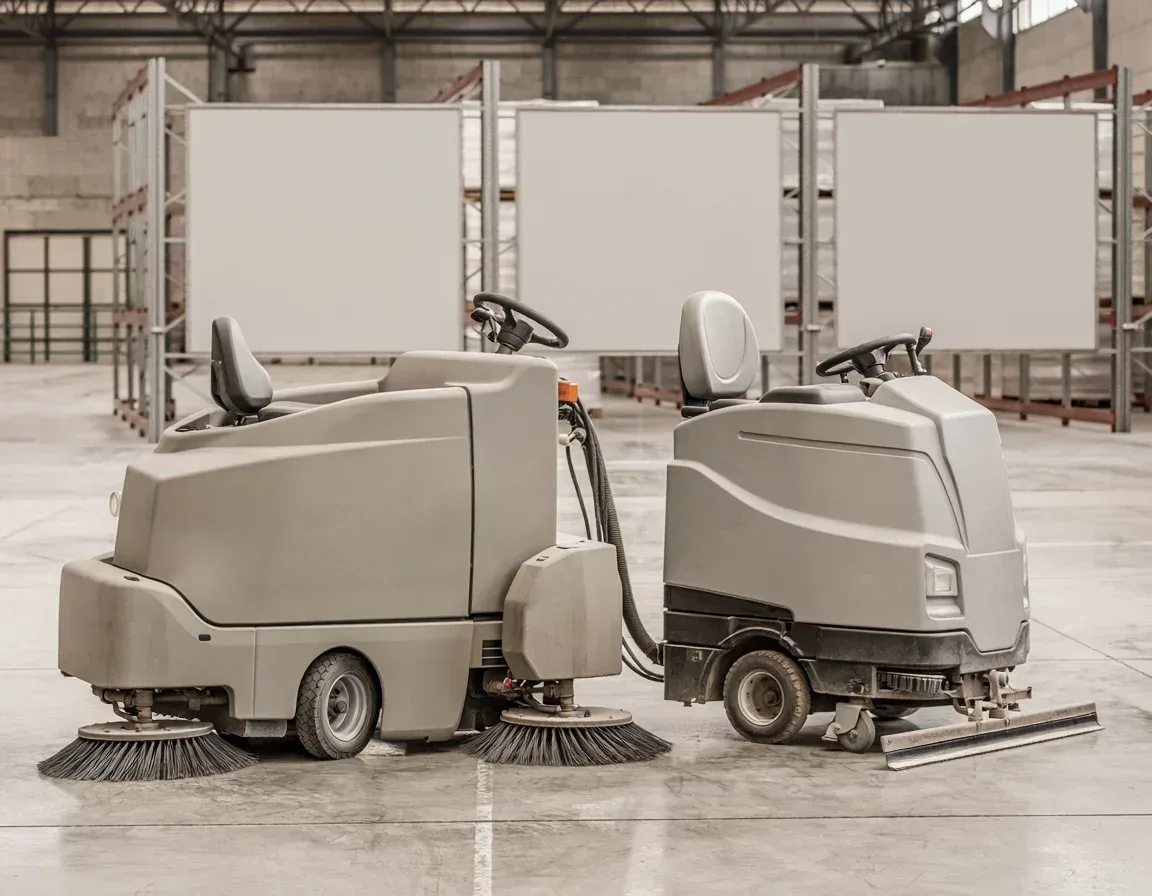
At the core of industrial floor cleaning are two separate machines and two separate tasks. The sweeper collects everything freely on the floor, that is, dust, sand, shavings, and packaging clippings, dry. The floor washing machine dissolves what sticks to the surface, namely rubber marks, dried mud, crushed product residue, and thin oil film, by rubbing it with a cleaner and withdraws dirty water. One cannot do the other's job; the washing machine does not collect splinters, and the sweeping machine does not remove film.
That's why the sequence is important. On a floor washed without sweeping, dust and sand turn into mud with water, work like sandpaper under the brush, clog the machine's filter and scraper blade, and when dry, stick back as a gray layer. Stretch film pieces clog the suction hose, stopping the machine in the middle of the aisle. The most cost-effective step in cleaning the warehouse is one done without water touching the floor.
Sweeping is done with walking or mounted machines that hold dust in its filter. Dry brush broom and blowing with compressed air do not collect dust but lift it into the air; the dust that rises eventually descends onto the products, shelves, and machines. Shelf bottoms, column bottoms, and wall edges are places where machines cannot enter; if these areas are not regularly removed with an industrial vacuum, the accumulated dust returns to the corridor with every air movement.
There is a third type of dirt outside of both machines: oil that has penetrated the pores of the concrete, hydraulic fluid, and rust. These do not come out with a few seconds of passing by the machine; they require separate intervention; we will also address them below.
Floor Washing Machine: Which Type, In What Field?
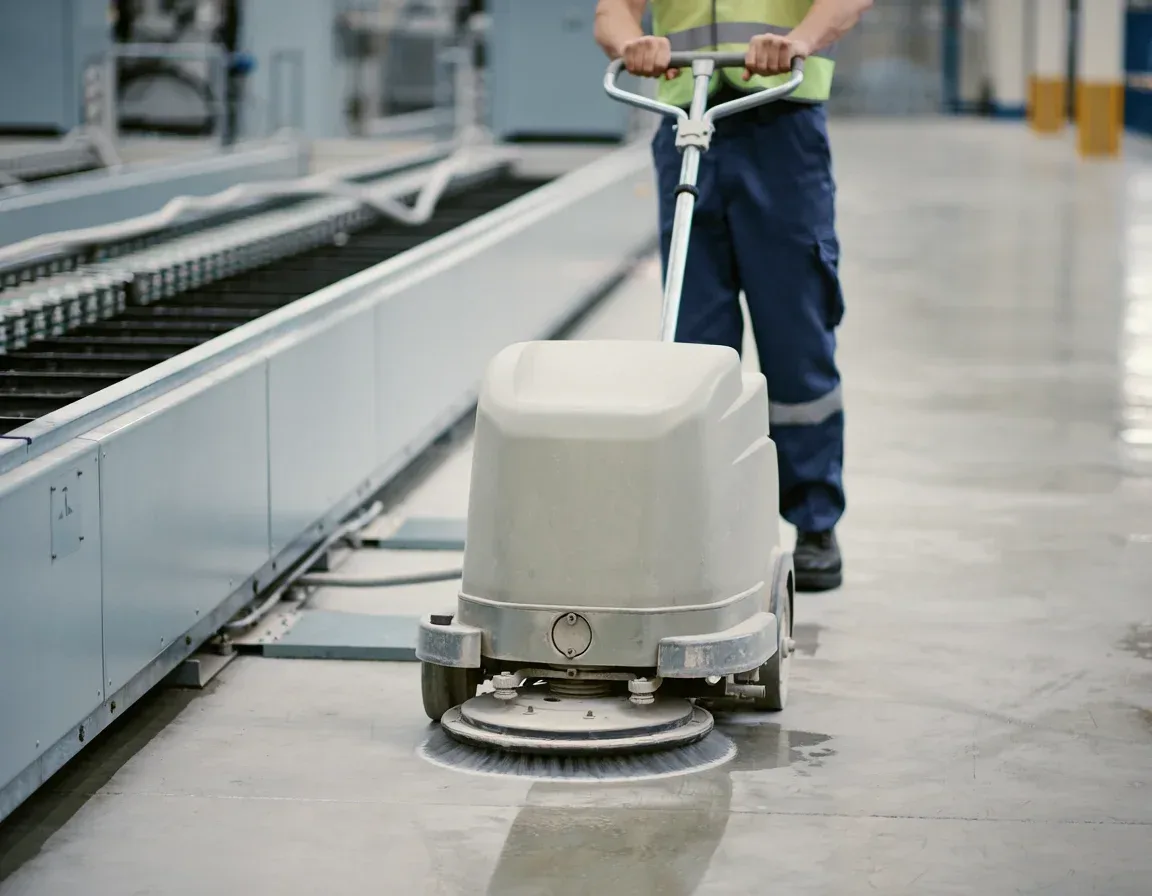
The floor washing machine performs three tasks in a single pass: it delivers the cleaner to the floor, scrubs with a brush or pad, and collects dirty water with the scraper rubber behind it and draws it into its tank. The difference from a mop and hose is that it does not leave dirty water on the floor. The main types selected according to the size and obstacles of the area are:
- Running machines: These machines, which the operator walks behind, are effective in narrow shelf spaces, around production lines, and in sections of several hundred square meters; however, they remain slow in large halls.
- Mounted machines: The wide brush machines the operator sits on can clean a much larger area in the same time in unobstructed areas such as main aisles and open stock areas.
- Roller brush machines: The horizontally rotating roller brush also throws small solid parts into its chamber and moves into grooves like joints and grooves more easily than the disc brush; it is preferred on rough surfaces.
- Machines that combine sweeping and washing: Large machines that sweep at the front and wash at the rear reduce two tasks to a single pass over very large areas, but they do not fully replace a separate front sweeper under heavy dust loads.
Battery-powered machines are preferred in enclosed spaces; the exhaust of internal combustion engine equipment poses a serious health risk in a closed warehouse.
Brush or pad?
What to install under the machine is chosen based on the texture of the floor and the type of dirt. An incorrect choice either does not clean or corrodes the floor. The general rule can be summarized as follows:
- Brush on rough and worn concrete: On textured, slightly rough, or densely grouted surfaces, bristles sink into the recesses; on these surfaces, the pad cannot reach the bottom and breaks down quickly.
- Soft pad on flat and firm concrete: On polished, hardened, or polished flat floors, soft pads or soft-bristled brushes remove the dirt film without scratching the surface for daily cleaning.
- Abrasive tools only for deep cleaning: Sandpaper embedded bristles and removal pads remove stubborn buildup but remove something from the surface with every use; it is not left stuck in daily work.
Since the hardness of pad colors can vary depending on the manufacturer, you should look at the product's technical information rather than the color. In uncertain situations, starting with the softest option and seeing the result in a small area is the right approach.
Detergent, Dosage, and pH: Does Not Remove Excess
The right product for daily and weekly cleaning is a near-neutral or slightly alkaline floor cleaner. These products dissolve dust and light dirt film and do not damage concrete. In areas where oil is constantly poured, stronger alkaline degreasers are used; these are applied not everywhere or every day, but in the required area and in the ratio provided by the manufacturer, then rinsed with clean water.
Acidic products are a sneaky mistake in industrial concrete cleaning. Concrete is a material that stands together with calcium compounds in cement, and acid dissolves these compounds. A floor washed with lime remover or spirit salt appears exposed and cleaned on the first day; in fact, what happens is a thin layer dissolving from the surface. As this is repeated, the surface becomes rougher, pores open, and the floor starts to dust more and get dirty faster than before.
A common belief about dosage is that excess detergent cleans better. However, excess product that cannot be collected from the floor leaves a sticky film when dried; this film traps dust, makes the wheel mark more pronounced, and becomes slippery when wet. A dull surface often thought to be dirty is actually detergent-based. The product should be prepared according to the machine's dosage settings or a scaled container, and no eye spills. The team working with chemicals needs to know these rules:
- Products are not mixed together: When bleach combines with acidic or ammonia-containing products, it releases toxic gases; if there is any residue from the previous product in the tank, the machine is rinsed before adding the new product.
- The label and safety data sheet are read: The dilution rate, waiting time, and required protective equipment vary from product to product; this information must be found in writing at the location where the machine is parked.
- Gloves, goggles, and ventilation: When transferring concentrated products, chemical-resistant gloves and goggles are used, and ventilation is kept open when working with degreaser in enclosed spaces.
Oil, Hydraulic Leakage, and Forklift Tire Trail
Entering the oil stain directly with the machine spreads it along the aisle instead of cleaning it; the brush and scraper carry the rubber oil, leaving a thin and slippery strip behind. The correct procedure is to first intervene by hand. Fresh spills are collected with absorbent granules or absorbent pads, alkaline degreaser is applied to the remaining film, the product is left to work for a few minutes, scrubbed with a stiff brush, and after the dirty liquid is collected, the machine is passed. Oil that has waited for months and settled into the pores only lightens with this method; scrubbing and other methods applied to deep stains Oil, rust, and paint stains on concrete floors in the text We explained.
Cleaning without finding the source of the leak is a never-ending task. A drop of oil appearing at the same spot every day indicates a forklift or machine that needs maintenance; the cleaning team reporting these spots to the maintenance team is the cheapest preventive measure possible for the floor.
The black stripes formed at the turning and braking points of forklifts are often rubber that breaks off the wheels. Since it stands on the surface, the alkaline cleaner comes off with a short wait and brush; a medium-hard pad on flat ground speeds up the work. However, not every black strip is dirt. If the concrete under the strip is rough or pitted, what is seen is wear and does not improve with cleaning; this separation and the effect of the wheels on the ground In the article on forklift traffic and ground wear we addressed it.
Cleaning Mistakes That Wear Down the Floor
Some floors wear out not from traffic but from repeated incorrect cleaning over the years. Common mistakes we encounter in machine cleaning and explorations are as follows:
- Leaving the abrasive tool continuously attached: Removal pads and sanding brushes designed for deep cleaning sand the surface with daily use; over time, they distinctly separate from the surroundings of traffic roads.
- Trying to finish with a single and quick pass: When the machine is driven quickly, the cleaner has no time to dissolve the dirt; when no result is achieved, the dose and pad hardness are increased, whereas what is needed is to slow down or double pass.
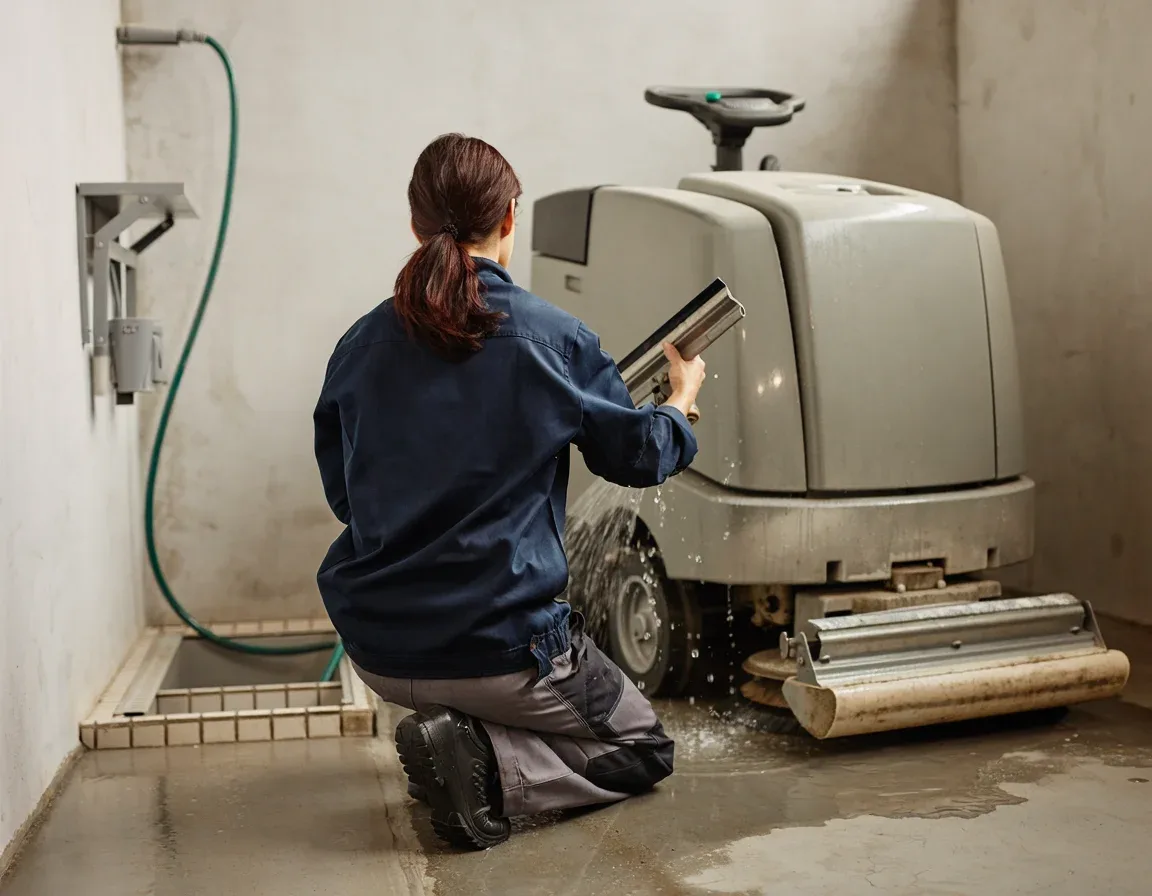
- Leaving the scraper tire and tank unmaintained: Worn or notched tires leave dirty water strips on the floor, and the unwashed tank smells; the dried dirty water returns to the floor as a thin film of dirt.
- Trying to open the floor with acidic products: Descalers and similar products dissolve the surface of the concrete to give it a light color; each application leaves the floor a bit rougher, more porous, and prone to dust.
- Washing indoors with a hose and pressurized water: Plenty of water fills joints and cracks, rusts the rack legs, and forces joint filling; a narrow-angled end held too close can tear off the weak surface.
- Sprinkle the wood chips on top of the oil: The wood chips absorb the oil, but when not collected, they are crushed under the wheels, plastered onto the floor as an oily putty, and turn into flammable waste.
The common feature of these mistakes is that they seem to work on the first day. Damage accumulates over months and is often attributed to traffic or the quality of the concrete.
Method and Frequency by Field Type

Not every part of a facility gets dirty at the same rate; entering every place with the same frequency both wastes effort and leaves the main contaminated areas incomplete. The table below is a starting order; frequencies are adjusted according to the work done, number of shifts, and season.
| Alan | Method | Starting frequency | Points to consider |
|---|---|---|---|
| Main corridor and turning points | Sweeping, then machine washing the rider | Vacuuming daily, washing several times a week | Tire tracks are removed without accumulating |
| Shelf aisles | Walking or narrow-body machine | Vacuuming daily, washing once a week | The bottom of the shelf legs is removed by hand |
| Loading doors and in front of the ramp | Frequent sweeping, roller brush washing | Sweeping every shift, washing several times a week | Sand and rainwater coming from outside |
| Production line surroundings | Pretreatment of stains, running machine | At the end of each shift | Oil and wood chips are first collected by hand |
| Battery charging area | Instant response to spillage, separate equipment | Daily inspection | Dissolves acid concrete; suitable neutralizing and protective equipment |
| Stock and intermediate storage areas | Sweeping machine, periodic washing | Sweeping once a week, washing once a month | As the pallet clears up, the bottom is swept |
| Open field and vehicle platform | Sweeping, controlled pressurized water when needed | Weekly sweeping, seasonal washing | Oily water should not go into the rain grill |
A practical way to adjust the frequency is to note the vacuuming tank full and the concentration of the collected dirty water area by area over a month. The frequency is increased in areas where the tank and tank are filled with dirt each time, and the area where almost clean water is collected is reduced.
Shift Plan: Placing Cleaning Amid Traffic
Cleaning is scheduled during times of least traffic: shift changes, meal breaks, or times when shipments stop. The machine is operated from the far end of the corridor toward the door and always along the same route so that the wet lane is not crossed again. To prevent the forklift and cleaning machine from meeting in the same corridor, the route is shared in advance with the shift supervisor. The washed concrete is slippery, especially when coated with oil or detergent film; a machine with a scraper rubber leaves the floor almost dry, yet the corridor is marked until it is completely dry.
The season is also included in the plan along the Mediterranean coast. During the long and dry summer months, dust entering through open doors increases the frequency of sweeping; during heavy winter days, the front of the loading gates fill with water and mud carried by vehicles, requiring additional tours during the day.
Where Does Dirty Water Go? Wastewater and Tank Sludge
The dirty water collected by the machine is not ordinary water; it contains oil, detergent, metal, and rubber dust. This water is not poured onto the rainwater grate, soil, or open field. It is discharged into the facility's wastewater line, if available, passing through an oil separator and from a designated point. Separate rules may be established for wastewater in organized industrial zones in Antalya, Mersin, and Adana; guidance from the facility's environmental officer is taken as the basis for this.
The sludge accumulated at the bottom of the tank is not discharged into the drain along with the water; it is filtered and separated as solid waste. The emptying point being close to the machine's parking and charging area makes it easier to perform this task without skipping at the end of each shift.
Where Cleanliness Is Not Enough: Signs Indicating Renewal
There are floors that cannot be tidied up even with the right machine, the right product, and a regular plan. The cleaning team sees the signs before anyone else: dirty water fills with cement-colored gray mud every time, the corridor swept in the evening is dusty in the morning even though the doors remain closed, traffic roads are light-colored and rough, and after the machine passes, the floor briefly looks clean and becomes dull again. These are signs of worn surfaces, not dirt. In this case, what is done is not cleaning but gathering the concrete a little more every day, and increasing frequency only accelerates wear.
At this point, the necessary task is to renew the surface. In this process, which craftsmen call grinding, the weakened top layer of the floor is removed with diamond-tipped machines, the opened solid surface is tightened with a hardener, and a dust-free, easily cleanable floor is obtained. What does the renovation change in the storage Warehouse and logistics center floors in the article, how work is placed in shifts in a working facility Concrete grinding without stopping production at the factory in the text You can find them.
If you're unsure whether your floor will be restored with cleaning or renovation, check the size of the area, the work done, and a few photos service request form you can convey it through the system; during the initial evaluation, a few changes to the cleaning routine often also emerge.
Changing Results in the Hands of the Operator

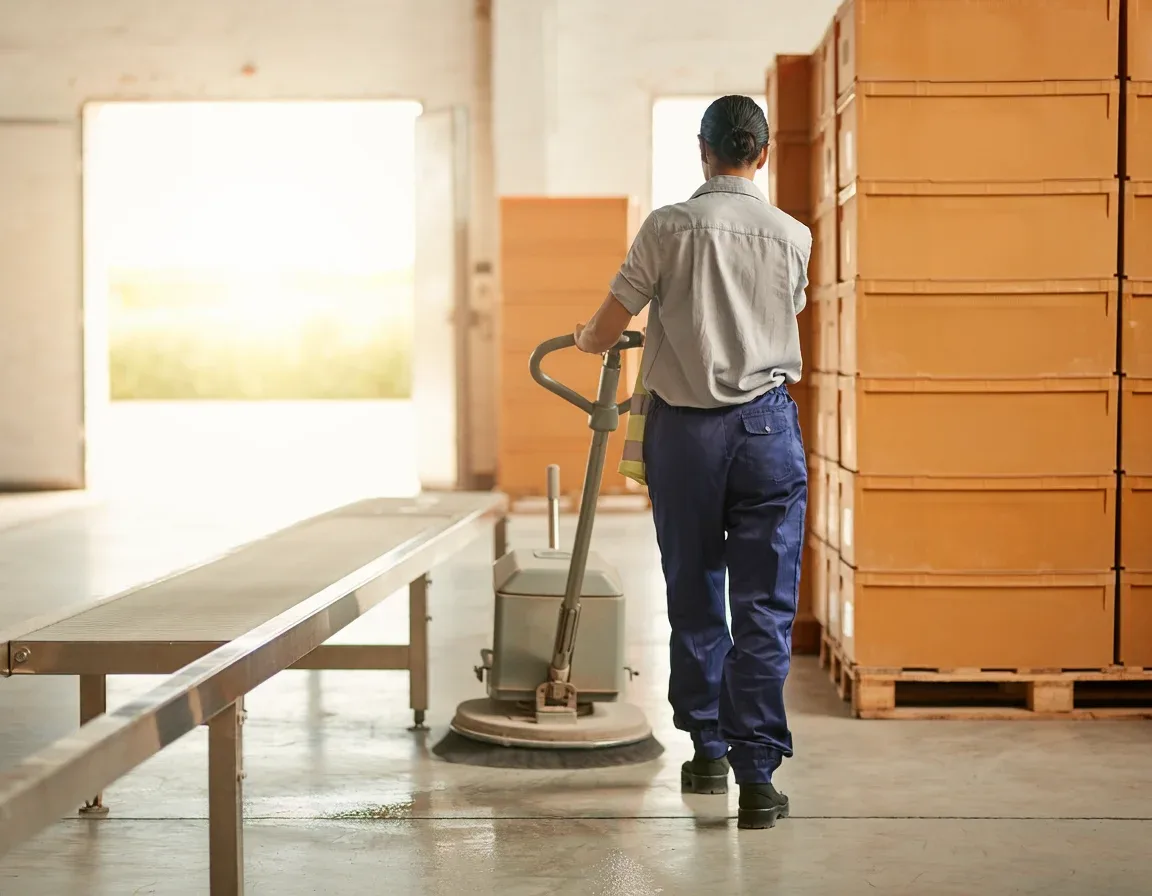
The same machine leaves two different surfaces in the hands of two different operators. A few habits make the difference: driving by overlapping the strips slightly, slowing down during turns so the scraper doesn't leave water behind, and finishing the job manually instead of forcing the machine around a corner.
What is done after the job is done is as important as the drive. The dirty water tank is emptied and rinsed, the brush and scraper rubber are washed, the filter is cleaned, and the battery is connected to the charger. This routine should be kept in the machine's parking lot and shown to the new operator at the start of the work.
Floor Cleaning in Citrus and Fresh Fruit Packaging

In citrus and fresh fruit packaging plants around Mersin and Adana, what pollutes the ground is not dust but crushed product. Fruit juice is both sticky and acidic; when it sits on the ground, it slowly dissolves the surface of the concrete, and that area gradually becomes rough over time.
The rule in these facilities is to remove the crushed product without waiting for the end of the shift. First, dry items are collected, then the machine is run through a neutral or mild alkaline cleaner, and the floor is thoroughly rinsed. The suitability of the products to be used for food business is determined together with the facility's food safety officer.
Putting acid, heavy pads, and excess detergent in the machine does not make the floor look clean; it wears it out. If you collect gray mud every time, do not increase the frequency; the problem is no longer cleaning but the surface itself. — Expert Note
Frequently Asked Questions About Factory and Warehouse Floor Cleaning
01Why is it not recommended to hose the warehouse floor?
02Do driverless (autonomous) floor washing machines work in the warehouse?
03Does sprinkling water on the floor to suppress dust work?
04Is it enough to run the machine with only water without detergent?
05Does a floor washing machine damage grouts?
06How to clean the bottom of pallets and shelves?
Related Articles
Warehouse and Logistics Center Floors: Dust-Free Warehouse with Concrete Cleaning, Forklift and Pallet Truck Traffic: Wheel, Joint, and Floor Wear, Concrete Rollover Without Stopping Production at the Factory: Segmentation and Shift Schedule, Concrete Floor Cleaning and Renewal: In Which Situation Is It Necessary?, Oil, Rust, and Paint Stains on Concrete Floors: Method by Stain Type