Forklift and Pallet Truck Traffic: Wheel, Joint, and Floor Wear
In a warehouse or production area, the lifespan of a concrete floor is determined not by the weight of the shelves but by the wheels moving between those shelves throughout the day. Forklifts, reach trucks, and pallet trucks pass through the same lines thousands of times; they rotate at the same point, brake at the same point, and jump over the same joint. The floor quietly endures this repetition in the first years, then a joint edge crumbles and the deterioration begins to spread from there. In this article, we explain in sequence how the wheel loads the concrete, by which mechanism the joint edge breaks, where wear concentrates in the tank, and the precautions that can be taken on both the floor and vehicle sides.
In short: What wears down the floor is less the total weight and more the impact it creates when passing through the joint, driven by the pressure applied by the hard and small wheel into a narrow area. Therefore, the precautionary sequence starts with the joint: the joint is filled with semi-rigid filling, broken edges are reinstalled, then the surface is tightened with a grinder and stiffener. Wheel selection and maintenance, along with traffic regulation, is the other half of this work.
The surface is tired not by weight but by the contact area
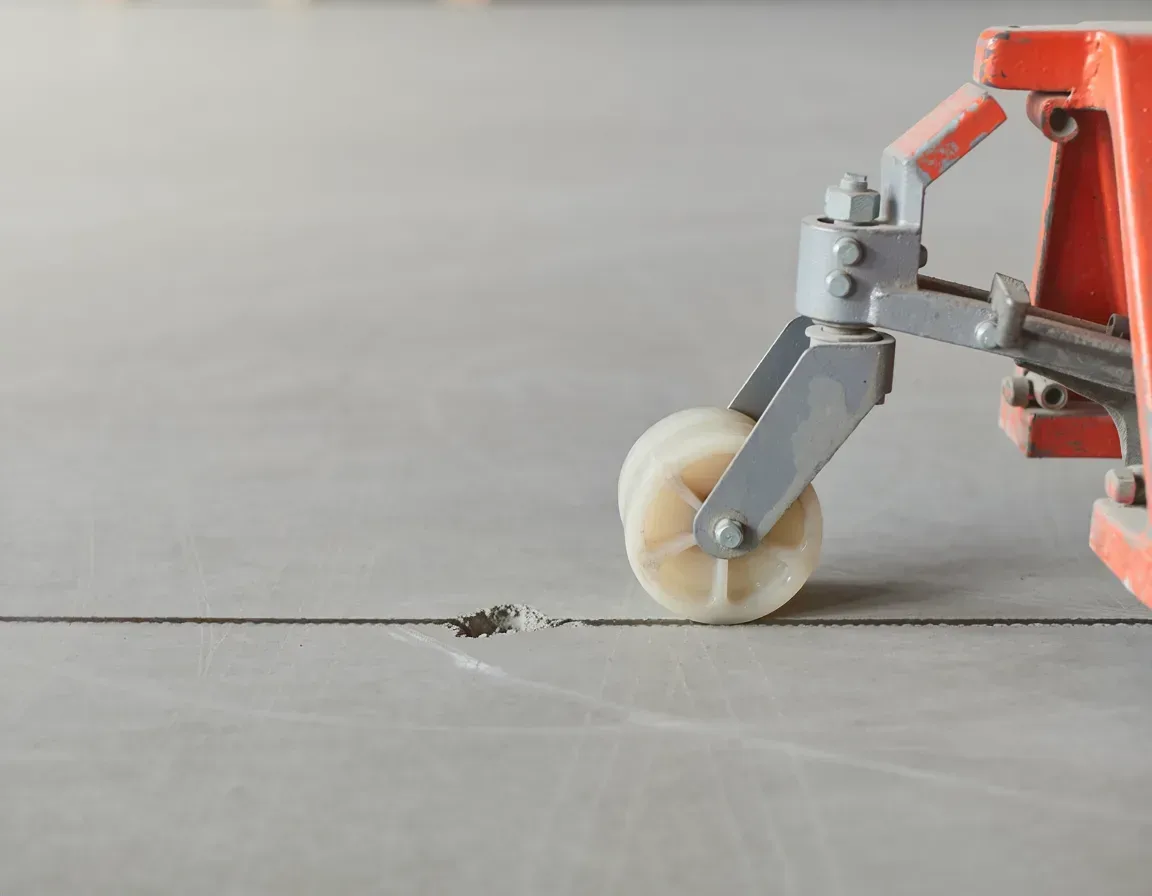
A truck's tire transfers its load to the ground with a wide and flexible surface; the air-pressurized tire is crushed, the contact area expands, and the pressure is distributed. The situation is the opposite with vehicles inside the depot. Most forklifts operating indoors operate with filled or bandage tires, while reach trucks and pallet trucks operate with small-diameter wheels made of hard materials like polyurethane or nylon. These wheels are almost never crushed; the load is loaded into a small area from a palm of a hand.
The situation is even sharper with a pallet truck. The load rollers at the fork end are a few centimeters wide and carry the entire weight of the pallet with these narrow strips. So the pressure the ground feels is not related to the vehicle's total weight but to how many square centimeters that weight reaches. A hand-pallet truck that looks light can leave more marks on a weak surface than a heavy vehicle due to its narrow and hard rollers.
A solid, well-polished, and tight concrete surface can bear this pressure for many years. The problem begins where the surface is weak or continuity is interrupted: a dusty top layer, an unrepaired crack, a loose joint, an old anchor hole. The wheel delivers a small blow to these defects with each pass, and the defect grows slightly with each pass. Why the surface remains weak and how it is tested in the field Why does the concrete floor dust in the article We also addressed it.
By which mechanism is the joint edge broken?
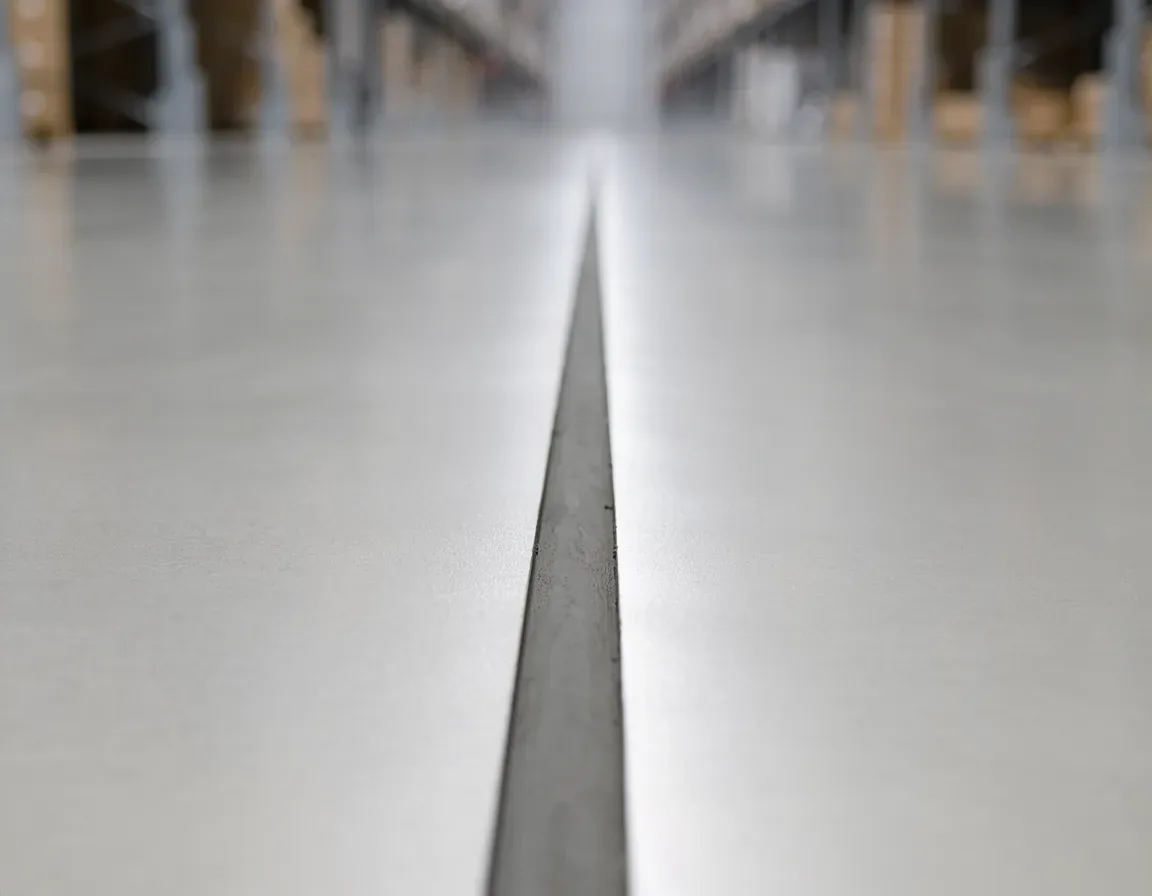
On industrial floors, concrete is cut at regular intervals to prevent random cracking; these control joints collect the concrete's shrinkage along a pre-selected line. As the concrete dries, it shrinks, and over time, the joint becomes a wider crack than on the day it was first cut. In a joint, either hollow or filled with soft mastic, two unsupported, steep and sharp concrete edges remain on either side of the crack.
When a hard wheel reaches this crack, it hangs briefly into the void, then hits the opposite side and rises. All the energy of the impact goes to a few millimeters of concrete corner without support behind it. The corner first cracks capillary, then breaks off in small scales; the crack widens, the wheel falls deeper, and the next impact becomes harder. This self-feeding cycle can start with a few millimeters of fracture and reach a groove palm-width wide. Because the wheel diameter decreases and it hangs deeper into the crack, pallet truck rollers start this cycle earlier than the forklift wheel.
A second factor is the bending of the slab. Since the top surface of the concrete slab dries faster than the underside, the edges may gradually lift up slightly; the bottom of the shield edge loosens. As the wheel passes, the slab edge stretches downward and returns when the wheel passes. This swaying both wears the edge and separates the joint filler from the edge. If you hear a loud knocking sound while passing through the joint, or if you feel the ground shifting when standing beside it, the problem is not only with the surface; a civil engineer's opinion is required to assess the underside of the slab.
You can read the stage of joint margin damage from the following signs:
- Capillary edge cracking: A fine line running a few millimeters inward from the edge parallel to the joint signals a break, and at this stage, damage can only be stopped with filling.
- Sawtooth appearance: Irregular small breaks have formed along the edge; the wheel now shakes noticeably with every pass, and the fill alone is not enough.
- Corrugated joint: The crack has exceeded the width of a finger, filled with crumbs and dust; the edge needs to be cut and rebuilt with repair mortar.
- Height difference: A step has formed between the two sides of the joint; this suggests more than surface damage that suggests the plate is sitting or bent.
Map of Wear in the Tank: Turning, Braking, and Waiting Points
Wear is not distributed evenly across the tank. In long corridors where the vehicle moves straight and at a steady speed, the ground is least fatigued; because the wheel only rolls. Wear accumulates where the wheel slips instead of rolling or rotates around its own axis.
At turns at the end of the aisle, the wheel rubs sideways and scrapes off a thin layer from the surface. When loading loads in front of the rack, the operator often turns the vehicle where it stopped; the steering wheel grinds a few square centimeters of ground like sand. In front of the loading doors, vehicles both brake and turn, and go up and down the metal edge of the ramp bridge. At charging stations and shift change points, vehicles always park in the same place; at these points, oil and acid droplets are also added to the wear.
Therefore, when evaluating a warehouse, the ground should be read not in square meters but as a traffic map. During the inspection, we first mark the roads the vehicles follow, the places they turn, and the stopping points; repair and erasure priority is determined according to this map. Other aspects of warehouse floors such as between shelves, in front of doors, and flat Warehouse and logistics center floors in the article We explained.
Wheel Track: Dirt or Wear?
Not all marks seen on traffic lines are damage, and separating the two changes the task at hand. Black or dark gray stripes are often rubber and polyurethane residues that pass from the wheel to the floor; they stay on the surface and are removed with a suitable cleaner and brush machine. Light-colored wheels that do not leave marks reduce this problem but do not eliminate it completely.
The wear mark is inside the surface. The traffic line appears lighter in color, rougher, and matte compared to its surroundings; fine aggregate particles have been exposed, and a fine dust continuously accumulates along the line. If gray dust appears on your finger when you rub your hand, it means the top layer of the surface is being ground. This dust is not just a cleaning problem: concrete dust contains fine quartz grains, settles on the product and packaging on shelves, and contaminates vehicle filters and sensors.
A third type of mark is scratching. Friction of the fork tip against the ground, nails hanging from under the pallet, a screw embedded in the wheel, or metal shavings leave fine and long lines on the floor. These spoil the appearance more than weaken the surface; but these are the most noticeable marks on a hardened and polished floor.
Battery Charging Area: What Does Acid Do to Concrete?
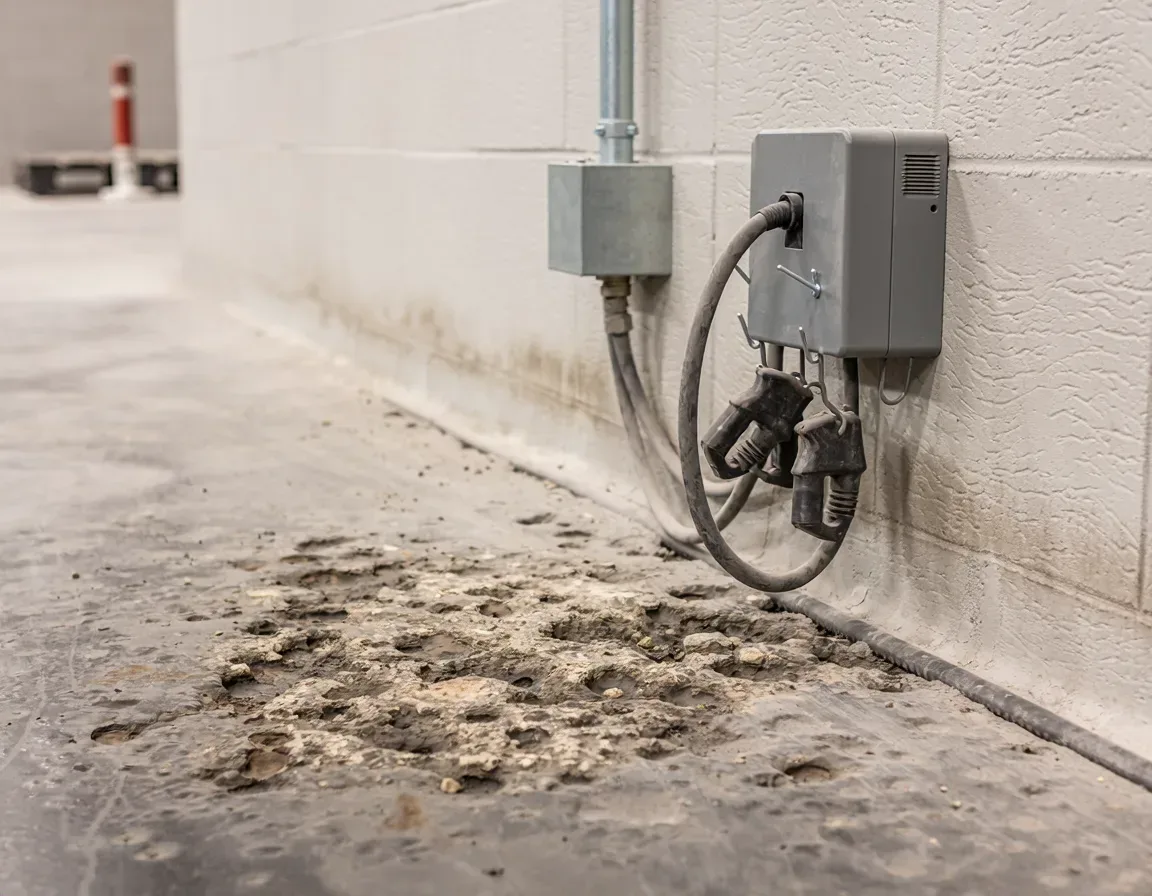
Areas where lead-acid battery-powered vehicles are charged and water is replenished are the chemically most aggressive corners of the tank. The battery electrolyte is dilute sulfuric acid; the overflowing or dripping electrolyte reacts with the cement paste, which binds concrete, and dissolves it. The surface first roughens, then softens; aggregate grains are exposed and begin to break under the wheel. The sulfate that comes with the acid also feeds reactions inside the concrete that lead to volume increase; the damage may not remain only on the surface.
A common mistake here is to assume that polished concrete or hardener will provide protection against acid. Silicate-based hardener tightens the surface and strengthens it against wear, but does not change the concrete's ability to react with acid. The effect of acid on lime and cement-based surfaces in the article on cleaning chemistry We explained it through the example of stone; the same chemistry applies to concrete. The right solution for the charging area is to treat this area as a separate floor: a resin coating with documented acid resistance, a drip tray under the battery, and an intervention kit containing a neutralizer and absorbent for spills.
In facilities that switch to lithium-battery vehicles, the problem of electrolyte dripping largely disappears; but the acid-soaked concrete in the old charging area remains in place. Before wiping this area, the weakened layer should be removed back to solid concrete, and the remaining acid residue on the surface should be neutralized and washed; otherwise, the repair mortar or coating applied on it will not adhere. Hydraulic oil and gear oil drops are a separate cleaning issue and must be removed before wiping; diamonds are plastered on the oily surface, and hardener does not penetrate concrete.
Order of Measures: First joints, then surface

Order is important when improving a floor under forklift traffic; because surface work done without repairing joint damage quickly deteriorates from the joint line. The first step is to clean the joints and fill them with a semi-rigid filler. Semi-rigid filler is usually a polyurea- or epoxy-based material that cures to a hard rubber consistency. Its purpose is not to make the joint waterproof but to carry the load under the wheel without collapsing and to support the two concrete edges from the side. Soft, elastic sealants like those used on window edges cannot do this; they are crushed under the wheel and leave the edge unsupported.
There are three conditions for the fill to work. The inside of the joint must be free of old filling, dust, and oil; the fill should be placed not only as a thin shell on top but along the depth of the cut; after curing, it should be shaved flush with the surface. The infill wheel that remains pitted again drops it, while the raised fill is removed with a wheel. Timing is also important: while the concrete is still noticeably shrinking, the fill separates from the edge at the filled joint. Therefore, on new floors, filling is done as late as possible, and the separated areas are reconsidered at the end of the first year.
In joints with broken edges, the edge must be reinstalled before filling. The broken area is cut as a straight-sided channel, filled with repair mortar, and the joint is reopened and filled through this mortar. The details of this work, types of mortar, and common mistakes in the article on potholes, breaks, and joint edge repairs We explained.
After joints and repairs are completed, the surface is next. The rough grind takes the weak and dusty top layer and aligns the repairs with the ground. Then, the silicate-based hardener reacts in the pores of the concrete, tightening the surface; the surface wiped in fine steps not only produces less dust but also leaves fewer rough surfaces to hold the wheel. What the hardener does and cannot do in concrete In the concrete hardener article we explained. Very high gloss is not required in traffic areas; a satin finish both makes cleaning easier and behaves more predictably on wet surfaces.
The table below matches common symptoms in the field with their possible cause and the first task to be done:
| Symptom | Possible cause | The first thing to do |
|---|---|---|
| Vibration and sound when passing through the joint | Empty or collapsed joint filling | Cleaning the joint and filling it with semi-rigid filling |
| Broken edge along the joint | Wheel impact to the unsupported edge | Cutting the edge and reinstalling it with repair mortar |
| Gray powder and light color on the traffic line | Grinding of the weak top layer | Surface tightening with smoothing and hardener |
| Pitting at the turning point | In-place turn, steering friction | Regional repair, followed by expansion of the maneuvering area |
| Rough, soft surface in the charging area | Dissolution of cement paste by battery acid | Removal of the weak layer, acid-resistant coating |
| Black stripe, solid surface | Wheel debris | Cleaning with alkaline cleaner and brush machine |
| Elevation difference on both sides of the joint | Plate settling or curling | Engineer evaluation, underplate treatment if necessary |
Wheel Selection and Vehicle Maintenance: The Other Half of the Ground
No matter how well the ground is prepared, the condition of the wheel running on it determines the outcome. The wheel material is a balancing act: a hard wheel shows less rolling resistance and tires the battery less but applies higher pressure to the ground and does not dampen the impact; a soft wheel is gentler on the ground but wears down faster and heats up under heavy loads. The decision is determined by the vehicle manufacturer's load and speed limits; from the ground side, the wider and less hard wheel among options that can carry the same load tires the ground less.
Maintenance issues that directly affect the vehicle side of the ground are as follows:
- Flattened wheel: The flat area formed on the wheel that has been stuck under load for a long time or locks and rubs against the ground like a hammer every turn.
- Embedded foreign body: Screws, metal shavings, or gravel pieces stuck in the wheel scratch the floor from end to end; wheels should be visually inspected at the start of the shift.
- Shredded coating: The wheel, which begins to separate from the hub with the polyurethane coating, rotates unevenly, putting impact loads both on the ground and on the vehicle's bearings.
- Fork height: Fork tips carried by friction on the ground cause long scratches on the surface; keeping the fork sufficiently elevated from the ground during transport is subject to operator training.
- Crumbs on the floor: Pallet chips, nails, cling film, and gravel act as abrasive between the wheel and the floor; regular sweeping directly slows down wear.
Regulating traffic is also a precaution. Route lines drawn on the ground gather vehicles in a narrow line; this is necessary for safety but also concentrates wear on the same line. Keeping turning areas wide, creating a layout that allows turning by drawing an arc instead of turning in place, and occasionally shifting waiting points distribute the load. Separating pedestrian and vehicle paths by a line is fundamental both for occupational safety and for knowing which area of the ground will bear which load.
The Cost of Damaged Ground: Vehicle, Product, and Operator
A broken joint is not just a problem with the floor. Tank vehicles without suspension transmit every jolt directly to the chassis, pole, and operator. Wheel coverings break down faster, and bearing and axle failures become more frequent; a shortened wheel change interval in maintenance records is often the first written sign that the ground is deteriorating.
The impact is more visible on the load side. When passing through the joint, the pallets shake and slip, damaging fragile products like bottles and jars. A small jolt received while the pole is above in high stacking turns into a large swing at the fork tip; the operator has to slow down in these areas, and the number of pallets transported in the same shift decreases. Thus, ground degradation goes unnoticed and turns into a loss of efficiency.
From the operator's perspective, constant vibration and impact are occupational health issues; they are associated with lumbar and neck complaints, and their evaluation is the responsibility of the workplace's occupational health and safety unit. The possibility that a pit or broken joint in the ground could cause a vehicle to tip over, drop a load, or trip a pedestrian should also be included in the risk assessment of the same unit.
Maintenance Routine: Catching Minor Damage While Small
The least costly repair on the ground under forklift traffic is early repair; because joint damage does not stop on its own. It is sufficient to walk the main routes once a month to inspect joints, turning points, and door openings, and mark the filling that has started to break and the cracks in capillary edges. If the marked points are accumulated and repaired collectively once or twice a year, both cost and work downtime remain limited.
The goal of daily cleaning is to reduce abrasive crumbs on the floor. If a sweeper or rider-mounted floor washing machine is used, the choice of brush and pad should be suitable for the surface, and strong acidic products should be avoided; the logic of choosing pads and chemicals in the machine In the floor washing machine text We explained. Oil and battery fluid spills should be taken without delay, and it should be written who will intervene in each spill.
If a joint break, dust, or pitting has started on your floor, a layout plan showing the routes and a few close-up photos service request form You can reach us through this method. During the inspection, we create a traffic map together, determine which joint will be filled, which edge will be rebuilt, and which part of the surface will be ground zone by zone.
Ramp Bridge and Door Threshold: The Hardest Blow to the Warehouse

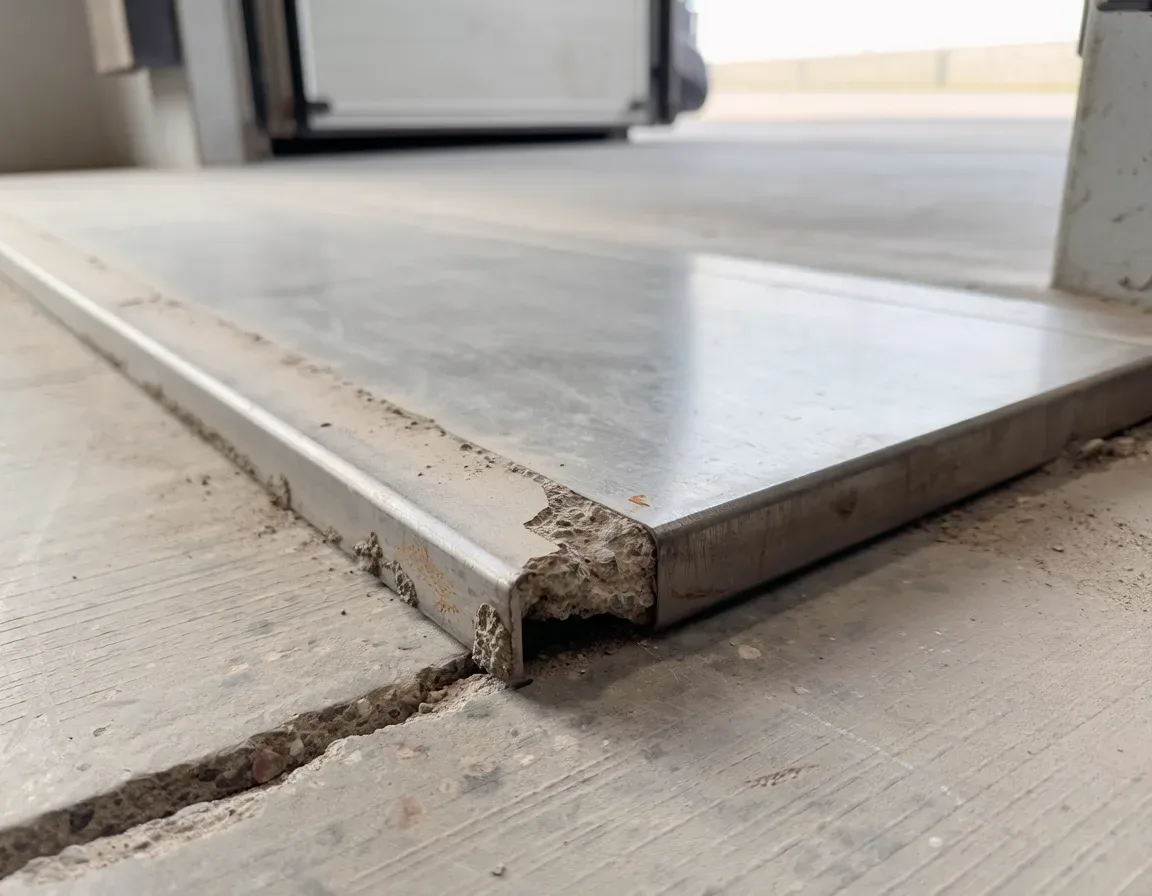
The passage between the ramp bridge at the loading gate and the concrete is the hardest impact point in the tank. The vehicle descends from the metal bridge to the concrete; the fill between the corner bar around the bridge pit and the concrete gradually loosen and the edge crumbles.
Surface cleaning alone is not the solution in this area. The loose concrete around the angle is removed, the edge is rebuilt with high-strength repair mortar, and the transition is leveled. The door area is also where rain is carried inside; here, we leave a texture that holds well at the bright finish site.
How did we handle joints in a distribution warehouse?

In a distribution warehouse where pallet trucks shake at every joint in the aisles between shelves, we started from the joints, not the surface. First, we walked through all the joints into three groups: those with only the filling, those with broken edges, and those with a level difference.
In the first group, we removed the old fill and applied semi-rigid fill; in the second group, we cut the edges and rebuilt it with repair mortar; and left the third group to engineer evaluation. After these cleaning and hardening, the corridor was done outside the corridor and shift; the warehouse never closed completely for a single day.
Slowly pass over the joint with an empty pallet truck: if your hand is shaking, that joint is breaking a little more every day and filling should not wait for the surface to be wiped off. — Expert Note
Frequently Asked Questions About Forklift Traffic and Floor Wear
01When can vehicles pass after joint filler is done?
02Can grout and surface work be done without emptying the shelves?
03Does a wheel track remain on a floor where hardener is applied?
04Can a filled joint be reopened?
05Does coating the floor with epoxy solve forklift wear?
06Does dust contaminate products during operation?
Related Articles
Pit, Breakage, and Joint Edge Repair on Concrete Floors, Warehouse and Logistics Center Floors: Dust-Free Warehouse with Concrete Cleaning, What is a Concrete Hardening (Densifier)? Difference Between Lithium, Sodium, and Potassium Silicate, Concrete Rollover Without Stopping Production at the Factory: Segmentation and Shift Schedule, Why Does a Concrete Floor Dust Out? Causes and Diagnosis of Surface Weakness