Concrete Rollover Without Stopping Production at the Factory: Segmentation and Shift Schedule
When you tell the factory manager that the floor needs to be renewed, their first question is not how long it will take, but whether production will stop. And they are right: the cost of a line stopping for one day is often more than the entire groundwork itself. The good news is that concrete removal is inherently a work that can be broken into parts; the bad news is that this partition does not happen spontaneously. In a working factory, the success of the floor work is determined not by the machine's power or the quality of the diamond, but by how well the work is integrated into the production flow. In this article, we explain how the area is divided into zones, which work fits into which time window, machine environments, dust and oil issues, occupational safety coordination, and the reopening of the area for use.
In short: The way to renew the floor without stopping production is to divide the area into zones according to the production flow and finish each area from start to finish in the window where it can be closed. Small areas are scheduled for shift breaks, an entire section for the weekend, and machine surroundings and main corridors for planned maintenance stoppages. Pre-cleaning the oil, limiting dust with curtains and suction, and making a joint plan with the factory's occupational safety unit are unchanging conditions of the job.
First Question: On what ground does production flow?
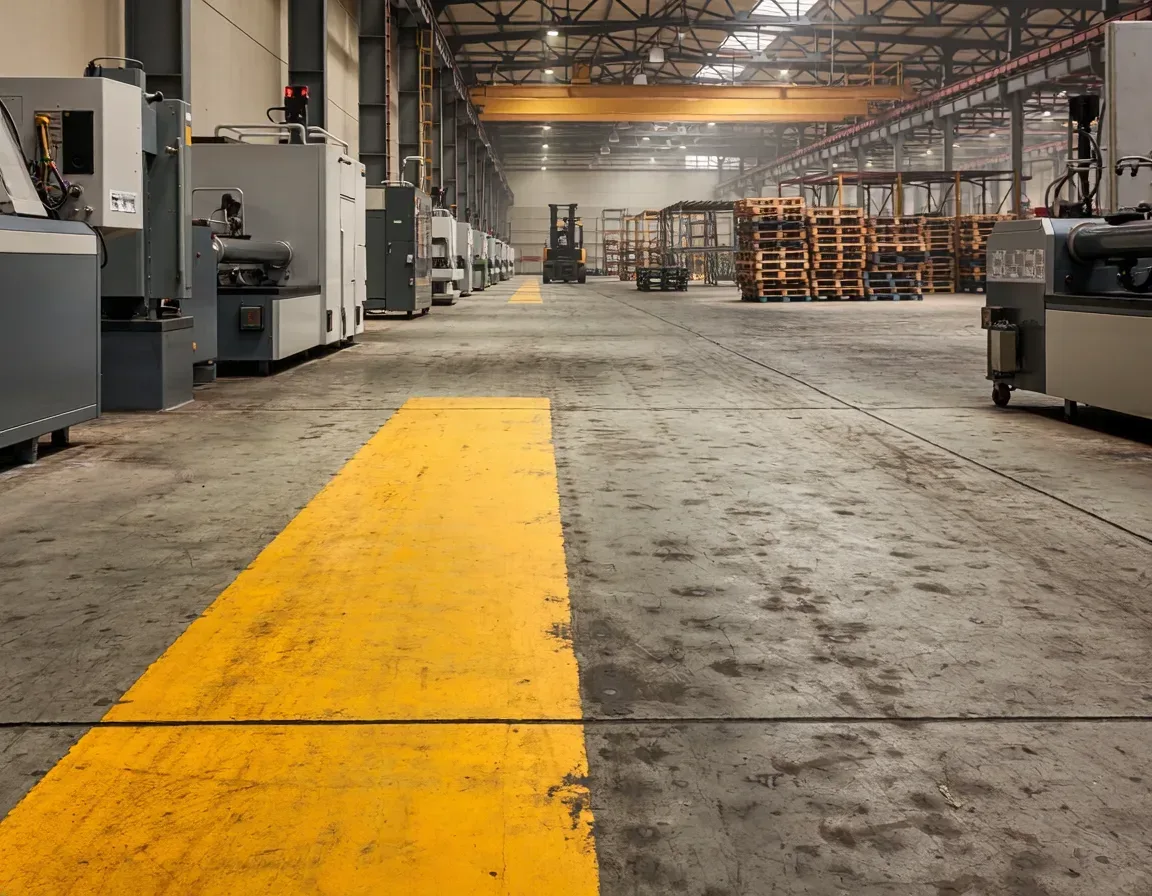
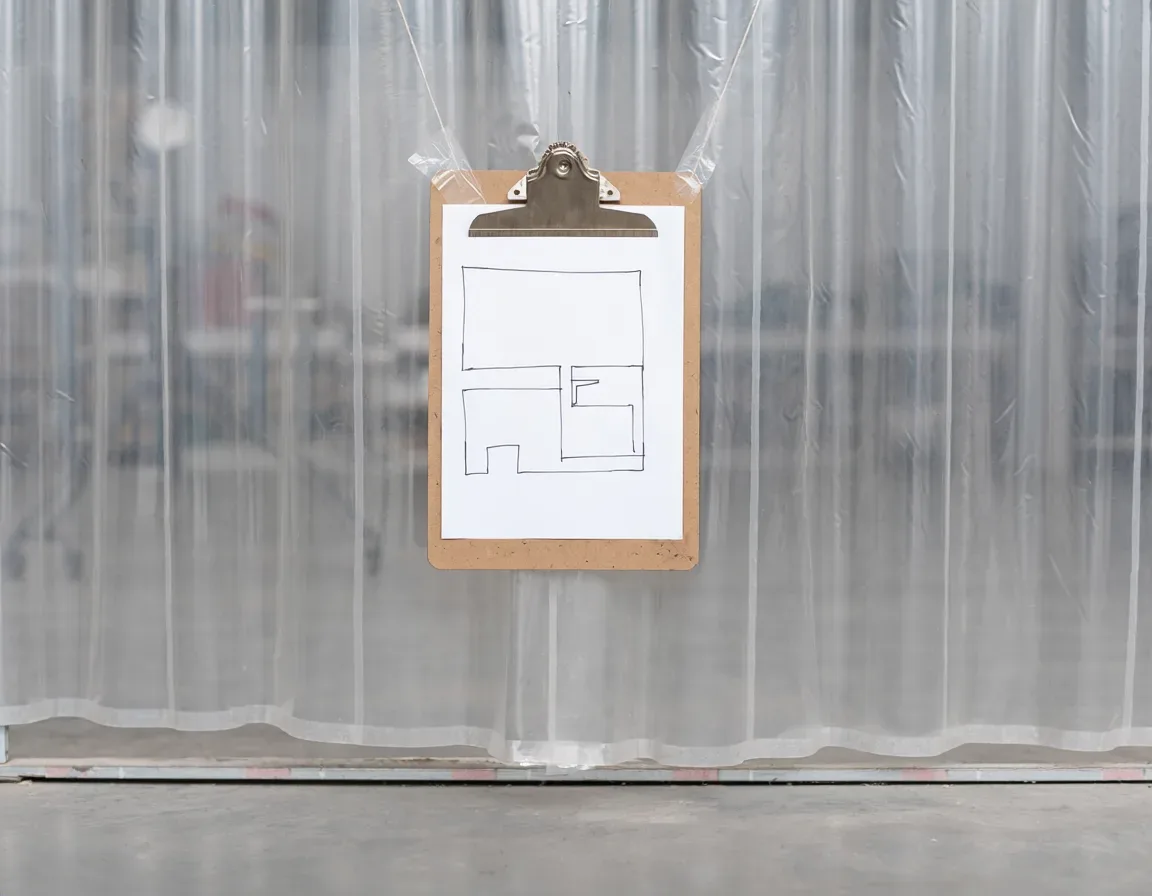
We begin exploration not by looking at the ground but by observing production. A ground plan made without learning where the raw material enters, by which route it is transported to the line, where the semi-finished product waits, and through which door the finished product exits, remains on paper. When this flow is drawn on the settlement plan, it is seen that the ground consists of three types of areas: the lines where production continues uninterrupted, the paths through which materials and people pass, and the relatively free spaces in between.
Each has different closure conditions. Free areas, i.e., intermediate stock zones, unused corners, and the front of the maintenance workshop, can be separated even during the day. When roads are closed, a different route must be shown for the material. Inside the lines are places where work can only be done when the line is stopped. For this reason, we would like the maintenance supervisor, occupational safety expert, and internal logistics manager to be present alongside the production manager at the inspection meeting; each knows a different constraint of the plan.
At the same meeting, the factory's schedule is also brought to the table. The shift schedule, whether work is done on weekends, during which period of the year maintenance stops are performed, and in which months order volume increases. The ground plan is a work schedule placed within the gaps of this calendar.
Dividing the Field into Zones
A region is a part of space that can be finished from start to finish in a time window and can be separated from production until it is finished. When drawing regions, we look at boundaries before magnitude because the intersection line of two adjacent areas deleted at two separate times may remain visible on the ground. The criteria we consider in zoning are as follows:
- Setting the boundary at the joint: Zone boundaries are aligned as much as possible with the floor's own joints or column axes; thus, the combination of surfaces wiped on two separate days disappears within a natural line.
- Fitting into the window: Repair, rough wiping, hardening, and fine stages of a region must be completed within the closed period; an area left unfinished cannot be returned to production.
- Leaving an alternative path: When an area is closed, a second route for materials and workers to use must remain open; two neighboring crossings are not closed simultaneously.
- Moving from dirty to clean: The queue is set up so that dust and mud from the unfinished area are not carried over the finished area; the exit door starts from the farthest area.
- Going from easy to hard: The first zone is chosen as the area that least affects production; how the concrete behaves and the actual speed of work are seen here, and the time of subsequent zones is adjusted accordingly.
After the regions are entered into the plan, a date, duration, and a responsible person are written for each. This document is not only for us but also for shift supervisors who need to know which road will be closed that day.
Schedule: Shift Break, Weekend, and Planned Downtime
The time windows that can be used for floor work in the factory are clear, and the appropriate work for each is different. The shortest window is the shift intervals. What should be noted here is that the time required for machine installation, energy connection, space conservation, and collection and cleaning at the end of the job is deducted from the net working time; only a small area or a single stage can be completed within a few hours interval.
The weekend is the first window that allows a section to be completed from start to finish. On Friday evening, the area is cleared, repairs are made, rough grinding begins, and on Sunday night the area is delivered cleaned. Here, the limiting factor is often not the grind but the curing of repair materials; cracks and grout fillers need to reach load-bearing hardness by Monday morning.
The most valuable window is scheduled maintenance stoppages. Many factories stop lines once or twice a year, mostly in mid-summer or during holiday periods. Areas such as machine perimeters, inside lines, and main corridors that cannot be closed at other times are recorded during this period. Since maintenance teams, electricians, and machine services will also be on site on the same days, a joint schedule showing who will work where on which day is essential.
The table below summarizes the time windows and the work that suits each one:
| Time window | Eligible jobs | Limiting factor | They will be prepared in advance |
|---|---|---|---|
| Shift breaks and nighttime | Small areas, corridor sections, single tier | Installation and assembly time | Energy point, emptied space, opening time |
| Weekend | A whole section from repair to protection | Curing of repair material | Shifting stocks from Friday, work permit |
| Official holiday and holiday | Main corridor, in front of shipment | Pre-finalization of the team and materials | Having materials and spare diamonds in the field |
| Annual maintenance stop | Machine perimeters, in-line areas, large areas | Overlap with maintenance teams in the same area | Joint work schedule, daily meeting |
| During the day while production continues | Separate corners, intermediate stock area | Dust, noise, and forklift traffic | Curtain, separate entrance, area lookout |
Around and Under the Machines
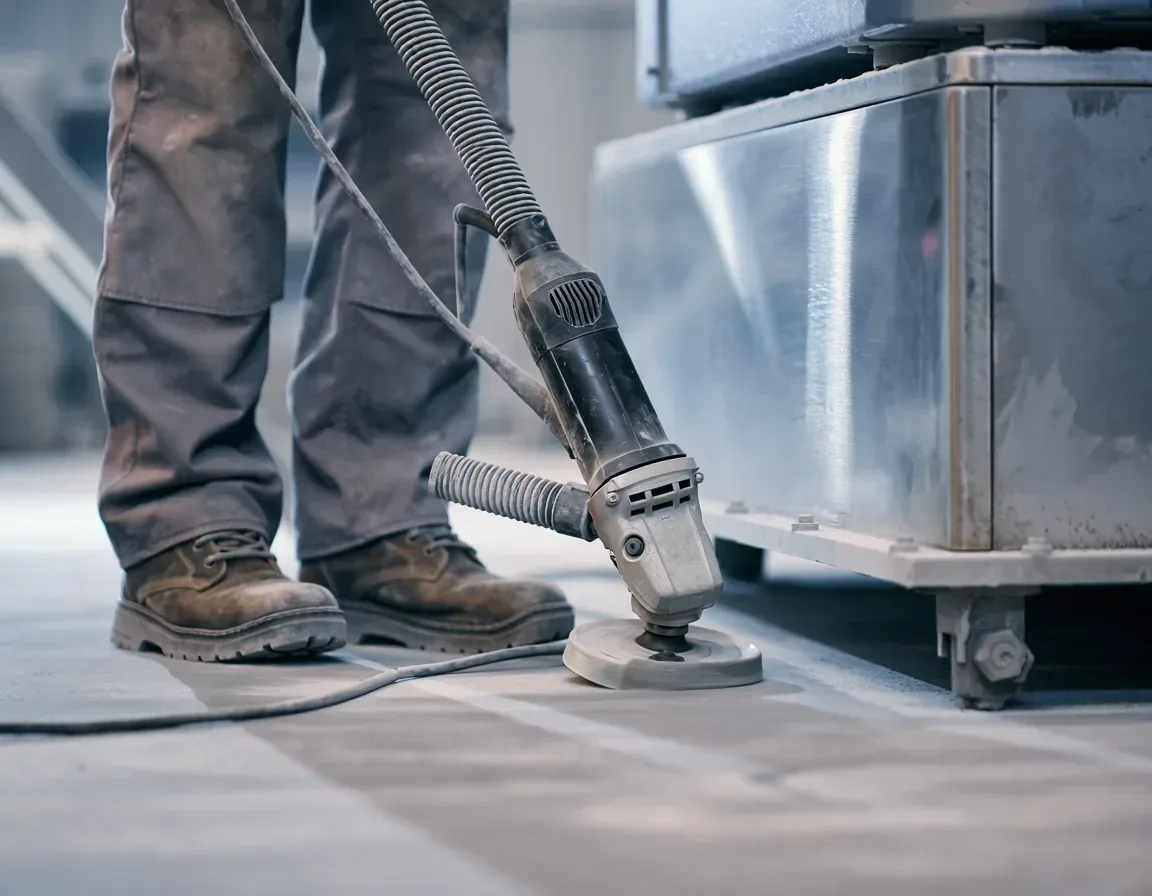
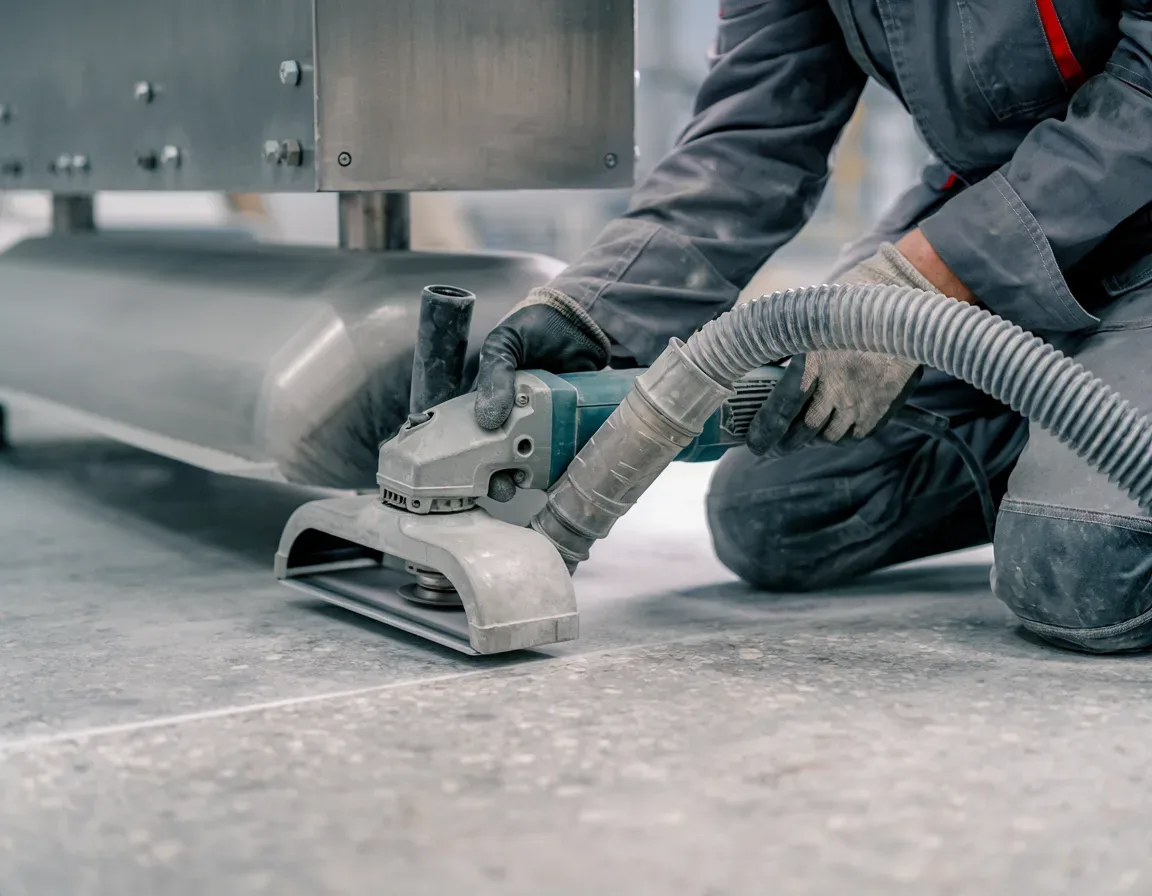
Fixed machines are not moved; the floor around them is renewed. The large grinding machine cannot approach the body, base, and protective fences beyond a certain distance; the remaining strip is processed by small hand machines. This edge work is slow and accounts for a significant portion of the total time in the factory; therefore, during reconnaissance, we also record the number of machines and perimeter lengths.
The bottom of the machine is often left out of the equation, and this must be stated from the start. The concrete covered by the base or body cannot be wiped off; the boundary forms along the line where the machine touches the ground or comes very close to it. If a machine is planned to be replaced or moved soon, the floor work in that area should be timed to coincide with the day the machine is dismantled, because the new machine may not fill the same mark as the old one.
There are many things embedded in the ground and passing over the surface around the machine: cable ducts and covers, compressed air and cooling water lines, floor grates, vibration-damping feet, and anchor bolts. Steel profiles around the duct covers damage the diamond and can cause sparks when in contact; these points are pre-marked. Electrical panels, driver cabins, and precision measuring devices close to the floor are covered against dust, and ventilation grilles are temporarily covered with filter cloth. How long these covers can remain depends on the device's heating and is agreed upon together with the maintenance supervisor.
Pre-cleaning of Oily and Chip-Covered Floors
Unlike warehouse floors, the floors of production areas are oily. Cutting fluids, hydraulic oil, machine oil, and metal shavings adhering to them form a dark, slippery layer on the concrete surface over the years. No direct grinding can be done over this layer: oil scrapes and prevents cutting the diamond surface, the chips drag under the machine and scratch the floor, hardener applied to oily concrete cannot penetrate and the protective material does not hold.
Therefore, a separate cleaning step is planned before the wiping day. The thick layer is scraped off, sawdust is swept away, the floor is moistened with an alkaline oil remover and left to rest, and the dirty water is scrubbed with a brush machine to collect the dirty water with a vacuum. In heavily soiled areas, this process is repeated several times. Oil that has been embedded in the concrete for years does not end with surface cleaning; after polishing, these areas may remain dark around them. Types of oil stains and what can and cannot be removed by polishing. oil, rust, and paint stains in the text We explained it in detail.
Pre-cleaning is the part of the floor work that can be done during production. If the factory's own cleaning team or we complete this work between shifts a day or two before the erasure, the entire limited time window is left to the cleaning.
Dust Curtain, Precision Equipment, and Ventilation

In the factory, we mostly work with the dry method because it is difficult to clean dust when the sludge reaches the bottom of the machines, cable ducts, and drains. The dry method is done with industrial dust extractors directly attached to the machine and pre-separators that separate coarse dust before it reaches the filter. Details of method selection Wet or dry in concrete slating in the text, the health level of the crystalline silica contained in the concrete powder is in silica powder writing You can find them.
The suction collects most of the dust at the source, but not all of it. In edge work, some dust escapes as the machine is lifted and lowered and the bag is changed. In a factory where production continues, the work area is temporarily separated by a curtain to limit this leakage: a plastic cover hung from the ceiling or a frame, reaching down to the floor and sealed with tape. If the air inside the curtain is kept flowing inward rather than outward, dust will not escape through the curtain gaps.
The ventilation system is also included in the plan. Suction vents in the work area can carry dust to the other end of the factory; during the work, these vents are closed or covered with a filter. If work is to be done near dust-sensitive areas such as paint lines, electronic installations, optics, or precision measurement sections, the responsible person of that section is discussed separately, and if necessary, the work is resumed during the time that section is not operating. In areas with fire detection systems, dust detectors may be affected; temporary measures to be taken in this regard are determined by the factory official, and the contractor does not interfere with a safety system at their own discretion.
Occupational Safety Coordination and Energy
An external team coming to the factory becomes part of the factory's occupational safety system. Therefore, the preliminary meeting with the employer's occupational health and safety unit is as important as the technical inspection of the work. The main points we clarified during the meeting are as follows:
- Work permit and entry rules: The permit procedure applied by the factory for contractor work, entrance training, and required documents are learned; it is asked whether separate permits are required for works that could spark a fire.
- Forklift and pedestrian traffic: Vehicle lanes passing around the work area are designated, the area is physically separated, and a lookout is assigned for crossings when necessary.
- Working near the machine: The factory's maintenance and safety supervisors decide whether a machine can be wiped next to a working machine and which machines will be powered off and locked.
- Emergency routes: Escape routes, fire cabinets, and emergency showers are never blocked at any stage; if closure is mandatory, a temporary regulation is decided in writing.
- Waste and cleaning: Where the collected concrete dust and oily cleaning waste will be collected inside the factory and who will remove it are determined from the outset.
On the legislative side, the obligations of the employer and contractor are defined in the occupational health and safety law and related regulations; interpreting these is the responsibility of the factory's safety expert, and we adhere to that framework. Erasure's own risks and the measures taken In the Deletion Occupational Safety Article. we addressed it.
Energy is the most common disruption to the plan. Large planetary grinding machines and their connected dust absorbers mostly require triphase feeding, and the current they draw exceeds the capacity of an ordinary outlet. During the inspection, we check the most suitable panels to the work areas, the types of outlets, and what other loads these panels carry at that time together with the factory's electrical supervisor. If the panel is far, the cable route and cross-section are taken into account; the cable must not block the forklift path. If there is no proper supply, a generator is an option, but in an enclosed space, due to exhaust, the generator must be outside and the cable must be brought in.
Temporary Routes and Opening the Zone
When one area is closed, materials and people pass through another road; ensuring this road is safe is part of the groundwork. If possible, the temporary forklift route should be separated from the pedestrian path, warnings are placed at narrow and blind spots, and workers at the start of the shift are notified of the closed area for that day. If the temporary road passes through an area normally unseen by vehicle traffic, it is also checked whether the ground and joints there can bear this load.
We look for three conditions for reopening the zone: the hardener and protective must be dry, the repair fillers must have reached load-bearing hardness, and the area must be dust-free. Curing is not expected for days in polished concrete as with resin coatings; most zones can be used in the next shift. Before opening, the area is toured together with the production manager, discussing the order in which the removed lines and markings are renewed. How the pedestrian path and forklift route lines are applied to the ground concrete In the floor marking text we explained. The opening plan of the institutions section by section In the text to enable the field You can find them.
Grades by Industry
The framework of the plan is the same in every factory, but the details are determined by what is produced. The highlights of the sectors we frequently work in are as follows:
- Metalworking: Pre-cleaning is the longest step due to cutting fluid and chips; impact damage is common on heavy mold and roller transport roads, and repair time is added to the schedule separately.
- Plastic: Raw material granules poured on the floor act like balls under the foot and wheel; before mopping, they are thoroughly swept down, and the dryer and feeding hoppers are sealed against dust.
- Textile: Fiber flying in the air quickly fills the filter of the dust absorber and creates a fire load; before work, the area is cleared of fiber, and spark risk is separately assessed by the safety unit.
- Packaging and printing: Ink residues are common with paper and cardboard dust, and print quality is sensitive to dust; the working area is separated from the printing line by a curtain, and factory rules apply to areas where solvents are used.
Food production and cold storage are topics that need to be addressed separately due to hygiene and temperature conditions, as well as other matters outside this list.
The first step to renovate your factory floor without interrupting production is to review the layout plan together with the shift and maintenance schedule. This information and a few photos of the floor service request form If you transmit it through it, we will prepare the regional plan and calendar draft together during the inspection.
One-Page Plan Given to the Shift Supervisor

No matter how detailed the regional plan is, the shift supervisor carrying out the work on site should have a single page in their hands. This page states which area will be closed that week and at what hours, which route the equipment will take, who will open the area and at what time, and who will be called when a problem arises.
A copy of the sheet is hung at the entrance of the work area. If the plan changes, for example, if a repair takes longer than expected, the supervisor is notified before the shift starts; production should not learn the condition of the floor on site in the morning.
Around a Press Line in Annual Maintenance Downtime

In a metalworking facility, the perimeter of the press line never emptied for the rest of the year; we recorded the floor work in the factory's annual maintenance downtime. The week before the shutdown, between shifts, we cleaned the oily layer around the line and marked the channel covers.
When the shutdown began, the maintenance team worked on the presses, and we worked on the ground; the joint schedule indicated which press's perimeter belonged to us on which day. We completed the edge work down to the press bases by hand machine. When the line resumed, the ground had been delivered.
What often delays floor work in the factory is not the grind but the preparation; if oil cleaning, energy connection, and clearing of the area are completed a day in advance, even a short time window is enough. — Expert Note
Frequently Asked Questions About Concrete Coating in the Factory
01Can the side line continue to work during erasure?
02Does noise disturb employees?
03How many days does it take for the job to be completed?
04Does the unwiped concrete under the machine continue to dust up?
05What happens to the lines and markings when the floor is renewed?
06Will there still be oil stains in the production area after polishing?
Related Articles
Warehouse and Logistics Center Floors: Dust-Free Warehouse with Concrete Cleaning, Forklift and Pallet Truck Traffic: Wheel, Joint, and Floor Wear, Is Concrete Cleaning Wet or Dry? Dust, Mud, and Ventilation Decision, How to Plan a Concrete Clearing Project of 1,000 m² and Above?, Occupational Safety During Cleaning: Dust, Noise, Electricity, and Slippage