Parking Floor Maintenance Plan: Daily, Monthly, and Yearly Tasks
A renovated parking lot floor is clean, dust-free, and bright on the day it is delivered; how it will look a year later is determined not by the gradient but by who did what during that year. Maintenance in parking lots is often remembered when complaints arise: when an oil stain grows, drains overflow, or lines are wiped off. However, all these tasks are known in advance, whose frequency can be predicted, and which can be attributed to a single person. In this article, we explain the daily, weekly, monthly, seasonal, and annual floor work of a parking lot operation in order, and at the end, we provide a task table showing the job, frequency, and responsible person together.
In short: Parking flooring has three enemies: sand, which acts like sanding under the tire, oil that penetrates concrete, and water that can't get out. Daily rounds manage spills, weekly sweeping sand, monthly washing, and drain cleaning manage dirt and water; the annual damage round covers the repair and renovation budget. For the plan to work, every job must have an owner and a written record.
Why Should the Plan Be in Writing?
The parking lot is the area of the building that everyone uses but no one owns. The cleaning team handles the lobby and floors, the technical service handles the boiler room and elevator, and security handles the entrance; the parking floor falls between these three job descriptions. A written plan fills this gap by answering three questions: what work will be done, how often it will be done, and who will do it.
When preparing the plan, the parking lot should not be considered as a single area. The entrance and ramp base are the first places that receive sand and water coming from outside and get dirty several times faster than the rest of the floor. Driving paths and turning points are areas where tire marks, parking pockets are areas where oil droplets occur, and elevator halls and pedestrian paths are areas where foot traffic is concentrated. The front of technical rooms and blind spots are places where garbage and abandoned items accumulate. Since each area has a different pollution rate, the frequencies are also written according to the area.
The frequencies we provide below are a starting recommendation for a medium-density indoor parking lot. A shopping mall parking lot that fills up and empties several times a day is not managed according to the same schedule as a residential parking lot where vehicles enter and exit once a day; frequency is increased or decreased by looking at the records kept in the first months.
Daily Tour: Trash, Spills, and Oil Drops
Daily work is not cleaning but an observation tour. The attendant walks through the parking lot from start to finish and looks at new things that appear on the floor that day: trash and packaging, broken glass, liquid leaking from spilled drinks or grocery bags, fresh oil and coolant droplets, wet spots appearing on a rainless day. Parts like broken glass and screws are a risk to the tire, spilled liquids are a risk to pedestrians; both are taken that day.
The main value of the round is catching the oil drop early. Concrete is a porous material and gradually absorbs the oil; while the droplet standing on the surface in the first hours can be removed without leaving a mark with an absorbent material, the oil that has been waiting for days descends into the concrete and can only be opened with repeated procedures. On the wiped and protected surface, this period is prolonged but not infinite; it saves time against the protective oil and does not provide immunity.
The attendant writing down what they see somewhere is also part of the tour. If oil drops appear one after another in the same parking pocket, the problem is not with the ground but with the vehicle parked in that pocket, and management should inform the vehicle owner. Wet spots that always appear at the same spot on rainless days are the first sign of a plumbing leak or leak.
First Response Kit for Oil Drops
Quick response to spills depends on having the material at hand. Instead of a cleaning cart locked in the warehouse, we recommend a small set ready on every floor or at a security point. The set should include:
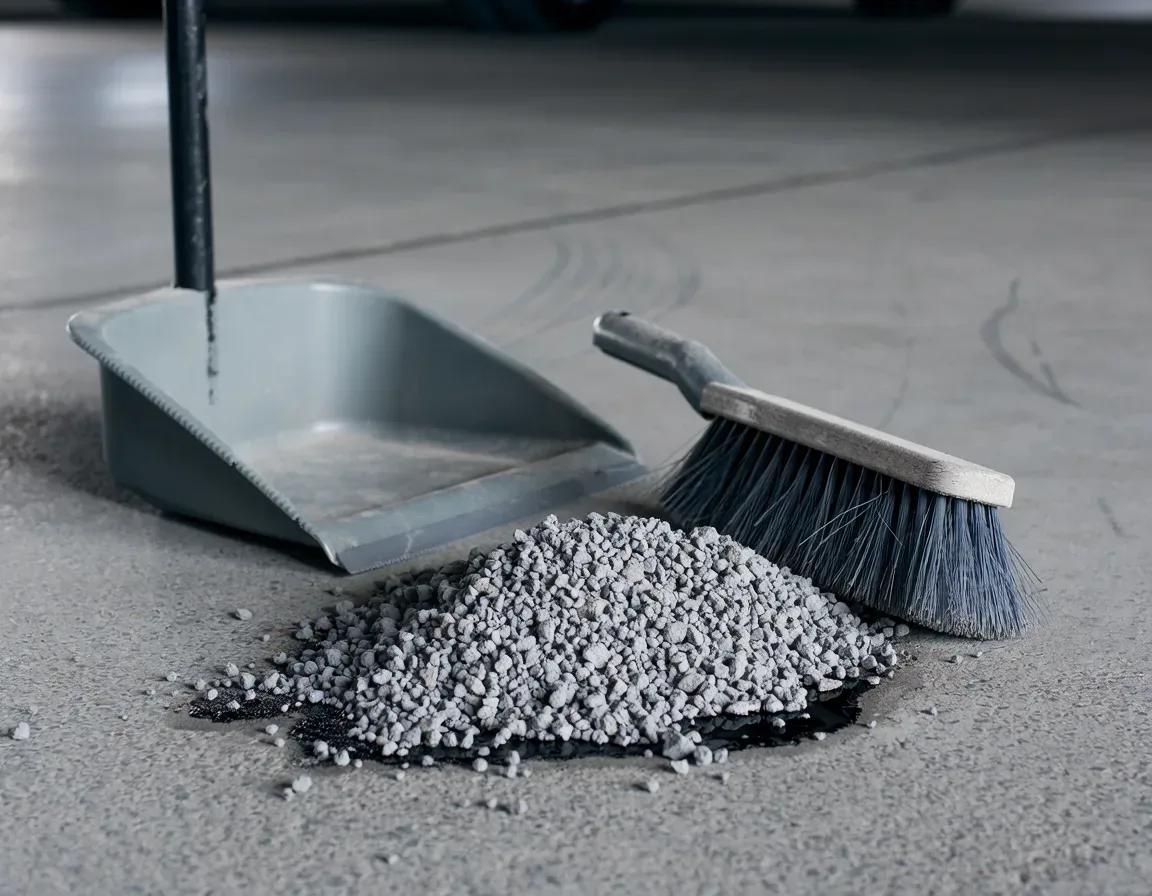
- Absorbent material: An oil-absorbing granule or absorbent pad is laid on top of fresh droplets to draw the liquid away from the concrete without being absorbed; sawdust and sand make this much weaker.
- Stiff brush and shaving: After sitting on the granule droplet for a while, it is rubbed with a brush to collect it; the scrubbing motion increases the absorber's contact with the oil and reduces the film remaining on the surface.
- Lidded waste container: Oil-absorbed material is not mixed with general waste but collected separately in a covered container and removed according to the building's waste management rules.
- Degreaser suitable for concrete: The shadow left after the absorber is brushed off with a diluted alkaline degreaser and rinsed with clean water; acidic products do not wear down the concrete surface because they are not placed on set.
- Warning cone and glove: During intervention, the area is marked with a cone because the floor soaked with degreaser is slippery for both drivers and pedestrians for a short time.
Old stains that cannot be removed with this set and have embedded into the concrete are not the work of the daily team. They are left to the deep cleaning at the end of summer or to the work to be done by the flooring company; and the precautions to be taken while working on wet surfaces in the article on wet ground management We collected them.
Weekly Sweeping: Sand is the sanding of the floor
Every vehicle entering the parking lot brings sand, soil, and fine gravel along with its tire. As long as this material remains on the ground, it is crushed between the concrete and rubber with each tire pass, scratching the surface; this is the main reason driving paths in polished concrete become dull over time. Sand also carries into drains and fills the filter baskets. Therefore, dry sweeping is the least flashy but most efficient step in parking lot maintenance.
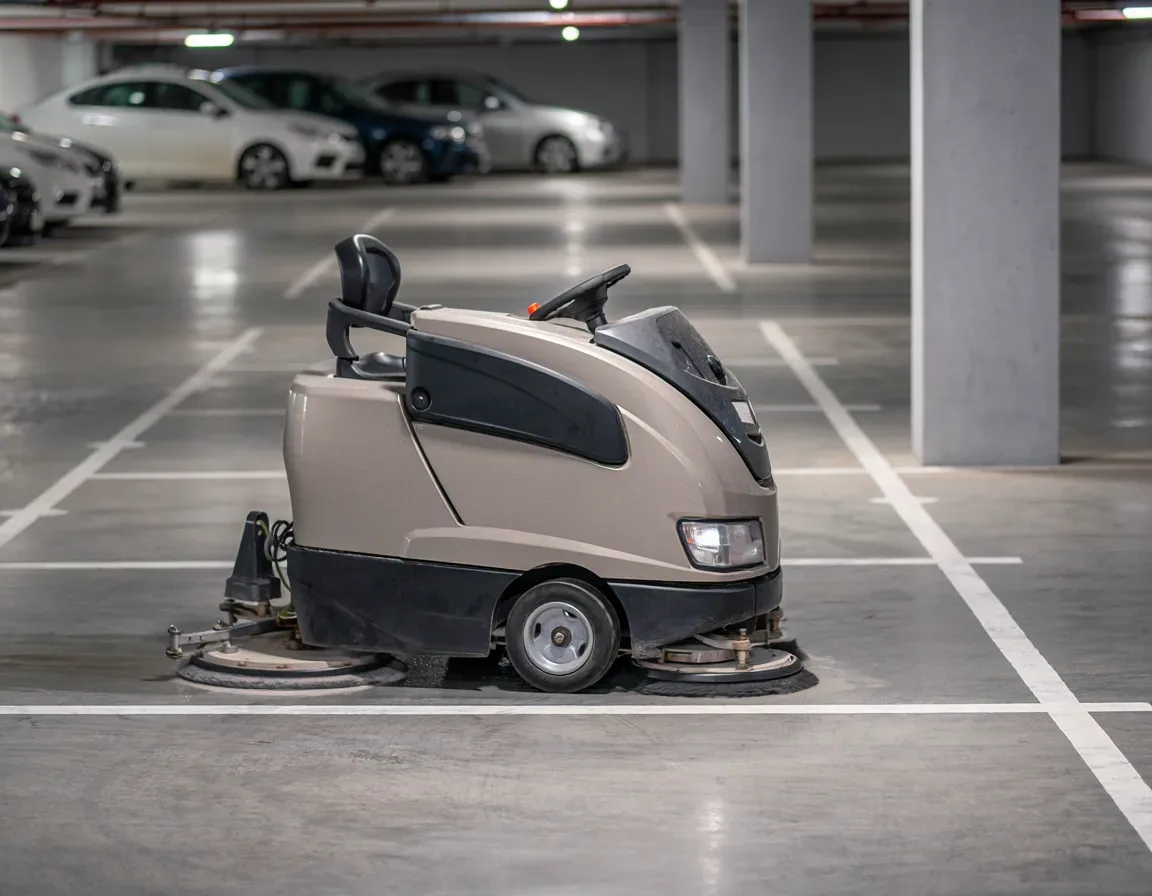
In small parking lots, a wide push-up vacuum is sufficient; in medium and large areas, a walk-behind or rider-mounted sweeper speeds up the work and traps dust in its filter. Places the machine cannot enter, such as the bottom of columns, behind wheel stops, and wall edges, are sweeped manually; sand accumulates most in these areas. Cleaning is not done by blowing with compressed air because dust rises into the air and lands on the vehicles.
The sequence is important: first dry sweeping, then wet washing. On the floor washed without sweeping, sand turns into mud with water, fills the machine's pad, and as it dries, it sticks back to the ground as a gray film. The entrance, ramp bottom, and footpaths are swept several times a week, the rest of the floor once a week; during rainy weeks, the frequency of entry is increased.
Monthly Wash: Equestrian Machine, Pads, and Chemicals
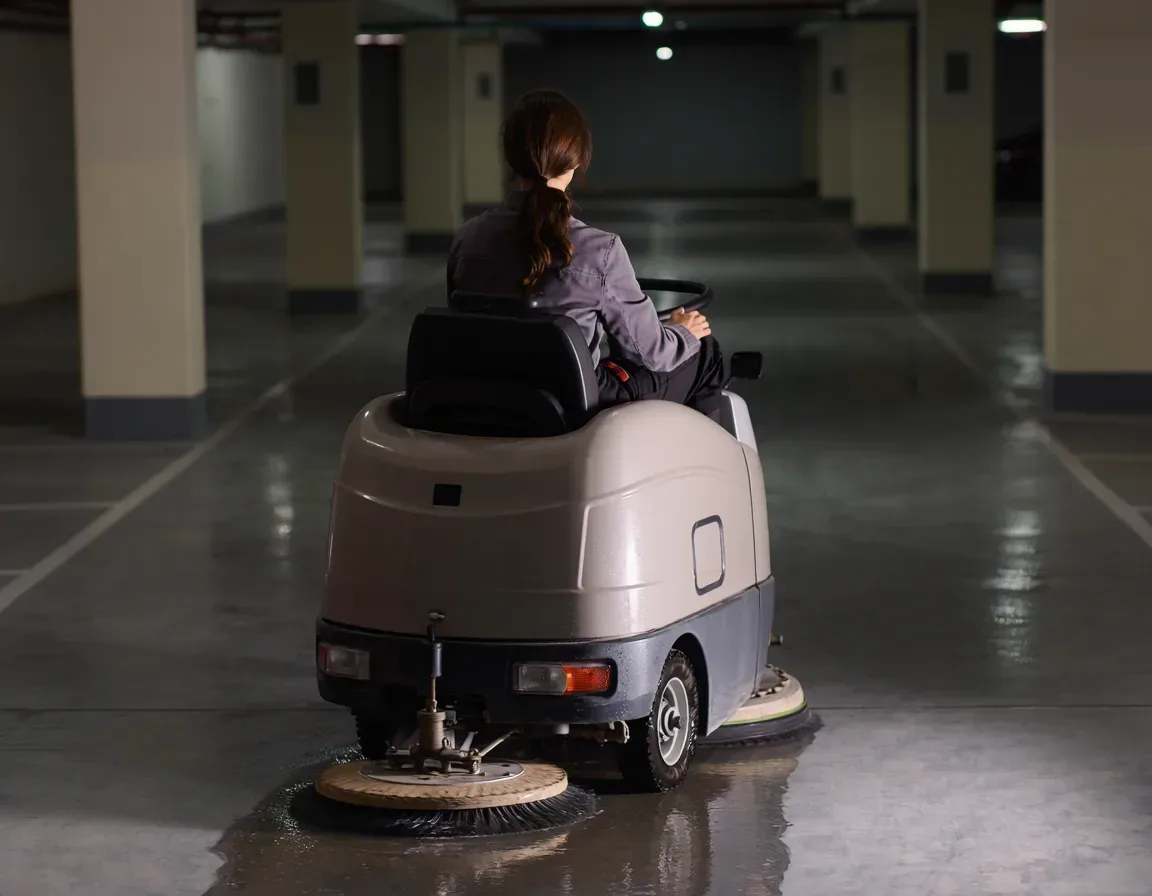
Fine dirt, tire dust, and oil film that sweeping cannot remove are removed by machine washing once a month. At the parking scale, the tool for this is the rider-mounted floor washing machine: it delivers the cleaning solution to the floor, scrubs it with a brush or pad, and collects the dirty water back with the suction rubber behind it. This is exactly where the difference lies from washing with a hose or pressurized water; water is not left on the floor, so it does not cause puddling in areas without drains.
What is installed in the machine determines the result. A soft or medium-hard pad is used in wiped and polished concrete; rough removal pads wear down the surface gloss and protector. In brush-textured or coarse concrete, the pad breaks down quickly; a cylindrical or disc brush is a better choice. A neutral or slightly alkaline product is used as a cleaner, diluted according to the manufacturer's specification; an excessive dose leaves a sticky residue on the surface and soils the floor more quickly. The logic of pad and product selection In the floor washing machine text We explained it through natural stone; the principle is the same in concrete. What acidic and strong alkaline products do to polished concrete is in the article on polished concrete maintenance You can find them.
Black tire marks at turning points do not appear in a single pass. First, degreaser is applied to these areas, then left for a while, then the machine is passed; details of the method In tire and brake mark text we gave it. The machine's dirty water tank contains oil and heavy dirt; it is discharged not into a random rain drain but at the point designated by the building for this purpose.
Monthly washing day is also the day for drains. Grates are removed, filter baskets emptied, ramp channels are cleaned, and water is poured into each drain to test its drainage. Heavy drains are marked and reported to the technical service; otherwise, during the first downpour water accumulation It returns as such.
Seasonal Jobs: Before and At the End of Summer
In the Mediterranean climate, the parking lot year is divided into two periods: dry and hot summers and autumn and winter when heavy rain comes. During summer, no water enters the ground, but oil dripping from hot engines increases, condensation water seeping from air conditioners leaves lime ring in the parking pockets, and tire tracks darken. Therefore, late summer is the right time for deep cleaning of the year: application of soaked oil remover, removal of tire tracks, and if necessary, restoring shine with a maintenance pad on traffic roads during this period.
Before the first showers, the water path is prepared. Channels at the top and bottom of the ramp, all grates, and filter baskets are cleaned; in parking lots with pump pits, water is supplied to the pit to see the pump and buoy operating. If there is a mat or scraper grate placed at the entrance, it is renewed. Since vehicles carry mud inside throughout winter, the frequency of sweeping at the entrance is increased.
In seasonal businesses such as hotels and holiday sites, the schedule shifts according to occupancy. Deep cleaning and repair work is scheduled during the period when the parking lot is empty; during the season, only daily tours, sweeping, and quick washing are carried out.
Annual Damage Type and Renovations
Once a year, the management, technical supervisor, and, if possible, the ground company tour the parking lot together. The purpose of this tour is not cleaning but to prepare the repair list and next year's budget. The main topics to be covered on the tour are:
- Joint fillings: Cracked, collapsed, or hardened fillings that have separated from the edge are marked because the open joint both absorbs water and the edge begins to break under the tire.
- Cracks and surface breaks: It is compared with photos from the previous year; the widening crack and growing break bring up floor repair, and if necessary, an engineer's opinion.
- Lines and markings: Lines ground at turning points, unread arrows, and faded pedestrian paths are added to the retouching list; line renewal is usually planned immediately after the deep cleaning.
- Status of the protector: Water is dripped on the floor at several points; if the drop looks like a bead, the protector is working; if it spreads immediately and darkens the floor, it is time to renew.
- Dulling on traffic roads: The brightness difference between driving paths and parking pockets is examined; if the difference is noticeable, high-speed polishing or a short maintenance wipe is planned.
- Hardware: Wheel stops, column guards, speed breakers, and ramp grooves are checked; each loosened part initiates a new fracture on the ground.
The list from the round is divided into three: immediate safety work, repairs to be done within a year, and renovations spread over several years. Thus, floor expenses are no longer an unexpected expense but become a known item in the budget.
Task Table: Job, Frequency, and Responsible

The table below is a one-page summary of the plan; it can be hung on the board or placed on the first page of the maintenance file. Frequencies are initial recommendations and should be adjusted according to parking traffic:
| Work | Frequency | Responsible | Registration and attention |
|---|---|---|---|
| Trash, glass, spill, and oil drop tour | Every day | Cleaning or security guard on shift | The location and date of the new stain are written |
| Sweeping of entrances, ramp bottoms, and pedestrian paths | Several times a week | Cleaning team | Frequency increases on rainy days |
| Removing the entire floor with a sweeper | Once a week | Cleaning team or contractor | The machine's hopper and filter are emptied |
| Machine washing with a rider | Once a month, more frequently in busy parking | Trained personnel or contractor | The pad and product used are recorded |
| Cleaning of the grille, strainer basket, and duct | Once a month and before the shower | Technical service | Heavy-pulling expense is marked |
| Pump well and oil separator control | One in a season | Technical service or plumbing company | The pump is tested by adding water |
| Deep cleaning and tire mark removal | At the end of summer | Contractor | Before and after are photographed |
| Type of damage and repair list | Once a year | Management, technical responsible, flooring company | Budget and calendar are generated |
Record Keeping and Maintenance Agreement
The weakest link in the plan is the record, because if the work done is not recorded, it cannot be distinguished from the work that has not been done. No complicated system is needed; a single-page form consisting of date, region, work done, person doing it, and observation columns if available is sufficient. New stains and damages are photographed by phone and stored in the same folder in the same order of dates. This record serves three purposes: it shows whether the frequencies are correct, documents what management did in case of a slip or damage complaint, and allows comparison with the previous year in the annual round.
Part of the work is done by the building's own personnel, while others are outsourced. If machine washing, deep cleaning, and floor repair are agreed upon with a company, the contract must clearly state the scope: which areas, what frequency, which machines and products, what kind of report will be given after the work, and which jobs are excluded from the scope. Contract drafting In the natural stone maintenance contract letter We explained in detail; the same principles apply to concrete floors as well.
If you want to adapt this plan for your parking lot according to the size of the area, traffic, and the current condition of the ground service request form You can write to us via this; we will do the first damage round together and fill the table according to your parking lot.
How to Wash Vehicles While Inside?

In residential parking lots, the floor is never completely emptied; therefore, washing is planned in two stages. Driving and pedestrian paths are washed every month during hours when vehicle movement decreases. Parking pockets are handled alternately: a few days in advance are announced for a block or axis each month, and those pockets are requested to be left empty at certain times.
The announcement must clearly state the date, time range, and the numbers of the pockets to be emptied. Those who do not tow their vehicles are skipped and left for the next round; trying to get between the machine and the vehicles is risky for both the vehicle and the ground.
What Did the First Year's Record Of A Residential Parking Lot Show?

In a residential parking lot whose floor we wiped, management started keeping a daily tour log after delivery. When we looked at the logbook together at the end of the year, two things stood out. Most of the oil drop logs were collected in the same three parking pockets; vehicle owners were informed and stains were removed.
The second finding was related to water: almost all puddle notes coincided with weeks when filter baskets were not emptied. Drain cleaning was recorded as a fixed day in the monthly plan, and no complaints of deposits were received the following winter.
What wears down the parking lot floor is often not traffic but the sand buried beneath it; a management that does not neglect weekly dry sweeping can postpone the need for repolishing for years. — Expert Note
Frequently Asked Questions About Parking Floor Maintenance
01Can a pressure washer be used in a parking lot?
02Is it necessary to close the parking lot for maintenance?
03Is it better to buy a floor washing machine or to get service?
04Is it necessary to apply polish or paste to a polished concrete parking lot?
05What can management do for a vehicle that constantly drips oil?
06If maintenance is neglected, will the swept floor return to its original state?
Related Articles
Polished Concrete Care: From Daily Cleaning to Repolishing, Tire and Brake Marks in the Parking Lot: Why Does It Form, How to Clean It?, Water Accumulation in Parking Lot: Slope, Drain, and Pond Problems, Parking Lines and Floor Marking: Paint Adhesion in Polished Concrete, How to Prepare a Natural Stone Maintenance Contract? Scope, Period, and Objectives