Water Accumulation in Parking Lot: Slope, Drain, and Pond Problems
When you go down to the covered parking lot the day after a rainy day, the same puddles stand in front of the same parking spaces. Most authorities consider this a cleaning problem, push the water away with a rake, and forget about it; however, the water collected in the same place every rainfall says something about the ground level, drains, or the building's insulation. Stagnant water wears down the concrete and the reinforcement inside it, removes the pavement, and creates slipping risks for drivers and pedestrians. In this article, we explain through which roads water enters the parking lot, why it does not flow but becomes a lake, how to map the problem, and which solutions from drain cleaning to sloped screed work where.
In short: There are three main causes of puddling: insufficient or reverse slope, subsequent collapse in the slab, and non-functioning drains. The solution starts with the simplest step; first drains are opened, then the pits are filled, and if necessary, slope screed or a new channel is constructed. Screed removes small bumps but does not produce slope; water coming from the wall or under the slab is the insulation specialist's job.
Which Roads Leads to the Water Parking Lot?
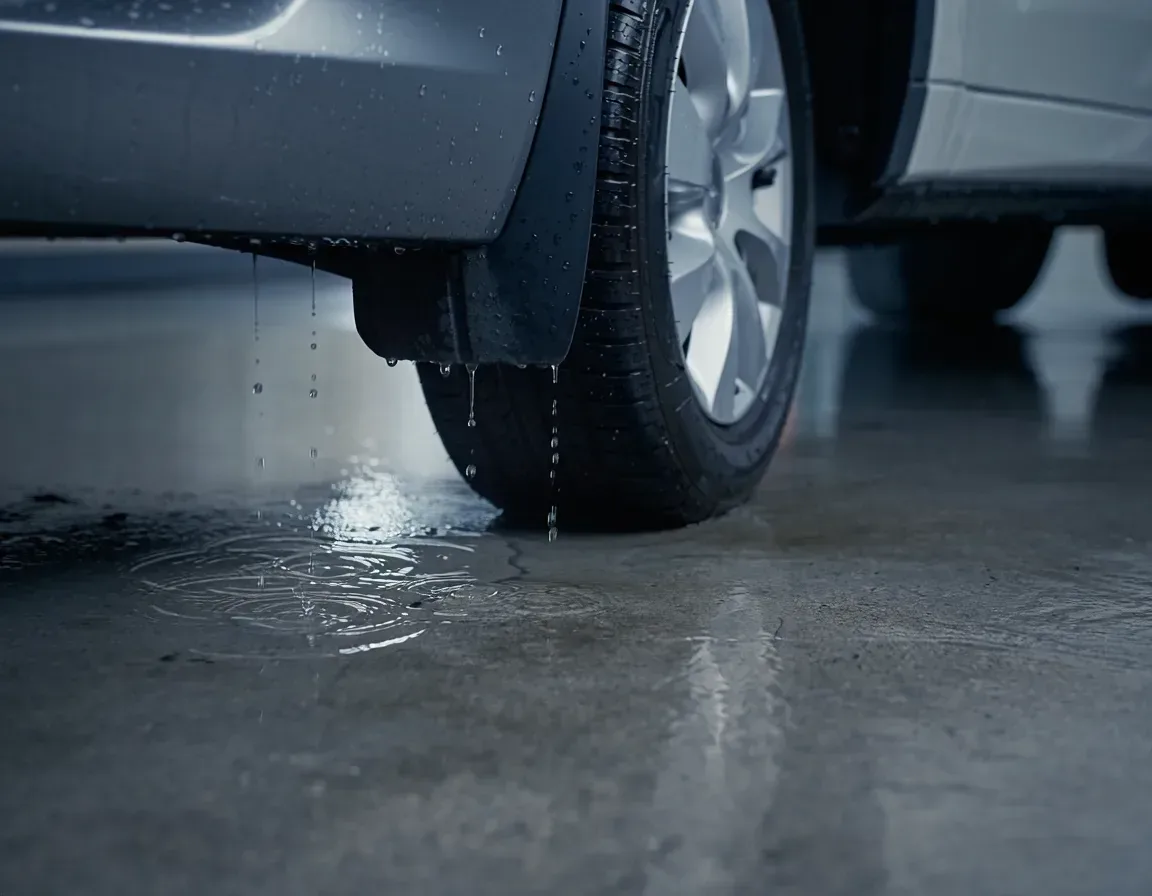
Even if a covered parking lot is covered, the ground does not remain dry. Knowing the source of the water is important because water brought by vehicle on rainy days and water that is not cut off even in dry weather are not solved by the same method. The main sources we encounter in the field are:
- Water carried by vehicles: Every vehicle entering in the rain leaves water in the parking area through the bodywork, fender interiors, and tire treads; the buildup always forms at the front or rear end of the parking pocket.
- Water flowing from the ramp and entrance: If the grate at the ramp is clogged or the channel is insufficient, the rainwater flows inside along the ramp and collects at the lowest point of the floor.
- Washing and cleaning water: The film left by the floor washing machine, hose washing, and vehicle washing points leave a long-lasting dampness that does not dry in areas far from the drain.
- Curtain wall and joint leakage: Water seeping through cold joints in walls facing the ground, formwork connection holes, and expansion joints creates a thin but continuous wet band at the base of the wall.
- Groundwater: When groundwater rises, water rises upward through joints and cracks in the flooring; the deposits appear days after rain and often in the middle of the floor.
- Plumbing and condensation: Dirty water on the ceiling, leaks in fire and air conditioning lines, and condensation in cold pipes all drip to the same spot, creating small but permanent lakes.
The practical equivalent of this distinction is this: in the first three springs, water comes from above and can be delivered to the drain with the correct slope. In the last three, water comes from the building's shell or plumbing; no matter how much you level the ground, wetness continues unless the source is closed. How to cut off water entering from the ramp through channels and gutters On the non-slip sign on parking ramps We also addressed it.
Why Doesn't Water Flow? Slope, Slope, and Drain Left High
Water flows by gravity; if there is sufficient slope in front and no open drain at the end of the road, it stays where it is. Parking tiles are often designed with a slope so low that it appears flat to the eye. Design sources generally consider a slope between one and a half percent to two percent as the lower limit, but casting and finishing tolerances make up for a small portion. Even if the project is correct on paper, drawing the gauge too much in one place and too little in another leaves shallow plate-like bowls on the floor.
The second cause arises over time. Floors in mezzanines undergo some shear in the middle of the opening over the years under their own weight and vehicle load; drains are usually placed at the bottom of the columns, that is, at the least moving points of the slab. As a result, water moves away from the drain and moves toward the center of the opening. The same effect is created by the filling settled in the lowest floor floors resting on the ground: the corner of a slab sinks a few millimeters, forming a long lake along the joint.
The third reason is the drain itself. If the grate frame is left elevated above the floor surface or if a retrofitted coating raises the elevation around the drain, water reaches the mouth of the drain but cannot enter it. Wheel stops, screed patches that have been added afterward, and raised joint fillers also work like small dams. If the number of drains is low, the distance the water must travel is lengthened, and even the smallest elevation error is enough to cause a puddle.
The Cost of Stagnant Water: From Equipment to Driver
A one-or two-centimeter deposit appears harmless, but its effect is measured not by depth but by duration. Concrete is a porous material; water sitting on it for days carries whatever dissolved inside it into the concrete. The most harmful of these is chloride: road salt contains water dripping from under vehicles coming from routes and sea salt carried by the air in coastal cities. When chloride reaches the reinforcement, it damages the thin layer protecting the steel and rust begins; since rust takes up more space than steel, it cracks and lifts the concrete on top.
In suspended floors, the first sign of this process is often seen on the ceiling of the lower floor: rust-colored leak marks, stalactite-like white lime flows, and a bulging concrete crust. Parking condition inspections report that deteriorations in the ceiling often fall below the depression points on the upper floor. From this point on, the issue ceases to be a floor maintenance task and turns into structural repair.
If a white ring remains behind water when water is drawn, it means the salts inside the concrete are being carried to the surface; its mechanism White salting on the interior floor we explained. If the floor is painted or resin-coated, stagnant water penetrates through the edges and cracks of the coating, causing bubbles and peeling to begin. Three outcomes stand out from the user's side: a water film mixed with oil and rubber dust creates a slippery surface, water that stands for days in warm weather becomes a breeding ground for mosquito larvae, and odor and algae settle in constantly moist corners. How to manage accident risk on wet floors in the article on wet ground management You can find them.
Diagnosis: Mapping Deposits
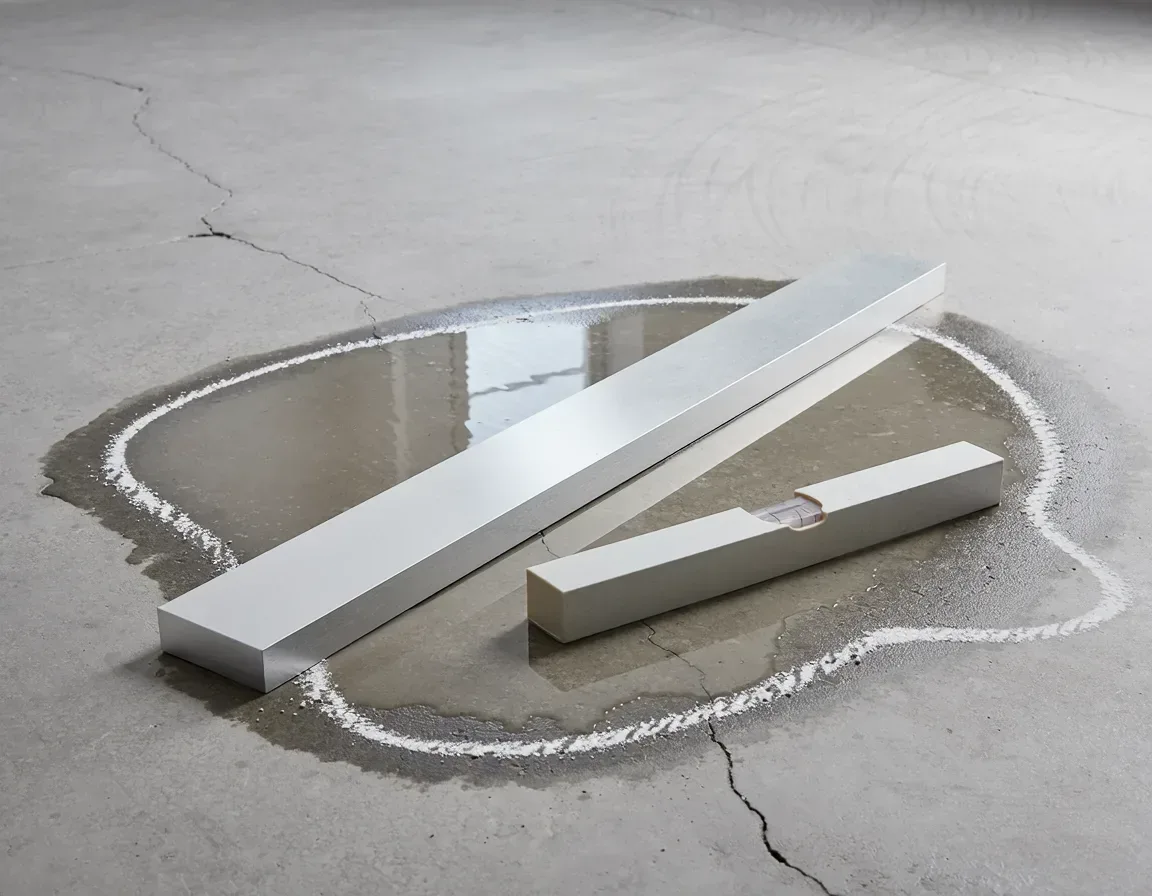
The most common mistake in the pond problem is seeking a solution without documenting the location and size of the deposit. In an exploration on a dry day, only dried mud rings are seen; depth and spread are left to guesswork. Therefore, we ask the management to perform this simple study before the discovery:
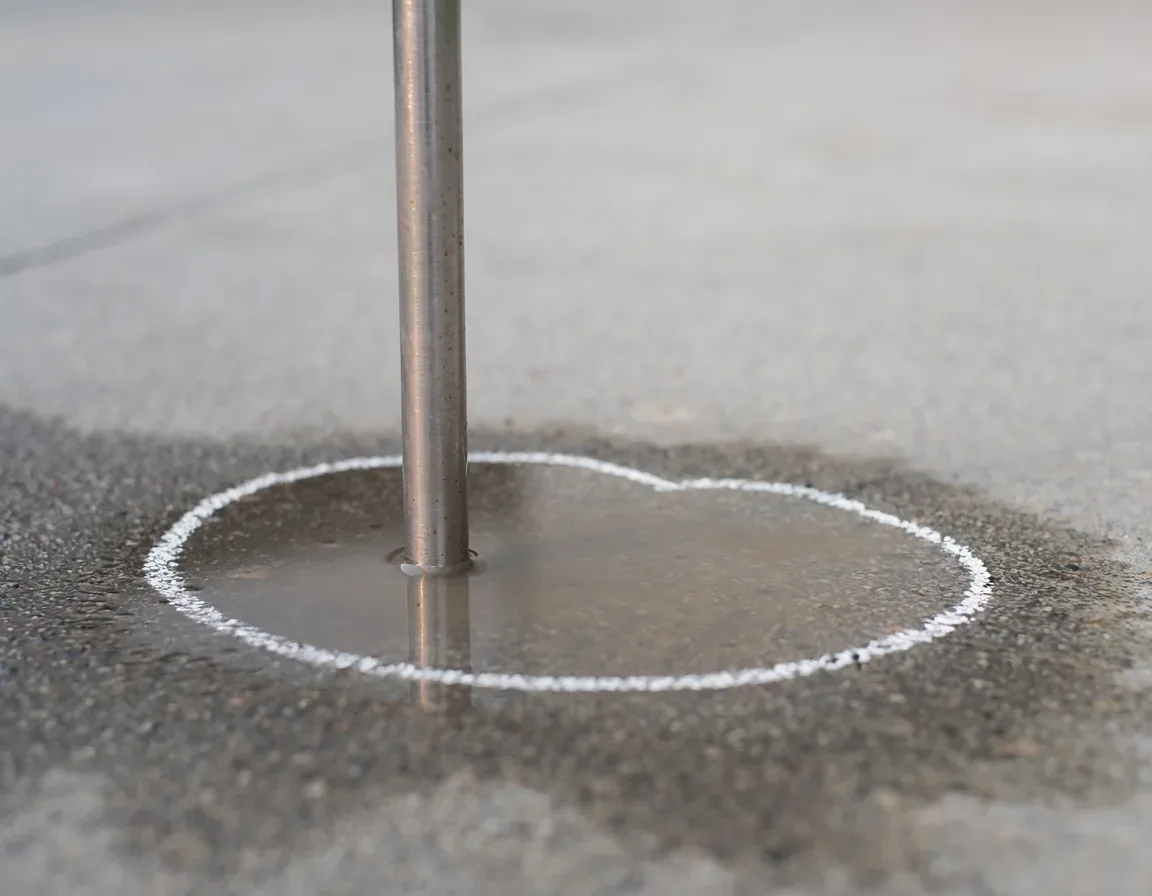
- Post-rain marking: A few hours after the downpour, the boundary of each deposit is drawn with chalk or marker spray, a date is noted next to it, and a photograph is taken from a general angle.
- Depth measurement: A ruler is placed at the deepest part of the deposit, recording the depth; a few millimeters of water film and a few centimeters of pit require different solutions.
- Monitoring drying time: The same deposits are checked again the next day and two days later; on rainless days, the wet spot indicates leakage or groundwater.
- Stream trial: On a dry day, controlled water is supplied by a hose from a distant point to the drain, and the direction and stop of the water are monitored, and it is recorded as an arrow on the plan.
- Expense control: The grate of each drain is removed and a bucket of water is poured into it; it is noted whether the water is immediately drained and whether the grate frame remains elevated above the ground.
During the discovery, measurements are added on top of these notes. With a long gauge and spirit level, the diameter and depth of the basin are read, and with a laser level, the elevation difference between the sediment and the nearest drain is read. The critical question here is: is the bottom of the pit higher or lower than the mouth of the drain? If it is high, it is enough to clear the way for the water; if it is low, the problem does not end without filling the pit or bringing a new drain there. The mark left by the water also provides information: the white crust indicates salt transport, the brown ring indicates reinforcement or metal rust, and the film glowing like a rainbow indicates oil.
The First Step is the Drains: Grid, Filter, and Line
A significant portion of pond complaints are related not to the ground but to the drain, and this is where the easiest solution lies. Parking drains fill with sand, leaves, cigarette butts, packaging, and rubber dust; when the filter basket under the grille overflows, water does not drain away, and a lake forms around the grille. Emptying the baskets is a simple task, but in most buildings, no one's job description is written.
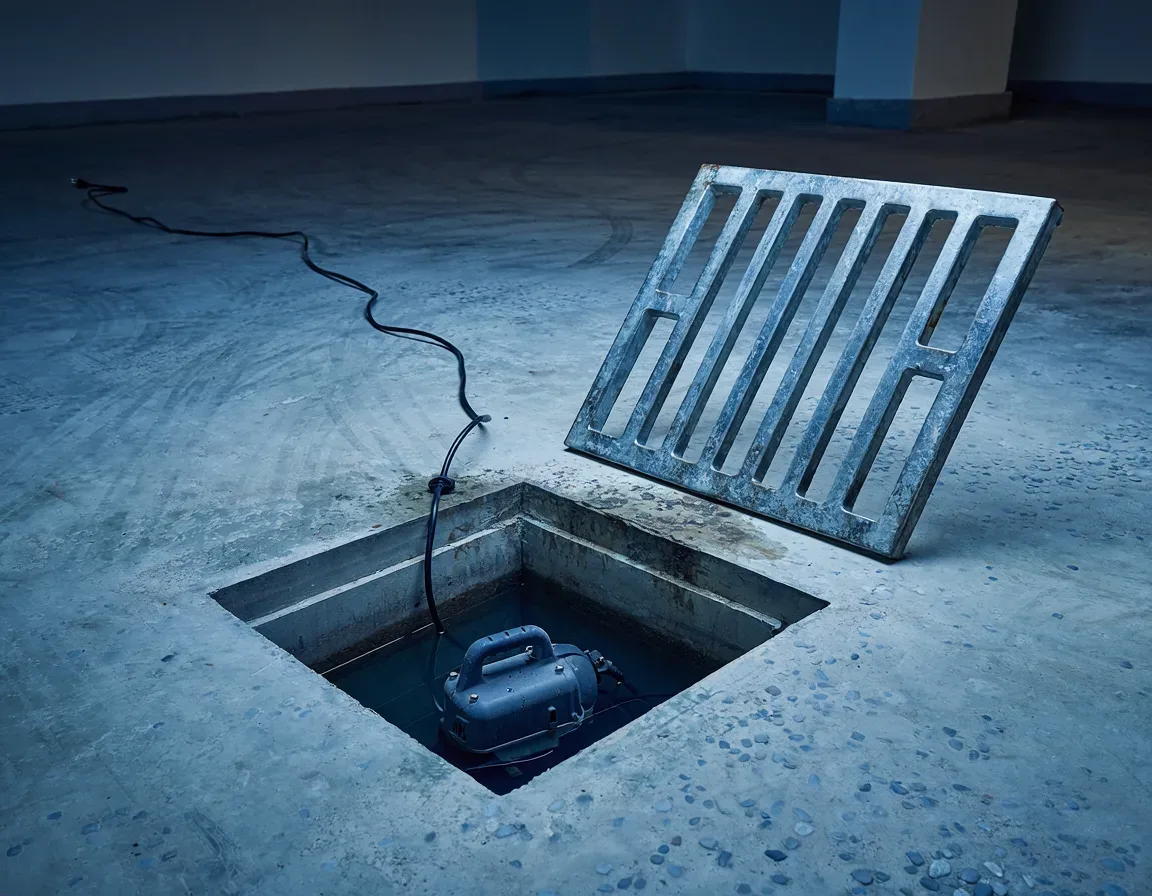
If the water is still drawn heavily while the basket is clean, the blockage is in the line. Since horizontal parking lines are laid with a slight slope, sand and cement syrup settle inside them over time; in this case, a plumbing company is called to open the line with pressurized water and, if necessary, to have it filmed with a camera. The pump pits where drains connect on underground floors is also a link in the chain: if the buoy is stuck or the pump is faulty, all drains suddenly rebound in heavy rain.
Another warning concerns our own business. If concrete mud released during floor cleaning is given to drains, it settles inside the lines, hardens, and directly causes the problem of puddling. Therefore, before wiping, we close the drain openings, collect the mud with a vacuum, and remove it from the area in separate containers.
Pit Filling, Slope Screed, and Channel: Permanent Fixes

If water remains even though the drains are working, the shape of the ground will be changed. There are three tools here, and which one is chosen depends on the size of the pit and the location relative to the drain.
Local filling
Bowls standing alone and not exceeding a few meters in diameter are filled with repair mortar. The boundary of the pit is marked based on the line drawn after rain, and along this line, the surface is cut to create a vertical edge where the fill will hold on; finishing the mortar by thinning it to zero means a patch that quickly peels off the edge. The surface is roughened, primed, and the mortar is pulled with a gauge with a slight slope toward the drain. Material selection and edge preparation In the article on pothole and joint edge repair We explained it in detail.
Slope screed
If the problem is not a single pit but an entire axis flowing in the wrong direction, a sloped screed attached to the surface is required. This means adding a new layer to the floor and requires considering three issues together. The screed thins as it approaches the drain; even in its finest spot, it should not fall below the thickness allowed by the material, so polymer-additively or resin-based special mortars are often used. The added weight means extra load in suspended slabs; the decision should be made by a civil engineer who knows the building's static design. Rising elevation affects ramp joints, door thresholds, and elevator fronts.
New outlet or channel
If the bottom of the pit is significantly lower than the existing drains, there is no way to drain the water upward; the drain must be brought to the water. In floors that fit into the ground, this involves cutting the concrete and placing a grated channel or point drain and connecting the line to the nearest manhole. In suspended flooring, drilling a hole can mean cutting the reinforcement and may overlap with the downstairs plumbing; therefore, it is only done with static approval and a plumbing project.
The table below summarizes the typical situations we see in the field and the first solution to look at:
| Situation on the ground | Possible cause | The first solution to look at | Border |
|---|---|---|---|
| Lake around the grid | A full basket, a blocked line, or a high grill | Cleaning baskets and lines, drain nozzle removal | If the line has collapsed, plumbing repair is required |
| A shallow bowl alone in a park pocket | Casting error or local seating | Vertical edge local filling | If sitting continues, the filling cracks |
| Wide lake in the middle of the clearing | Seem in suspended flooring | New goes to the slope screed or opening | Not done without static confirmation |
| Long deposits along the joint | Collapse at the plate edge, raised filling | Correction of joint edges, renewal of filling | If the plaque is moving, it is monitored first |
| Constantly wet strip at the base of the wall | Curtain wall or joint leakage | Insulation expert review | Ground leveling does not cut the weld |
| Wet in the middle on a rainless day | Groundwater pressure | Drainage and insulation project | Coating or filling is not a solution |
| Deposits at the base of the ramp | Insufficient or clogged ramp channel | Opening or expanding the channel | Heavy rain load must be taken into account |
How Long Does Removing High Points with Grinding Work?
The most frequently asked question by managers is whether we can fix puddles while wiping the floor. The honest answer is: the gradient does not fill the pit; it only lowers the height around it. A diamond can take a few millimeters of humps, screed overlaps, raised joint edges, and the concrete lip at the drain mouth that stand like a dam in front of the water; thus, water reaches the drain using the already existing slope. It is also often possible to drain the basin by lowering the edge of a shallow bowl facing the drain.
The boundary is determined by the amount of concrete that can be cut. Removing centimeters of material by grinding takes a very long time and is risky: deep cutting opens large aggregate and changes appearance, wears down the hard surface layer on polished floors, and thins the protective concrete cover above the reinforcement. Tilting an entire axis is not the job of grinding. Therefore, we make separate decisions for each deposit during the survey: this mound is removed by grinding, this dish is filled, and an engineer's opinion is requested for this area.
Wiping also has an indirect contribution. Hardened and compacted concrete absorbs less water; water remaining on the surface is easily collected with a rickshaw or washing machine and does not leave dark, slow-drying stains behind. The reason we keep the finish satin-grade rather than very shiny in parking is because on a mirror-like surface, the thin water film behaves more slippery under the tire and shoes.
Turn in Leakage and Groundwater to the Insulation Expert
If water comes from the wall, joint, or under the flooring, the work the flooring company can do is limited and must be stated from the outset. In shear wall leaks, solutions such as crack and cold joint injection, tape and profile renewal in expansion joints, and environmental drainage, pump pit, and internal insulation in groundwater come to the forefront. The selection of these is the responsibility of a company specialized in waterproofing and, if necessary, a civil engineer. Our contribution is often limited to surface arrangements that take water into a channel at the base of the wall and deliver it to the drain.
Order is also important. If paint or resin coating is applied to a floor with moisture coming from below, it will swell; polished concrete is more forgiving in this respect because it remains vapor-permeable, but it does not hide salt leakage or dark moisture stains. On every floor considered for covering, moisture must first be measured; the logic of measurement In the article on alum moisture We explained it. If there are signs of rust, raised concrete, or an expanding crack on the ceiling, we recommend showing the structure to a civil engineer before starting the groundwork.
After Correction: Monitoring Water Every Time It Rains
Pondling is not a matter that can be solved and forgotten once; drains fill up again, joint fillers wear out, and the slab continues to move. Whether the correction is effective is understood at the first downpour: the old sediment map is held, the same round is taken after rain, and the remaining points are remarked. The cleaning of filter baskets and pump pit should be scheduled before the rainy season; the frequency and responsible person for these tasks In the parking floor maintenance plan text We presented it in the form of a table.
To see which deposits in your parking lot will be solved with drain cleaning, which with filling or mopping, take photos after the rain and, if any, the floor plan service request form you can transmit it through; we prepare separate recommendations for each point during the inspection.
Pump Pit and Oil Separator: Two Overlooked Points

Most drains in underground floors cannot flow spontaneously into the city drain; water first flows into a collection pit and is pumped upwards from there. When the pump or float fails, all drains stop working simultaneously, and the problem is mistakenly attributed to ground slope. Sand accumulated at the bottom of the pit wears down the pump; if the check valve on the outlet line fails, the pressed water returns.
In parking lots with oil separators, the filled tank also slows down the flow. The location, key, and maintenance company of these two points should be written in the management file; the pump should be tested by injecting water into the pit before the rainy season.
Eleven Deposits in a Business Center Parking Lot

In a two-story parking lot of a business center, the management marked eleven accumulations after rain and sent us their photos. During the inspection, we saw that five of these were caused by full filter baskets; cleaning was done the same day. At three points, we wiped down the concrete lip at the drain mouth and the old screed overlay, and the water started flowing at its own slope.
We filled two shallow bowls with straight-sided repair mortar. The last spot at the base of the wall was wet even in dry weather; we directed the management to the insulation company for that and postponed the groundwork until after that repair.
Document the accumulation while it is wet, not dry: a photo of a chalk-drawn border and a ruler held to water a few hours after rain says more than just hours of measurement on dry ground. — Expert Note
Frequently Asked Questions About Water Accumulation in Parking
01Isn't it enough to push the accumulation with a rickshaw every rain?
02Should the color of the infill be the same as the ground?
03When can vehicles park after the pothole fill?
04Can these tasks be done during rainy seasons?
05Does placing a fine wire strainer on drains work?
06How long does it take for a puddle to damage concrete?
Related Articles
Non-slip and Wear on Parking Ramps, Parking Floor Maintenance Plan: Daily, Monthly, and Yearly Tasks, Pit, Breakage, and Joint Edge Repair on Concrete Floors, Covered Parking Floor Renewal: Dust-Free and Bright Parking with Concrete Cleaning, White Salting on Indoor Floors: Moisture from Screed and Adhesive