Removing Old Epoxy and Floor Paint and Turning Into Concrete
When the old coating begins to peel off in places on the floor of a parking lot, workshop, or storage facility, management has two options: either apply another coat on top or remove the entire coating and return it to the concrete itself. The second path, if started without knowing what the coating is, why it deteriorates, and what kind of concrete lies underneath, can cause surprises both in terms of time and result. Removal relies more on accurate diagnosis than on machine power; one of two coatings of the same thickness can easily fall off while the other softens and plasters under the diamond. In this article, we address all decisions in order, from recognizing the layer on the ground to removing tools, dust management, concrete that appears when the coating is removed, and under which conditions recoating is more appropriate.
In short: Before starting dismantling, the type, thickness, and deterioration of the coating are read; because the method and subsequent decision depend on these. Hard and thin coatings are made with metal-bonded diamonds, thick and flexible ones with PCD tips, and very thick systems by milling or ball blasting. The concrete coming out from underneath is not as smooth as new casting; the difference in primer shade, patch, and tone limit the appearance of polished concrete.
Getting to Know the Layer First: Paint, Epoxy, or Leveling Mortar?
In everyday language, every shiny layer on the floor is called epoxy, whereas the materials encountered in the field are very different. Single-component acrylic or alkyd-based floor paints form a thin film and follow the texture of the concrete. Two-component epoxy and polyurethane systems harden by chemical reaction; they range in thickness ranging from thin roll layers to self-spreading castings of a few millimeters. On parking decks and terraces, thick, elastic-like insulation membranes are found. A separate group is cement-based leveling mortars: this gray, concrete-like layer may actually be a thin substrate poured to cover it with another coating.
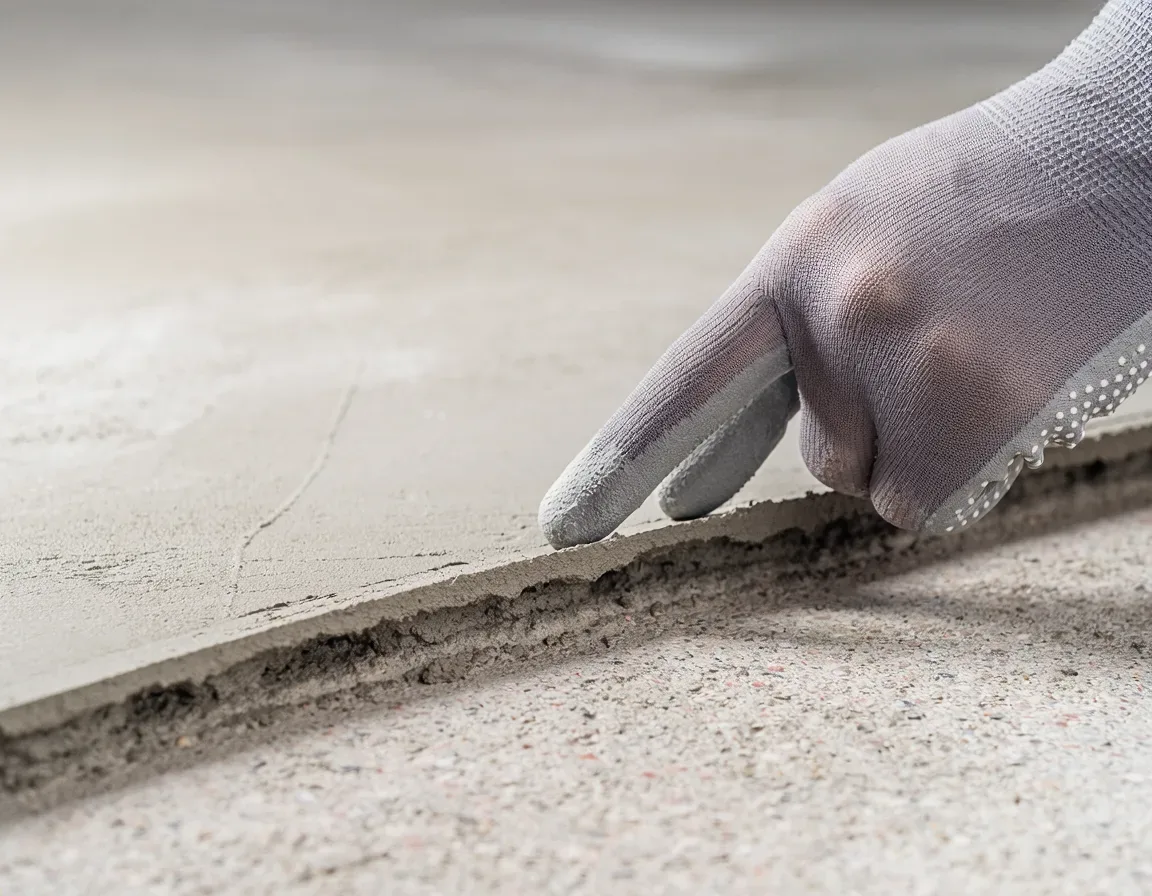
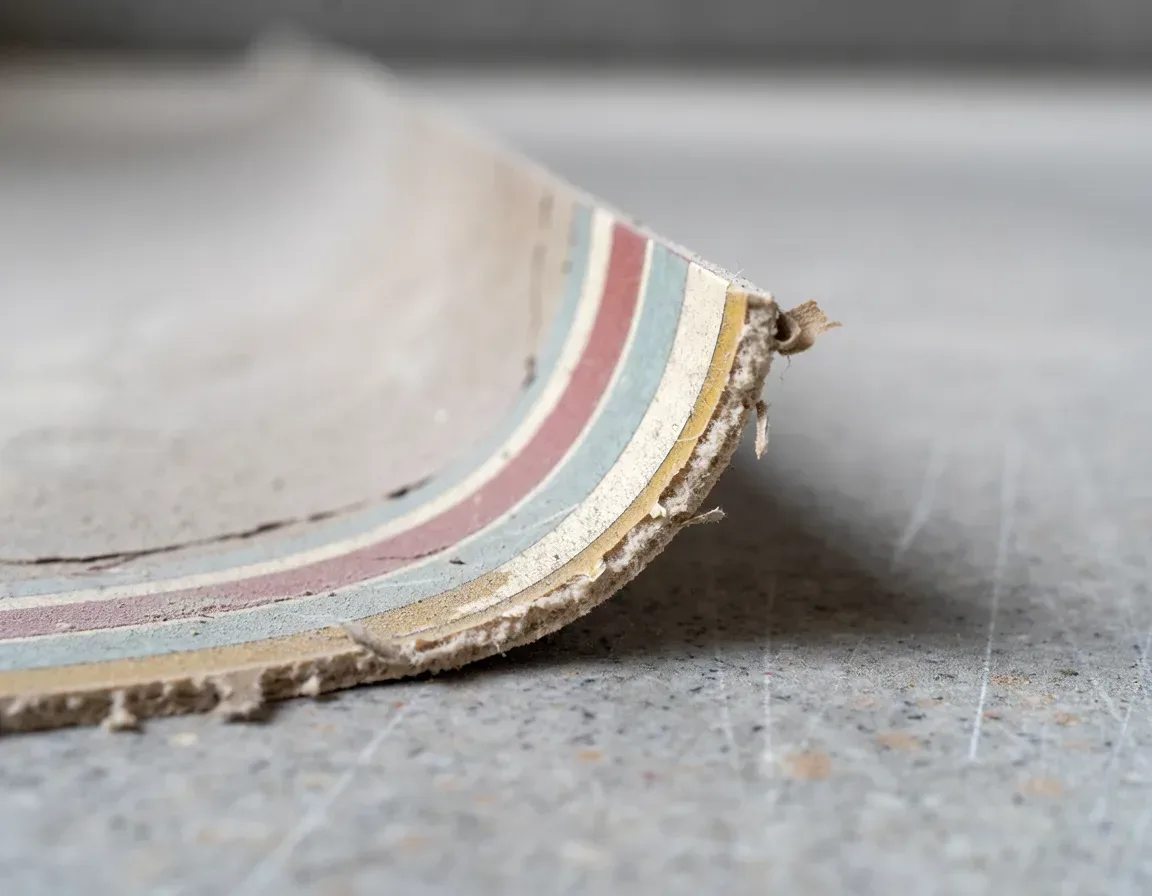
The first way to distinguish is to look at the cross-section. A piece that breaks off at an edge where the cladding lifts on its own or at the joint opening is examined; the number of layers, the color of each layer, and how much the primer penetrates the concrete can be seen in this section. It is common for three or four layers of different colors to appear on surfaces painted on top of each other over the years.
Simple discernment attempts in the field
When the section is not enough, a few small trials give ideas. The coating is rubbed for a while with a cloth dipped in solvent in a hidden corner: if the cloth absorbs the paint or the surface becomes sticky, the layer is most likely a single-component paint; if there is no reaction, it is a two-component system. When scratched with a knife, the coating that produces brittle flakes and the coating cut by stretching like rubber is not removed with the same tip. The cement-based layer, when scratched with the nail tip, produces dust and may produce a hollow sound in places when hit. These tests are not a definitive diagnosis but a preliminary screening that determines which tip the test removal will start with.
Reading the Back of the Coating: Don't Remove It Without Understanding Why It's Broken
A shield cladding piece is the most valuable document that tells the history of the floor. By looking at the back of the part, it is understood where the break occurred, telling three different stories. In the first case, a thin layer of concrete is attached to the back of the piece; the cladding is firmly adhered, but the concrete underneath is weak, causing the concrete to break off from within. In the second case, the back surface is clean or covered with dust and cement syrup; the coating never fully adheres to the concrete, and surface preparation is insufficient. In the third case, the primer remains in the concrete, and the upper layer is separated from the primer; this indicates that the waiting time between layers has been exceeded or that contamination has occurred in between.
Bubbles are a separate head. Bubbles filled with water or a sticky liquid, concentrated only in layers that settle on the ground or at the bases of curtain walls, and rise during rainy months, are signs of moisture coming from below. How humidity is measured on such a floor In the article on alum moisture We explained; the measurement logic is the same for concrete slabs. This diagnosis is not just a matter of curiosity: in moisture-related deterioration, recoating with the same system gives the same result, but in deterioration caused by insufficient preparation, a properly prepared new coating can work smoothly.
The deterioration pattern may not be the same everywhere in the area. A surface that swells from moisture at the base of the ramp, is examined under the wheel in the middle section, and remains as it was on the first day can all be found on the same floor. Therefore, during the exploration, the floor is walked from start to finish, and the findings of each area are noted separately.
Disassembly Method According to the Behavior of the Coating
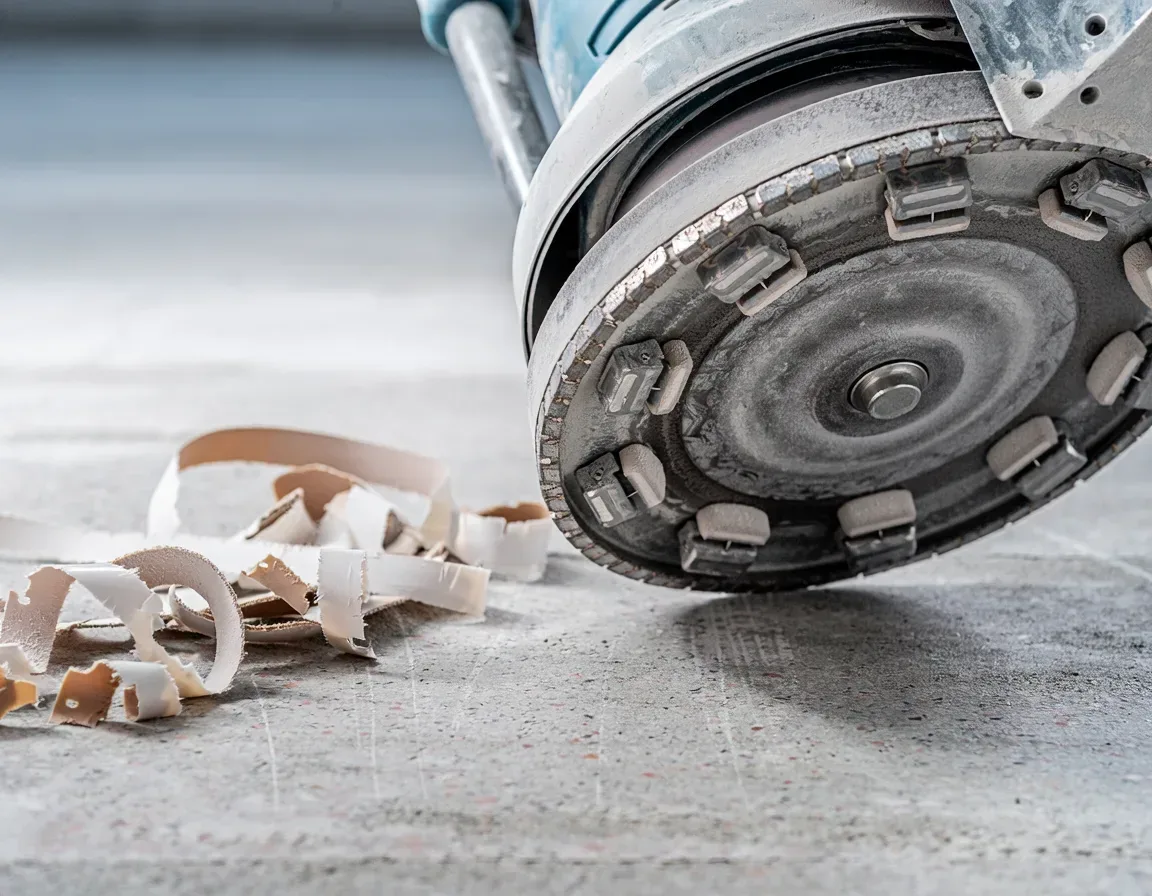
The thickness of the coating determines how the removal tool behaves under friction. Hard and brittle coatings crumble as they are worn away; flexible and heat-sensitive ones heat up and soften, are applied between the tips, and stop working. The main tools used in the field and their appropriate situations are as follows:
- Metal-bonded diamond: It removes fine floor paints and hard, thin epoxy films by eroding the top surface of the concrete and smooths the surface as it removes.
- PCD tips: Polycrystalline diamond plates work by etching rather than abrasion; thick epoxy, flexible polyurethane, and thick membranes propagate where metal-bonded diamond is clogged.
- Ball blasting: The machine, which throws steel balls onto the surface and collects dust and balls back, is fast in wide, flat, and open areas, but cannot approach wall bases or corners.
- Milling: It excavates the surface by hammering with chisels on a rotating drum; it is preferred in very thick and sandy systems and in places where a significant elevation difference is required.
- Hand machines and scraper: Wall bases, column perimeters, drain openings, and steps are places the main machine cannot reach and should be considered separately in the time calculation.
Tools are often used in turns. PCD or milling quickly removes the coating but leaves distinct scratches and grooves on the surface; if a correction is not done with a metal-bonded diamond afterwards, these marks are fully visible on polished concrete. The rough texture left by ball blasting is suitable for adhering to a new coating, whereas on a surface to be polished, an additional step is needed to wipe this texture. The difference between diamond bond types in resin, metal, and hybrid diamond inscriptions we have addressed it. Chemical removers are rarely used as the main method on large scales; they slowly dissolve thick systems and can transport dissolved resin toward the pores.
Dust, Sawdust, and Odor: Managing Uprooting Waste
Removal waste is different from silicon dust. It contains resin particles from the coating and fine mineral dust from the concrete underneath; since concrete dust contains crystalline silica, inhalation poses a serious health risk. Therefore, machines operate connected to an industrial dust extraction system, the team uses appropriate respiratory protection, and the work area is separated from other sections by a curtain. The health dimension of the issue Silica powder in dry wiping in the text We also processed it.
The type of coating also changes the shape of the waste. Thick epoxy scraped with PCD produces fragments like splinters and chips instead of fine powder; these parts fill the hose and pre-separator faster. Heated resin can stick to the filter and reduce suction power, so filter maintenance is included in the workflow during long dismantlings. Some coatings heated by friction also emit a sharp odor; ventilation and operating hours in closed parking lots and operating facilities are adjusted accordingly. Collected waste is removed from the area in sealed bags and is not swept into drains and stormwater drains.
If the content of the coating or the adhesive underneath is unknown in very old buildings, it is appropriate to have a sample taken and analyzed before dismantling. If the result is suspicious, the matter falls under the jurisdiction of the teams authorized to work with that material, and the rules in the legislation are applied.
When the Coating Develops: What Concrete Hides

The coating has covered everything underneath for years, and on the day it is removed, it is all visible at once. Therefore, the first task after dismantling is to reassess the concrete that has been opened by walking through the floor from end to end. The most common images encountered in the field and their general meanings are summarized below:
| Image | Its general meaning | What to do |
|---|---|---|
| Dark shadows that look wet | The primer is embedded in the pores of the concrete | Opens with a deeper swipe; may not go completely |
| Sharp limited patches in different colors | Repairs made before coating | Its durability is checked, and it is accepted that it will remain visible |
| Lines covered with paint or putty | Hidden cracks | Its movement is monitored, repaired again with appropriate materials |
| Tonal differences between neighboring regions | Separate casting days, different finishing | It decreases with deletion but is often selected. |
| Brown or black rings | Oil under coating | Removed with degreaser and cloth before wiping |
| Surface that crumbles like flour, scratched with a fingernail | Weak top layer | Solid concrete is reached, hardener is planned |
| Different concrete under a thin gray layer | Cement-based leveling or old screed | Its thickness and adhesion are also examined |
To distinguish whether cracks are movable or immobile and to select the right material to the concrete crack repair article you can check it. Oil stains left under the coating are also important: if grinding starts without removing oil, it scrapes the diamond surface and prevents the hardener and protector from adhering. Along with the coating, broken pits and broken joint edges are also cut and repaired upright before grinding; otherwise, the machine will open these edges even further.
How much does the appearance improve after demopping?
The most disappointing aspect in the decision to return to polished concrete is the appearance. To remove the porous part of the pavement, some of the upper surface of the concrete is also cut; this largely removes the fine cement paste on the surface. A flat gray cream surface with no aggregate visible is often not achieved on these floors. Since the cutting depth varies from region to region depending on how much the primer is processed, fine sand grains may appear in one place and coarse aggregate in another. The difference between aggregate appearances and which ones are possible in existing concrete In the article on aggregate and brightness selection We explained.
The way to reduce this uncertainty is to use the test area not only for disassembly speed but also for appearance. If small areas are opened up in different areas of the floor, such as the entrance, middle section, and wall edge, and taken to the finish stage, the business sees the result before making a decision. In areas like warehouses, parking lots, and workshops, this natural appearance is often not a problem; in stores and offices, it is not correct to promise without looking at the test area.
In terms of shine, the post-dismantling floor is not far behind a floor that has never been covered. The main difference lies in uniformity: patches, primer shadows, and repairs on the polished surface are read in a different tone than the surrounding area. This is not a workmanship defect but the history of the concrete and should be discussed in writing at the proposal stage.
Elevation, Threshold, and Passage: The Steps Left by Shield Thickness
When a thin layer of paint is removed, the floor level does not change noticeably, but when a few millimeters of cast coating or leveling mortar are removed, the floor lowers that much. Small steps appear at door thresholds, elevator entrances, around drain grates, and ramp joints. These steps are the landing points for pedestrians and impact for pallet trucks and forklifts.
Therefore, the thickness of the coating is measured at several points in the dismantling plan, and it is predetermined where the thickness to be removed will cause problems. If necessary, grates and manhole covers are reinstalled according to the new quota, and a short transition slope is made at the thresholds. If these works do not appear as separate items in the proposal, they become a subject of discussion at the end of the dismantling.
The situation is more sensitive in underfloor heated areas and coatings made on very thin screed. Since the coating will also cut from concrete, deep wiping is not done without knowing how much distance remains between pipes or insulation; project drawings or a small control hole answer this question.
When is it better to recoat instead of turning to concrete?
Dismantling is not a result but a crossroads, and it may not be right for every floor to turn to polished concrete. General comparison of the two systems In the article Is it concrete slather or epoxy? We did; here we list the situations specific to post-disassembly. We strongly recommend considering recoating in the following cases:
- Continuous chemical or wet hygiene needs: In areas such as the battery charging room, chemical warehouse, or wet food processing area, bare concrete does not create a barrier against liquid poured.
- The opened concrete is too damaged to be polished: Common surface breakage, many patches, and weak top layers do not provide a smooth surface; a thick coating gives more consistent results.
- Underneath, there is only a thin layer of leveling: If the load-bearing concrete is deep and the leveling mortar is not produced as a wear surface, it should be recoated instead of polished.
- Condition for a solid color and spotless appearance: If the business does not accept patch, shade, and tone differences, polished concrete will not meet this expectation, and a colored coating is the more appropriate choice.
On the other hand, if the coating is swelling due to moisture and there is no chemical load in the area, returning to concrete is often a more permanent route; because there is no film left to bubble up. Removal is not wasted on the floor chosen for recoating: solid, clean, and rough concrete is the first step that determines the lifespan of the new coating. If you want to see why the coating on your floor has deteriorated and what kind of concrete awaits underneath with a trial removal on site service request form You can request a discovery through it.
Non-Dismantling Islets: Shelves and Machine Bases

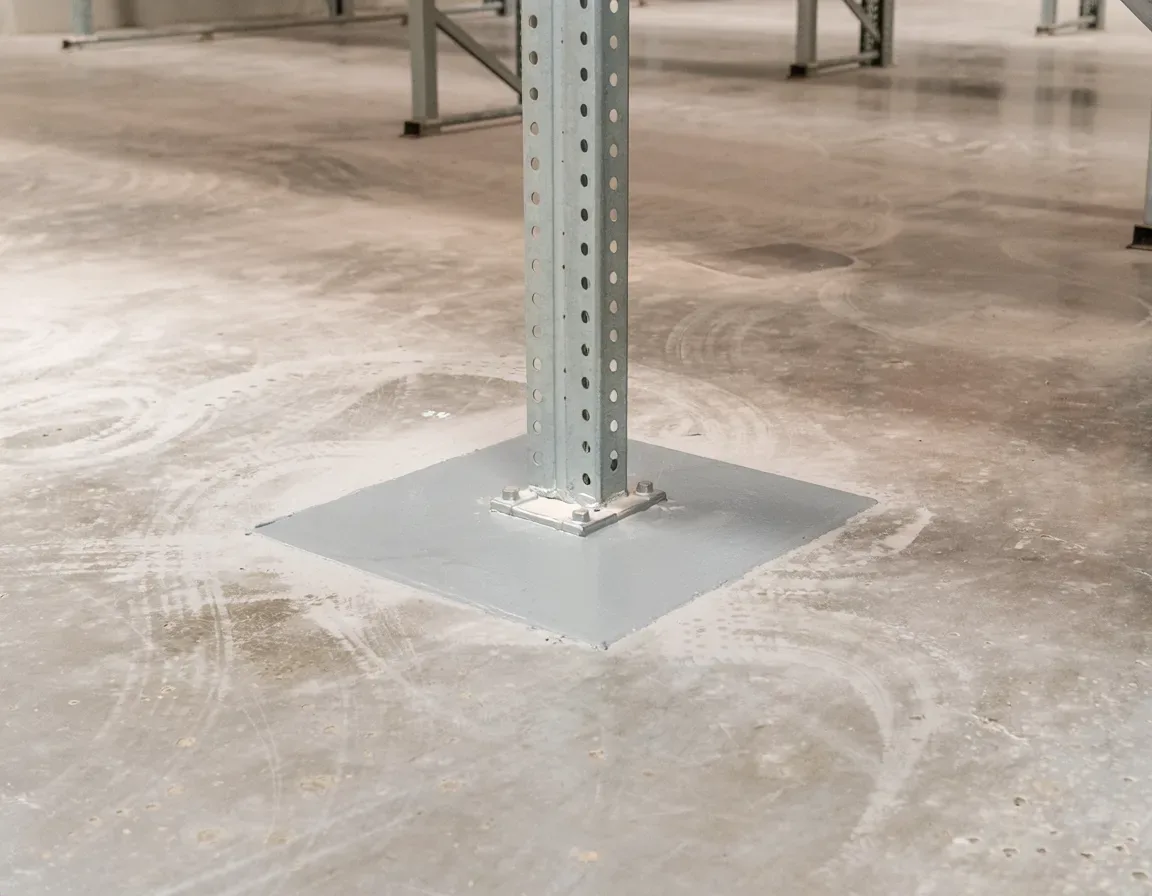
In a working warehouse or workshop, the coating can never be removed whole; the bottom of rack legs, fixed machines, and anchored equipment remains coated. The edges of these islets leave a thin step at the dismantling boundary and a gap where water can enter.
We chamble and seal these edges with a hand machine, and if necessary, we treat the islet as a separate step in the next position. If the shelves are to be moved later, it should be written from the start that the covering underneath will look different and must be added separately to the same grinder.
When the leveling mortar comes out from under the epoxy

When thick epoxy was lifted with PCD tips in a workshop, a gray, smooth layer emerged underneath; at first glance, it looked like concrete. A cross-section taken from the edges showed that this was a few millimeters of cement-based leveling mortar and that it separated from the concrete in places.
With the impact attempt, the empty sounding areas were marked, the leveling layer was completely removed and the load-bearing concrete was lowered, potholes were repaired, and the ground was wiped and hardened. If we had tried to polish the leveling, the empty areas would have broken quickly under traffic.
Start dismantling by looking at the back of a shielded part: if there is concrete behind it, the problem is on the surface; if the back is clean, it is in preparation; if there is water in the bubble, it is moisture. Both the method and the next decision come from these three answers. — Expert Note
Frequently Asked Questions About Old Coating Removal
01Can we continue to use the area while the dismantling is ongoing?
02Does the work always extend to the same extent as the coating thickens?
03Can we immediately open the floor for use once the dismantling is finished?
04Does the floor get more dust after dismantling?
05Can dismantling be done in open areas or in rain-affected areas?
06Do old line paints and directional arrows also be removed using the same method?
Related Articles
Concrete Coating or Epoxy Coating? Comparison of Lifespan and Maintenance in Large Areas, Crack Repair on Concrete Floor: Separating Moving and Immobile Cracks, Aggregate Appearance and Gloss Level Selection in Polished Concrete, Oil, Rust, and Paint Stains on Concrete Floors: Method by Stain Type, Silica Powder in Dry Iron: Health Risk in Granite and Quartz