Tire and Brake Marks in the Parking Lot: Why Does It Form, How to Clean It?
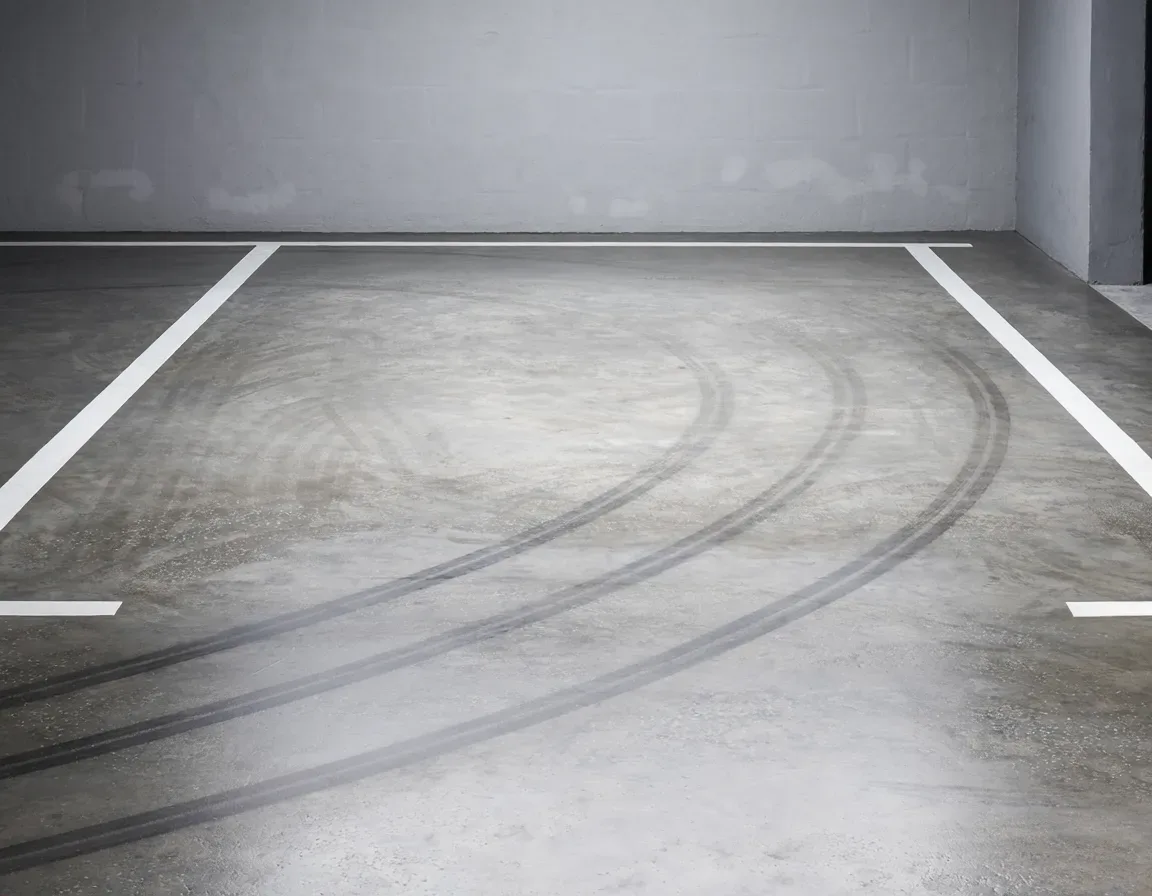
In the first weeks of a renovated parking lot, the question that comes to the manager is often the same: was the floor spotless, where did these black marks come from? Tire marks are the most visible and often misunderstood dirt on parking lot floors. Sometimes a rubber layer wiped off within minutes, sometimes a permanent shadow embedded inside the pavement; cleaning without separating either results or damages the floor. In this article, we explain how tire and brake marks form, why they behave differently on paved floors and polished concrete, in what order they are cleaned, and how they are reduced.
In short: Most black marks are rubber that breaks off the tire during turns and brakes and is plastered onto the surface, and comes off with an alkaline degreaser, sufficient waiting, and brushing. The yellowish tint left by the hot tire is a chemical stain; it can be permanent on coated floors. The mark cannot be completely prevented, but a tight surface can be removed without settling with regular washing prioritizing protection and turning points.
Same Blackness, Three Separate Remnants
Although the dark marks on the ground are given only one name, three separate residues are encountered in the field, each with a different cleaning quality. Knowing which one is being dealt with before starting the cleaning determines both the duration and the product selection:
- Rubber wear mark: It is formed by applying thin rubber that breaks off the tire to the surface during turning and braking; it stands on the ground and is mechanically removed with the correct product.
- Plasticizer stain: It occurs when oily impurities inside the hot tire penetrate the ground; it leaves a yellowish-brown tint where the tire stands and can penetrate the tread.
- Brake dust: It is a fine, dark-colored powder containing iron that wears away from the disc with the plate; it accumulates at wheel level and can turn into brown rust spots with moisture.
A simple test is enough to make the difference. A small part of the stain is dropped with diluted alkaline cleaner, left for a few minutes, and rubbed with a white cloth. If the blackness passes to the cloth and a clean floor emerges underneath, the residue is rubbery. The cloth remains clean; if the shade remains in place, the stain is not on the surface but inside it, and it should not be expected to come off with cleaning alone.
What Does Hot Rubber Leave on the Floor?
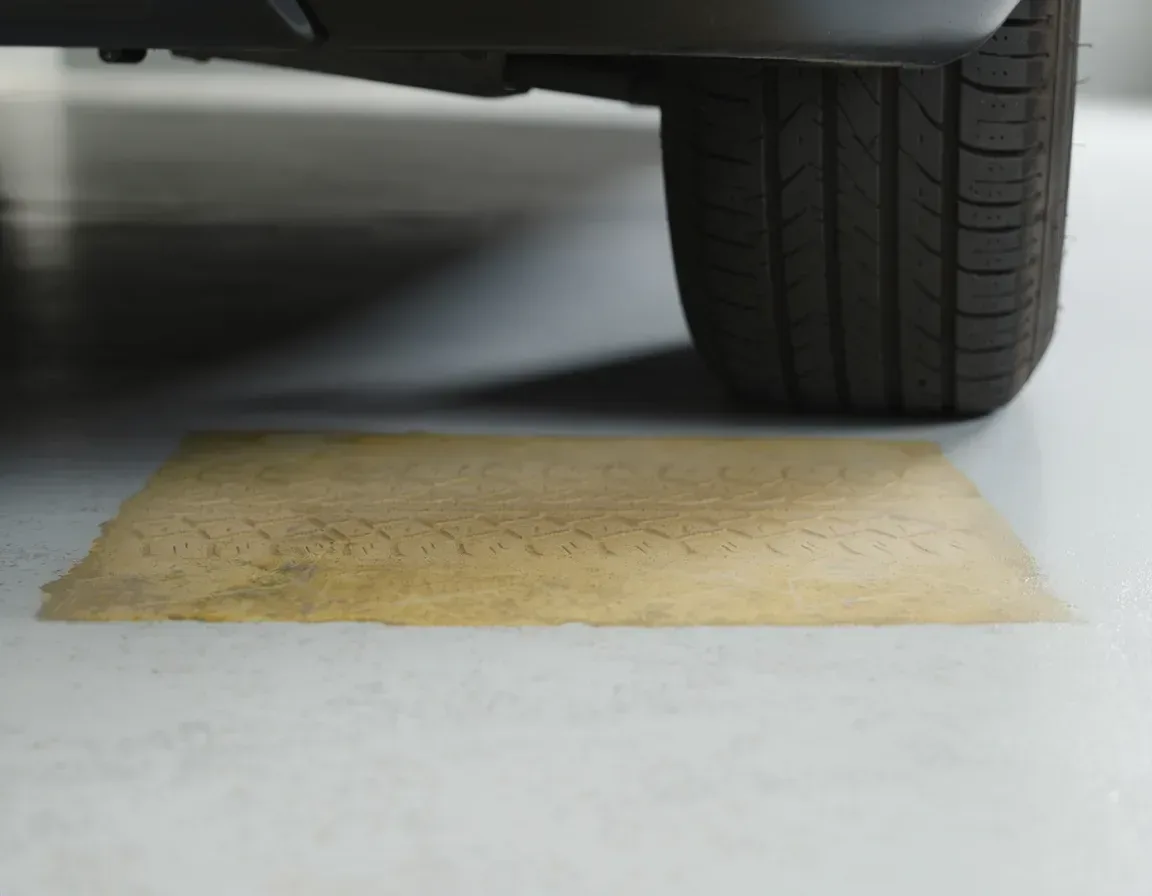
Rubber compound is not made solely of rubber; it contains carbon black, fillers, and oily softeners that keep the compound flexible. The tire heats up while driving. In summer, tires coming from a road under the sun are still hot when entering a parking lot and cool down upon contact with the ground after parking. During this cooling, some of the plasticizers reach the tire surface and then the ground.
If the floor is covered with a film, this is where the problem begins. Plasticizers are compatible with many paints and resins; they penetrate the film and soften it. In finely applied, low-solid, or unfinished coatings, the film adheres better to the tire than the ground and lifts with the tire when the vehicle moves. This damage, known in the industry as hot tire lift, appears as bare concrete islands at the four points where the tire presses. High-quality and properly thick coatings resist lifting, but the yellowish shade left by the softener can also form on them.
There is no film to lift in polished concrete; the surface is the concrete's own mineral texture and cannot be softened with rubber softener. The softener leaves a slight shadow mostly on the thin protective layer on the surface or on exposed pores. This difference is one of the factors considered when selecting the floor system in heavily used parking lots in hot climates; the two systems are fully Concrete gradient or epoxy coating? We compared them in the article.
Turning and Maneuver Points: Permission Map
The rubber trail is not evenly distributed across the parking lot. When the tire is going straight, it rolls on the ground and leaves very little material; while turning, part of the sole surface rubs sideways. The densest trail forms where the vehicle is almost stopped and the steering wheel is turned all the way to the end because the tire spins around its own axis without rolling there and ground the rubber onto the ground.
That's why tracks accumulate at specific points: ramp entrances and exits, inter-floor turns, stop-and-go lanes at entry and exit points, narrow corridor corners, and the mouths where the steering wheel is turned when entering the parking pocket. Brake marks are added at the ends of the ramp. The vehicle's weight and the tire compound also change the result; heavy vehicles and soft-compound tires leave darker tracks.
The texture of the surface determines the appearance of the mark. A very rough concrete tire wears down like a file but buries the rubber into the tissue; a very shiny floor tears off less rubber but makes the remaining mark look like a mirror. On dusty floors, rubber mixes with dust and turns into gray-black mud when washed. Marking the points where marks collect on a floor plan in a parking lot is the shortest way to determine where and how often the cleaning machine will enter.
Brake Dust and Brown Spots
Brake dust is less noticeable than tire marks but is a more insidious dirt. With every braking, fine particles break off from the disc and disc; a significant portion of these are metal. Dust accumulates on the rims, dripping water from the vehicle on rainy days or spilling spontaneously, reaching the points where the wheels stop in the parking pocket. Over time, dark gray shadows form at the front wheel alignment.
In a damp parking lot, the iron inside this dust rusts and leaves small orange-brown spots on the floor. Trying to clean brake dust by wetting it worsens the situation because it carries particles into the pores; it should first be swept dry or removed by vacuum. On settled rust spots, rust removers suitable for concrete that do not corrode the surface are tried. Acid-based products seem to dissolve rust but also eat the cement paste of the concrete and leave matte rings on the polished surface.
The same warning applies to rim cleaners used in parking lots. Some of these products are acidic; when vehicles are cleaned in parking lots, the solution dripping onto the floor leaves light-colored burns that are much more permanent than tire marks. The behavior of stains such as rust, oil, and paint on concrete Grease, rust, and paint stains on concrete floors We examined it in detail in the article.
How Does Trace Behave on Coated Floors and Polished Concrete?

The same vehicle leaves different marks on different surfaces with the same tire. The table below summarizes how the mark holds on the main surfaces encountered in parking lots and what to encounter during cleaning:
| Floor type | How does the mark hold | Behavior in cleaning | Main risk |
|---|---|---|---|
| Bare, dusty concrete | Rubber mixes with powder and is embedded in the tissue | Difficult; dirt remains in the pores | Material tearing off the surface with every wash |
| Finished, firm concrete | It stays on the surface and is barely visible on dark ground | Alkaline products and brushes are often sufficient | Slippery film combined with oil |
| Polished concrete, protected | It stands on the surface and is prominent on open ground | Easy to remove with short wait | Hard pad mattifies the protector |
| Epoxy or polyurethane coating | Rubber on top, inside the softening film | The top mark will be removed, shadows may remain | The solvent-based product softens the film |
| Acrylic paint and fine varnishes | Hot rubber sticks to the film | Cleaning often takes the film as well | Getting up with the tire |
| Rough-textured ramp | Fills with grooves and roughness | A brush is essential, the pad doesn't reach the bottom | Filled tissue reduces adhesion |
The conclusion from the table is that the cleaning method should be chosen according to the floor. A stiff brush that works well on polished concrete can remove a thin paint film; a product that is harmless in the coating can dull the protective in the concrete. If you are unsure about what the floor is, learning before cleaning is cheaper than repairing later.
Cleaning Order: Solvent, Standby, Brush
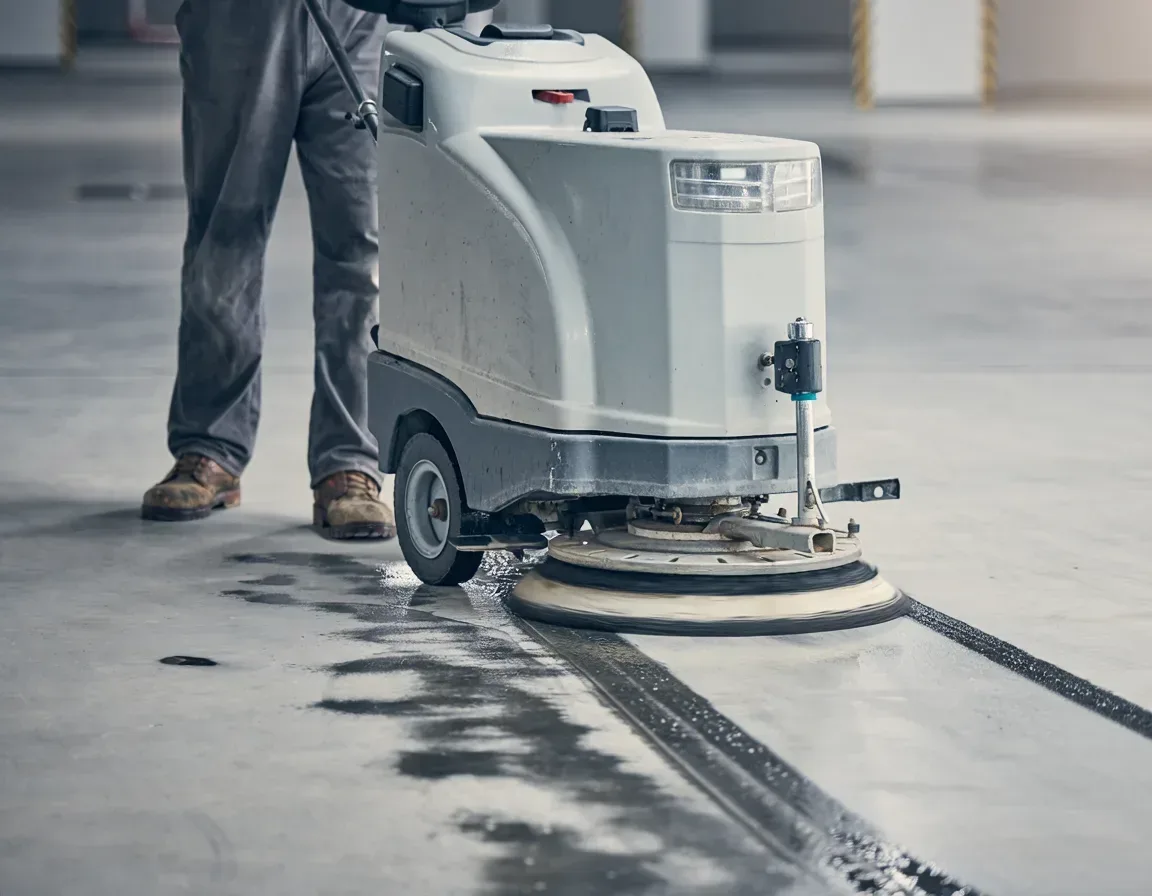
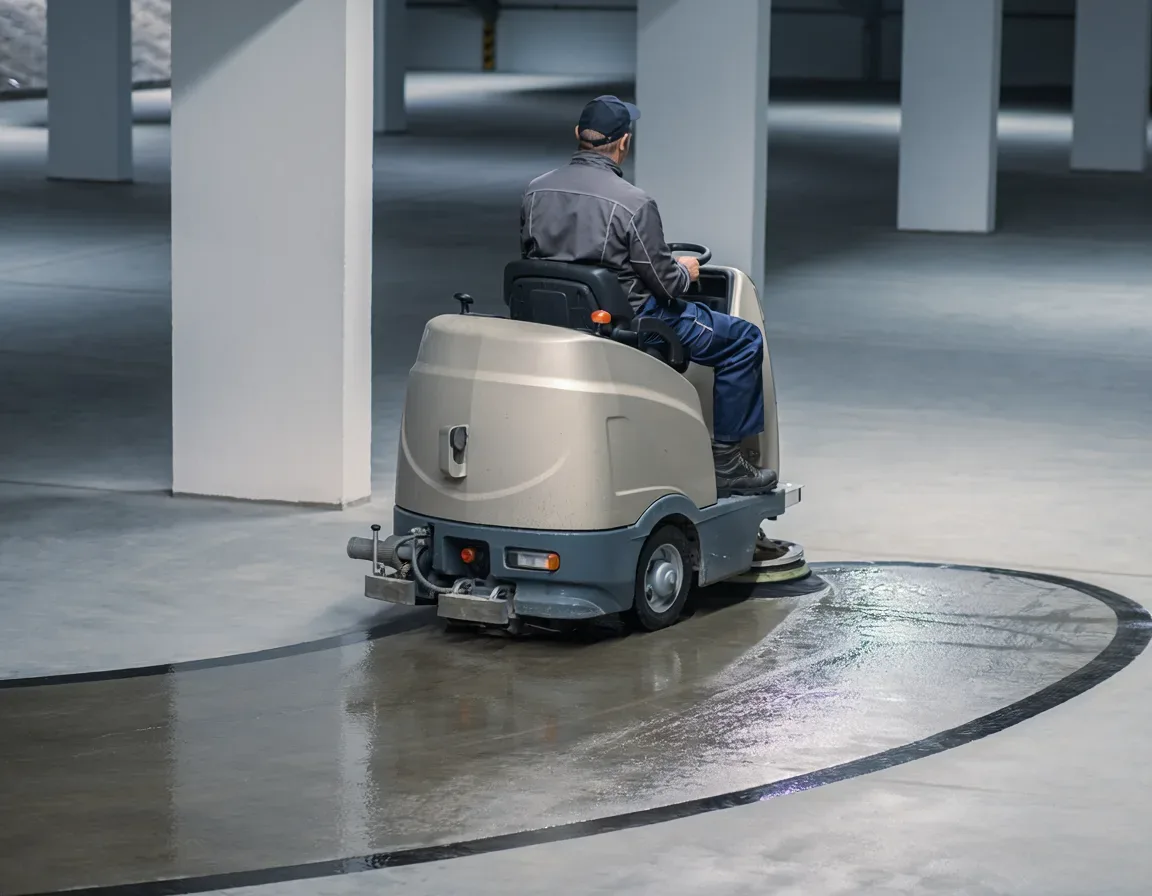
In cleaning a rubber mark, the order and duration are decisive more than force. Alkaline degreasers soften the rubber layer and the oily dirt that binds it to the ground; however, they need to remain wet on the surface for a while. The order we apply is as follows:
- Dry pre-cleaning: Sand, gravel, and brake dust are removed by sweeping or vacuum; when wet, it turns into mud and scratches the surface under the brush.
- Product distribution: Alkaline oil is diluted at the ratio on the label suitable for concrete and applied to sections large enough to be processed without drying out according to the trace density.
- Waiting time: The manufacturer's recommended time for the product to take effect is usually expected to take between a few minutes and a quarter of an hour for most products, and the surface is not allowed to dry.
- Brush or pad: The softened layer is scrubbed with a brushed floor machine or a pad suitable for the surface; a brush is more effective on rough-textured floors, and a pad on flat surfaces.
- Collection and rinsing: The dirty solution is collected by vacuum before drying on the floor, the surface is rinsed with clean water, leaving no alkaline residue.
Pad selection is half the result. Soft pads or diamond-impregnated care pads are used in polished concrete; hard black pads produced for removal remove the mark while also opening the protector and leaving a matte stripe on the traffic path. The machine, pad, and product relationship we explain for natural stone floor washing machine The logic in the article also applies to concrete. How alkaline products dissolve dirt and why they need to be rinsed cleaning chemistry You can find it in the article.
For marks that do not appear in the first round, it is safer to repeat the process rather than reinforce the product. Warm water enhances the effect. Special tire track cleaners containing citrus-based solvents work on stubborn layers, but since they can affect some protectors and coatings, they are first tested on a small area out of sight. The floor remains wet and slippery throughout the work; for zone separation and warning order wet ground management The rules in the article are also applied here.
Methods to Avoid
Since tire marks look stubborn, tools that are too hard are often used for cleaning. The methods that cause more damage to the floor than the mark are as follows:
- Strong solvents: Thinners and similar solvents soften the coating and line paint while dissolving rubber, while in polished concrete, they remove the protector and leave a matte stain.
- Wire brush and metal scraper: It scratches the surface; scratches turn into permanent matte strips on polished concrete, and in coatings, they turn into openings where water enters, and broken wire pieces later rust.
- Acidic cleaners: They have no effect on rubber; instead, they corrode the surface of concrete, extinguish gloss, and open pores, causing the next mark to work deeper.
- Dry and high-speed rubbing: Rubbing with a hard pad without using the product generates heat, spreads the rubber on the surface instead of removing it, and can burn the protector.
Pressurized water alone is not a solution. It is difficult to manage large amounts of water in an indoor parking lot, and the rubber layer cannot be easily removed by water alone without softening it with the product.
Reducing Trace: Surface, Protector, and Washing Frequency
It cannot be promised that there will be no tire marks on the ground the vehicle enters; the goal is to remove the mark easily and without settling it. The first condition for this is a firm surface. Hardened concrete left at a satin level does not absorb rubber into its pores; the mark remains on the surface and comes off in a single pass. The protective applied to polished concrete strengthens this effect but wears down at turning points and needs to be renewed at certain intervals.
The second condition is timing. Fresh rubber marks are soft; the mark, which has been waiting for weeks, hardens, is layered with new layers, and forms a crust with the dust. Therefore, the frequency of machine washing is determined not by the entire parking lot but by the trail map: entry-exits, ramp ends, and turning points are washed once a week or more in busy parking lots, driving lanes are less frequent, and parking pockets are washed during periods when they are empty. The exact range depends on the number of vehicles; the criterion is that the trail has not debarked since the previous wash.
The third condition is to leave no residue. Poorly rinsed cleaning products leave a sticky film on the floor; this film both holds the rubber more easily and increases the tire noise during turns. How to distribute daily, weekly, and yearly tasks parking floor maintenance plan We presented it in the form of a table.
Situations Where Cleanliness Is Not Sufficient
Some marks do not come off with cleaning and must be stated upfront. The softener shade embedded inside the coating is permanent; if the image is disturbing, the solution is to renew the top layer in that area. Patching coatings that have lifted with rubber is short-lived because the cause of peeling is mostly in the entire film.
In polished concrete, turning points that have not been cleaned for years can be both streaked and dull. In such areas, high-speed polishing and protective regeneration after deep cleaning are often sufficient; if the surface is scratched, only the final diamond steps are repeated on that strip. In bare and dusty concrete, the mark is a result, not a cause: unless the surface is tightened, each cleaning lasts shorter than the last.
A few close-up photos to see what kind of marks are on your parking lot and whether the floor will be cleaned or finished with a surface treatment. service request form You can send it through. A small trial cleaning on site often gives the answer to the question the same day.
First Weeks on New Ground

The first weeks after floor renewal are the easiest time to settle the trail. When resin coatings harden enough to be walked, they do not reach full strength; a hot tire parked before this period can soften and lift the film. Therefore, complying with the manufacturer's vehicle traffic deadline is not negotiable.
There is no film cure to expect in polished concrete, but if the preservative is newly applied, cleaning with a hard pad and strong chemicals are avoided in the first days. Removing the first marks immediately with a neutral product and soft pad determines the appearance of the floor in the following years.
Turnaround Point Routine in a Shopping Mall Parking Lot

It is neither possible nor necessary to wash the entire floor every night in a busy shopping mall parking lot. Instead, we mark the points on the floor plan where traces are collected and give the machine operator a short route consisting of these points: ramp openings, in front of the payment point, and turns between floors.
The operator travels this route several times a week, leaving the product to sit for a few minutes; the entire driving path is washed less frequently. This reduces machine time, tracks are removed without debarking, and the preservative's lifespan is extended.
Extend the waiting time before reinforcing the product on the tire track: a medium-strength alkaline cleaner that stays wet on the surface will remove more marks and cause less damage to the floor than a strong product that is brushed immediately. — Expert Note
Frequently Asked Questions About Tires and Brake Marks in Parking
01Does a tire mark indicate that the floor is made defectively?
02Is parking closed during tire track cleaning?
03Can dirty water from cleaning be given to the drain?
04Why do scars form more often in summer and less so in winter?
05Does applying a protector completely prevent tire marks?
06How to clean tire marks on parking lines?
Related Articles
Parking Floor Maintenance Plan: Daily, Monthly, and Yearly Tasks, Oil, Rust, and Paint Stains on Concrete Floors: Method by Stain Type, Polished Concrete Care: From Daily Cleaning to Repolishing, Concrete Coating or Epoxy Coating? Comparison of Lifespan and Maintenance in Large Areas, Floor Washing Machine and Natural Stone: The Right Pad and Product in an Automatic Machine