Non-slip and Wear on Parking Ramps
A significant portion of accidents and complaints in a parking lot happen not on the floor floor but on the ramp. A vehicle that skidds on a rainy morning while starting, another vehicle sliding while braking on landing, a resident who slips while walking along the edge of the ramp: their common point is that the ramp surface loses grip due to slope, water, and dirt. The ramp is also the fastest wearing concrete surface in the parking lot; it is where the wheel applies the most force at every pass. In this article, we explain why concrete vehicle ramps become slippery, where wear intensifies, how and by which method it is repaired, and how to monitor the ramp afterwards.
In short: The goal of a ramp is not shine but glazing; a glossy polish is not applied to the ramp. A slippery concrete ramp is first cleaned, then its texture is re-opened up: cross-groove opening, rough wiping, ball blasting, or non-slip aggregate coating are chosen according to the slope of the ramp, traffic, and the condition of the concrete. If cracks at the start and end of the ramp, opened joints, and insufficient water drainage are not treated as part of the same work, the new texture will also disappear quickly.
Why Is the Ramp the Hardest Surface of Parking?
On a flat floor, the vehicle mostly moves at a steady and low speed; the force between the wheel and the concrete is small. On a ramp, the vehicle either wants to pull uphill or brakes downhill. In both cases, the tire drags the concrete in its own direction, and rough surfaces carry part of this force. As the slope increases, the need for grip also increases; a weakness unnoticed in dry concrete turns into a spinning on wet and dirty surfaces.
The slope of the ramp is determined in the design, and legislation sets an upper limit on this matter. The Parking Regulation grants separate upper limits for ramp slopes for public parking lots and buildings that meet parking needs within their own structure; since the regulation changes over time, current and binding values should always be checked from the latest text in the Official Gazette and the approved drawing of the project. It is not possible to replace the slope of an existing ramp with groundworks. What can be done on a steep ramp is to bring and maintain the surface adhesion to the slope.
Another factor that makes the ramp difficult is its location. The ramp is the concrete surface where everything coming from outside comes into contact first: rainwater, sand and mud carried by tires, and pieces that break off from the asphalt that softens on hot summer days are left there first. Even if the floor of the covered parking lot is renewed, the ramp continues to carry this load. The renewal of the floor floor is also In the covered parking floor renewal article We explained.
What Happens on a Wet Ramp? Skidding, Slipping, and Falling
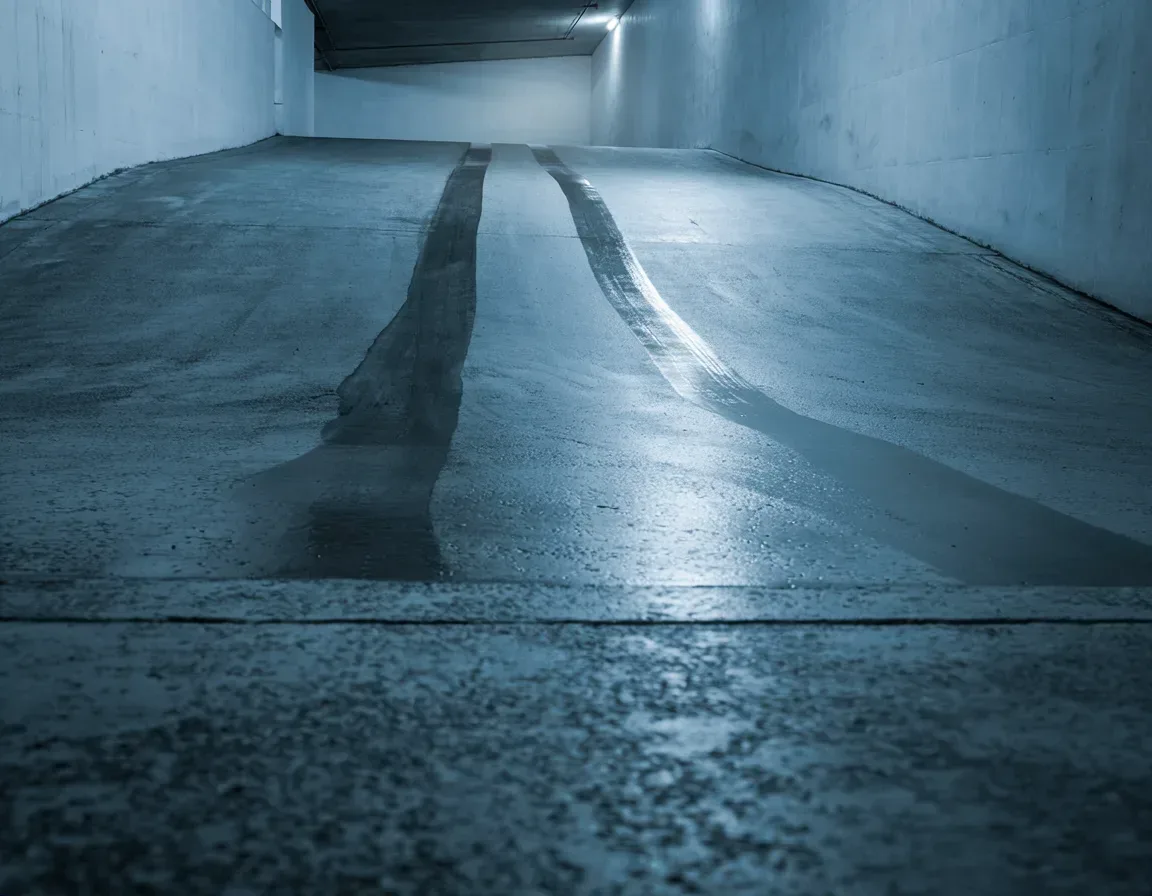
On a dry concrete ramp, the rubber adheres to the sand and aggregate grains on the concrete surface. When water enters, a thin film forms between the rubber and the concrete. If the surface is rough, the grains pierce this film and maintain contact with the tire; if the surface is flattened, the film remains uninterrupted and adhesion quickly decreases. The main cause of slipperiness on the ramp is often not the water itself but the loss of the tissue underwater over the years.
The texture disappears in two ways. The first is the wear of cement paste on the concrete surface due to tire friction and the polishing of the aggregate peaks; the concrete darkens on the tires and begins to reflect light. The second is when oil droplets, rubber rubber and fine dust fill the pores, creating a sticky layer on the surface. The first rain after a long dry period wets this layer and spreads it onto the surface as a slippery mixture; therefore, many ramps are more dangerous in the first rain than the downpour itself.
The situation is different for pedestrians. The driver senses the skidding and slows down; when the pedestrian steps on a sloped surface with their heel, the contact area with the ground is small, making slipping easier on wet, flattened concrete. If the pedestrian path in the parking lot passes through the ramp or if residents use the ramp as a shortcut, the ramp should also be considered for pedestrian safety. Principles of accident prevention on wet surfaces in wet ground accident prevention article We collected them.
Wear Map: Ramp Head, Ramp End, and Wheel Track
Wear is not evenly distributed along the ramp. Looking at the field, we see that the most noticeable damage is concentrated in three areas:
- Slope breakpoints: At the start and end of the ramp, the vehicle suspension is compressed and opened, the wheel is loaded onto the concrete by impact, and breakage, breakage, and pitting are first seen here.
- Tire track strips: Since most vehicles use the ramp from the same line, two parallel lanes flatten, darken, and slip much faster than the other areas.
- Seams and joints: The joints, grids, and channel edges where the ramp and floor slab meet directly receive wheel impact, their edges break, and water enters the opened void.
This map has a practical result. It is often not necessary to treat the entire ramp using the same method, but treating only wheel tracks is not enough; when the worn strip is corrected, traffic shifts by a few centimeters and the neighboring area begins to wear down. Broken ramp crossings and joint edges are repaired before the texture work is done, because a broken edge quickly breaks the newly opened tissue. Repair methods In the article on pothole and joint edge repair We explained.
Diagnosis: Reading the Ramp
To choose the right method, it is first necessary to see the current condition of the ramp in detail. During a walking tour on a dry day, the color and brightness of the tire tracks, the roughness of the surface when touched with the palm, and if there is any groove or texture, how much remains are noted. Then the ramp is moistened in a controlled manner; where the water flows, where it accumulates, and in which strip the surface shines is read much more clearly while wet.
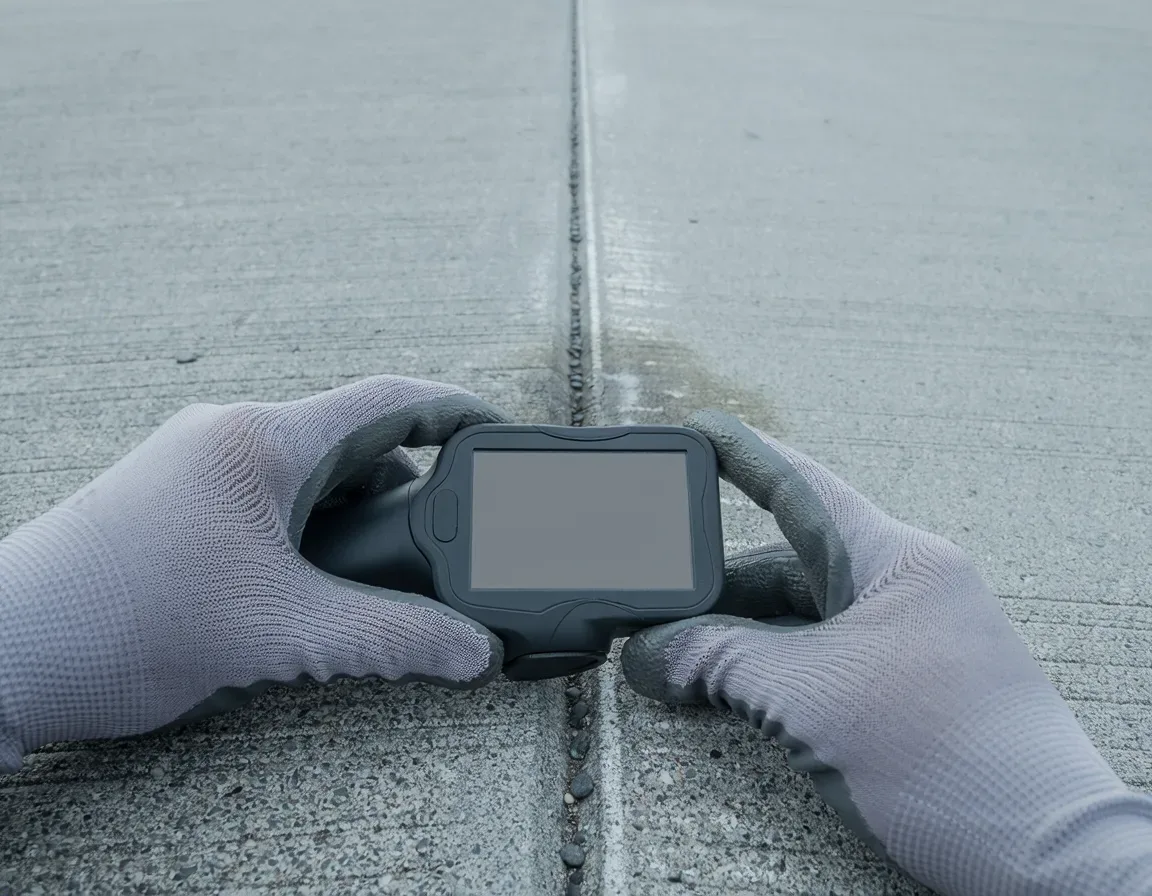
Measurements can also be taken alongside eye and hand tests. Wet slip resistance is measured with a pendulum device, and the ramp is compared with the floor floor at different points. Measurement, especially when done before and after work, shows the impact of the work with numbers and serves as the basis for the report to be presented to the board of directors. How measurement values are interpreted How to read anti-slip values in the article We also explained.
The final part of the diagnosis is the concrete itself. It is learned how the ramp surface responds to the scratch test, whether it is a no-noise area when hammered, and whether the ramp is a slab sitting on the ground or a slab with another layer underneath. This final information determines how deeply the surface can be interfered with.
Transverse Guttering: The Classic Solution of the Ramp
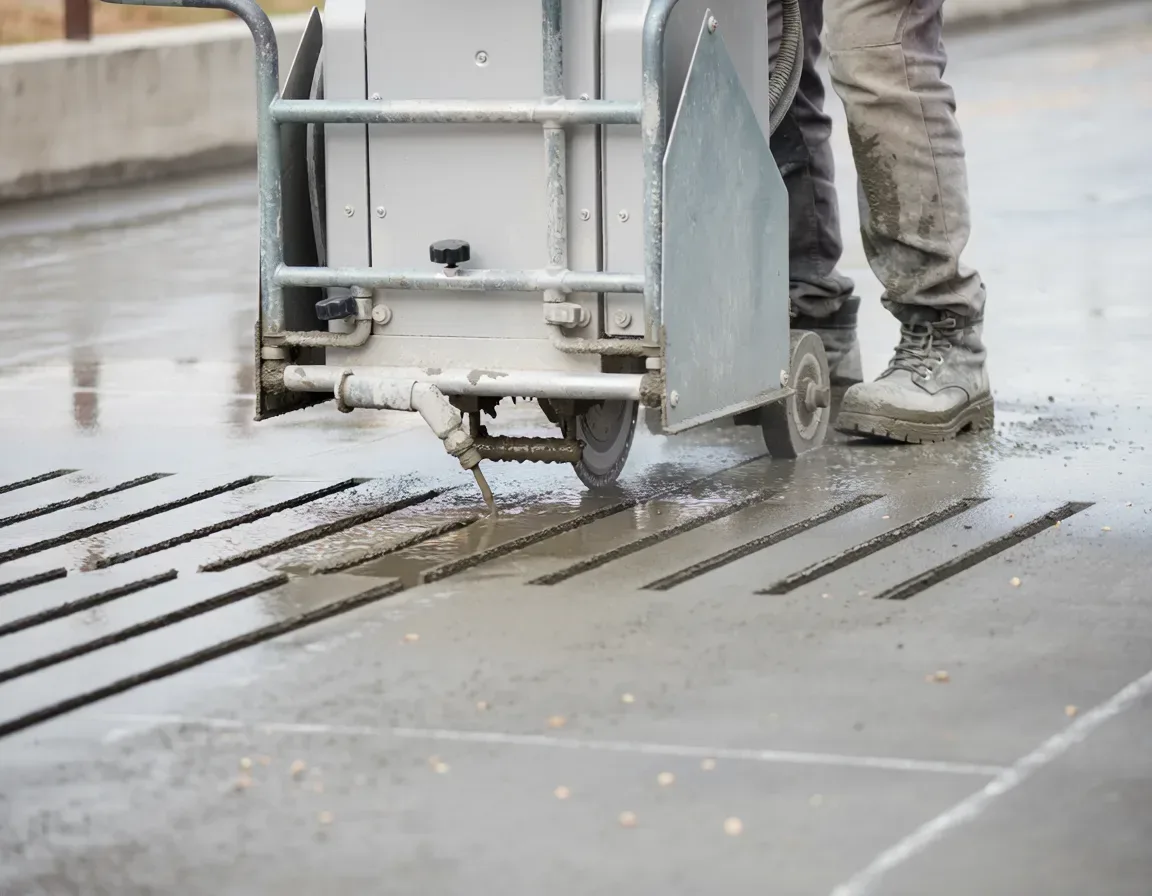
A common solution on concrete ramps is to make shallow and parallel grooves on the surface with a diamond saw. The grooves are cut perpendicular to the slope, that is, transversely toward the vehicle. They do two things: they give the tire a new adhesion line at each groove edge and allow surface water to escape into the groove without forming a film under the tire. The width, depth, and spacing of the groove are determined by the slope of the ramp, the condition of the concrete, and traffic; these values vary by project, and no single measurement fits every ramp.
Guttering has its own specific points of attention. Gutters are often planned at a slight angle to direct water to the edges of the ramp or the channel below; otherwise, water stagnates in the gutter and fills with dirt. Sharp gutter edges accelerate edge breakage, so softening the edges is desirable. On a weak and sandy surface, the saw displaces aggregate; on such a ramp, the weak layer is removed first, then the gutter is opened.
A similar texture can be applied in the pouring on freshly poured ramps: a transverse line or herringbone pattern is drawn on the surface with a profiled tool before the concrete hardens. On an existing ramp, this texture is only achieved by cutting. In both cases, the distance between the groove depth and the reinforcement should be taken into account; this topic is also addressed separately in the box below.
Other Methods and Glossy Polishing on the Ramp

A gutter is not the only correct one for every ramp. Sometimes a deep cleaning alone makes a big difference, sometimes the surface needs a completely new texture. The table below compares the methods we use for the ramp:
| Method | What it provides | Suitable ramp | To be careful |
|---|---|---|---|
| Deep cleaning | It removes the oil, rubber, and dust layers, restoring the existing texture | A dirty ramp with a still distinct texture | It is a prerequisite; it does not fix a flattened surface on its own |
| Coarse smoothing and hardening | It takes the flattened dough, creating a rough and firm surface | Ramp with medium slope, solid concrete | Thin steps are not taken; the rough steps are left |
| Ball spraying | Evenly roughens the surface | Wide, flat, and smooth ramp | Requires attention at the joints and grate edges |
| Transverse groove opening | Provides a grip line and a way for water to escape | Steep, frequently wet ramp | Reinforcement distance and gutter cleaning should be monitored |
| Non-slip aggregate coating | Provides high adhesion with a rigid aggregate resin layer | Very steep, spiral, or heavily trafficked ramp | Moisture from below, adhesion, and periodic renewal are required |
Non-slip aggregate coatings are made by sprinkling hard grains such as corundum, calcined bauxite, or quartz inside or on top of an epoxy or polyurethane-based binder. It is one of the options that increases adhesion the most, but since it is a coating, it depends on its adhesion to the concrete; it can bubble on a ramp that absorbs moisture from below or is poorly prepared, and grains wear down the wheel tracks over time. Therefore, the decision to cover is made along with the ramp's moisture status and maintenance plan.
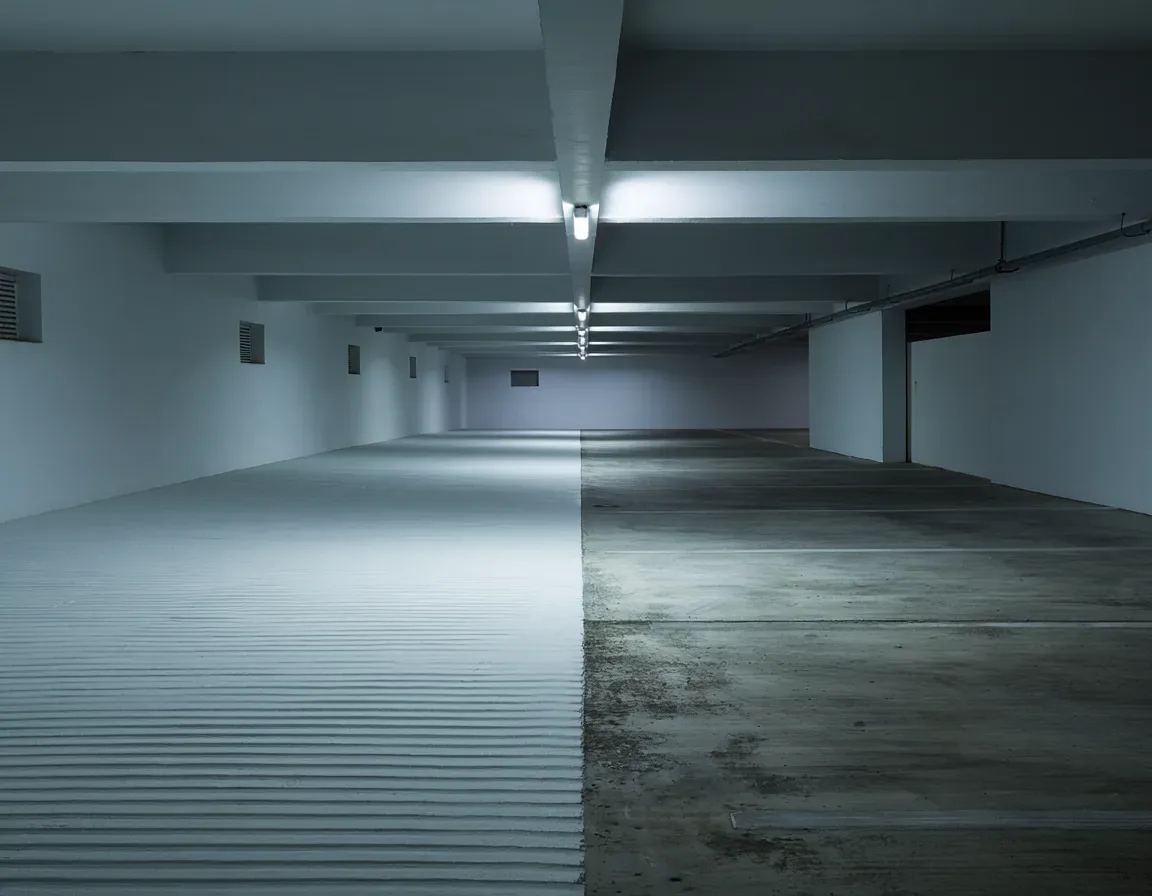
There is no polishing on any line of the table because gloss is not applied on the ramp. Thin diamond steps cover the surface and significantly reduce wet grip. One more detail is important in polished floor parking lots: a vehicle descending from the ramp releases water from its tire onto the floor floor within the first few meters. We recommend leaving this transition area just in front of the ramp entrance more matte and rougher than the floor floor. The balance between shine and non-slip In the article on the balance of brightness and non-slip we addressed it.
Water: The Problem Coming From Above the Ramp
Holding on the ramp and water drainage are inseparable. If there is no grate or channel at the top of the ramp to collect water or if it is blocked, the rainwater flows along the ramp like a stream; this flowing water both reduces adhesion and carries dirt to the bottom of the ramp. If the channel at the lower end of the ramp is insufficient, water accumulates there and pools form at the most frequently used point of the floor floor.
Before groundwork, the channels and grates must be cleaned, the grate covers must be properly aligned, and if necessary, the gutter direction planned to direct water to these channels. Loose grate covers make noise with every passage and break the surrounding concrete; securing them is also part of the job. Where and why water accumulates inside the parking lot, and how drains will be opened In the article on water accumulation in the parking lot We explained in detail.
Screw Ramps and Pedestrian Strip
In screw ramps, the vehicle both slopes and turns simultaneously. Turning also applies a lateral force to the tire; wear is therefore concentrated on the outer wheel track, and the outer edge of the ramp flattens faster than the inner edge. On flat ramps, transverse grooves are planned toward the center of the helical ramp, that is, perpendicular to the turn. In very steep and narrow spirals, non-slip aggregate coating is a frequently preferred option because high grip is required at every point of the surface against the turning force.
If pedestrians also use the ramp, the pedestrian lane should be considered separately. Deep grooves opened for vehicles can be uncomfortable for high heels, wheelchairs, and strollers. Therefore, a thinner texture or a separate non-slip surface is preferred in the pedestrian lane; the lane is visually separated from the vehicle path and placed aside where the handrail is located. Preventing the ramp from being used as a shortcut when there is a separate staircase or elevator for pedestrians is also the management's responsibility.
Ramp Maintenance and Monitoring
If the newly opened tissue is not cleaned, it fills with dirt within a few months and the ramp returns to its original state. The ramp should be swept more frequently than the floor floor; sand and gravel fill the grooves and act as abrasive agents under the rubber. Regular washing is done with a brush machine or suitable cleaner to remove oil and rubber buildup; on corrugated surfaces, make sure the brush reaches the grooves; dirt accumulated in the grooves is not noticeable when viewed from the surface, but it reduces adhesion the most.
A simple arrangement is sufficient for monitoring. Before the rainy season, channels and grates are opened, and joints and edges at the start and end of the ramp are checked. Once a year, the ramp is checked by walking while wet; if measurements were taken before work, they are measured again at the same points to see how well the texture is preserved. When shine on tire tracks resumes, the entire ramp does not need to be renewed; often, a light rough treatment is sufficient only on those lanes.
If you have complaints of slipping on your ramp, a break at the top of the ramp, or water leaking in in the rain, here are a few photos of the ramp taken both dry and wet, along with its approximate length and slope type service request form you can transmit it to; we inspect it on site and together develop the appropriate method and work plan for the ramp.
Pay Attention to Reinforcement When Opening Gutters

The reinforcement inside the ramp concrete is protected from the surface by a certain rust allowance. If the groove depth narrows this allowance, moisture and chloride can reach the reinforcement more easily, and corrosion may begin over the years. This issue is even more important in suspended ramps with another layer underneath.
Therefore, before cutting, we inspect the project and, if necessary, measure the rust margin on-site with a reinforcement scanning device. For slabs with backstretched or unknown projects, the opinion of the building's engineer should be obtained before cutting.
Night Work on a Single-Entry Ramp

In a residence parking lot where one enters and exits through a single ramp, it was not possible to close the ramp. We divided the ramp lengthwise into two; on the first night, cleaning and guttering were done halfway and the other half was used one-way with an attendant.
On the second night, we moved to the other half and repaired the broken passage at the top of the ramp with quick-setting mortar. No vehicle gutters were opened in the pedestrian lane; the lane was left with a separate thin texture.
Assess the slope's slipperiness not on a dry day but after the first rain; unless diagnosis and measurement are done on wet surfaces, the real risk of the slope is not visible. — Expert Note
Frequently Asked Questions About Parking Ramp Non-slip Issues
01Can parking be used while working on the ramp?
02Is guttering a dusty and noisy job?
03Is it enough to stick non-slip tape or sprinkle sand on the ramp?
04Do grooves damage vehicle tires or make noise?
05How long does newly opened tissue remain effective?
06Can ramp work be done during the rainy season?
Related Articles
How to Read Anti-Slip Values? R Class, Pendulum Test, and Wet Ground, Water Accumulation in Parking Lot: Slope, Drain, and Pond Problems, Covered Parking Floor Renewal: Dust-Free and Bright Parking with Concrete Cleaning, Tire and Brake Marks in the Parking Lot: Why Does It Form, How to Clean It?, Pit, Breakage, and Joint Edge Repair on Concrete Floors