Why Does a Concrete Floor Dust Out? Causes and Diagnosis of Surface Weakness
The first complaint about a dusty concrete floor usually goes to the cleaning team: swept up, washed, and the next day the same gray powder again. However, in most cases, the problem is not cleaning but the top few millimeters of concrete, and that layer thins a bit with each sweeping. The correct solution depends on the cause of the dust and how deep the weak layer has gone; the same symptom is resolved with a single impregnation on one floor, and only with surface renewal on another. In this article, we explain in sequence the causes of dust from the day of pouring to years after, the tools performed on site, how to read the cause from the dust distribution on the floor, and the possible solutions.
In short: Concrete dusting results from the cement mixture on the surface being weak from the start or weakening over time; the most common causes are perspiration water absorbing to the surface, insufficient curing, and wear over the years. Wiping, booting, tape, and water droplet tests indicate the degree of weakness. For light dusting, a hardener is sufficient; if the weak layer is thick, it should be removed first; if the concrete is weak from the start, the surface should be renewed.
Remove First: Dust from the Floor or Outside?
Not every gray dust is concrete dust. Soil carried by vehicle tires, sand entering by the wind, field dust from the loading gate, plaster left from renovations, and paint dust also cover the floor. What they have in common is that they run out when the source is cut. The concrete dust itself reforms even in a corner where no one enters because it is the soil itself that produces it.
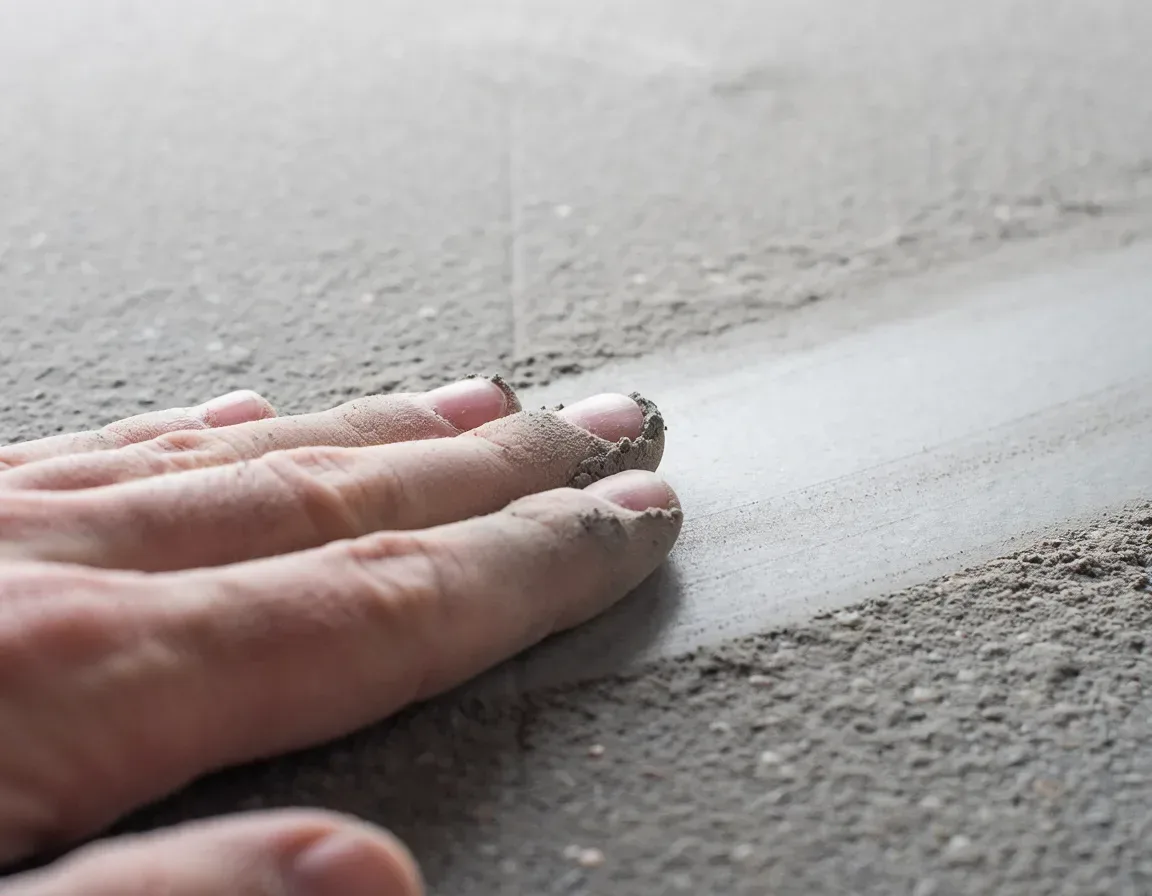
An easy way to distinguish is to vacuum a section of the floor thoroughly and leave it in normal use for a few days and see where the dust accumulates. Dirt coming from outside accumulates along the traffic route and in front of doors, decreasing in the inner corners; concrete dust, although more abundant in high-traffic areas, appears everywhere in the same light gray tone. The color is also a clue: soil dust mostly leans toward brown, concrete dust is the color of the floor itself, and slides between your fingers like flour.
The distinction also reveals an important detail: the two welds often work together. Outside sand acts like sand, rubber, and rubber, and under the wheel, eroding the weak surface faster. Therefore, dust at door fronts and ramp bottoms starts before the inner areas of the same concrete.
Seeds Sown on the Day of Casting
The most common causes of dust lie in work done while the concrete is fresher. After the concrete is placed, heavy particles settle down, water rises, and a bright water layer appears on the surface for a while; this is called perspiration. If this water is worked with a trowel or trowel without removal, the water is fed back into the cement paste on the surface. As a result, the water-cement ratio rises at the top few millimeters, and the layer most exposed to wear becomes the weakest part of the concrete.
Early polishing produces a similar result in a different way. If the surface is covered before sweating is finished, water trying to escape from below accumulates just under the closed crust; this area remains weak and can gradually crust. Adding water to the mixture on site or sprinkling water on the surface to facilitate grinding also thins the same layer.
Another common habit is to sprinkle dry cement or a cement-sand mixture on top to quickly dry the sweaty surface. This material absorbs water but does not form a smooth whole with concrete; it leaves a thin crust on the surface that is weak and easily disintegrated. Finally, the dough on top of a floor that has been exposed to rain without setting is washed or watered, leaving behind a sandy surface.
Mistakes Made in the First Weeks: Cure, Heat, and Cold
Cement needs water to harden, and this need does not end with the day of pouring. Keeping concrete moist in the first days is called curing; a wet cover is done by spraying water or curing material. If no curing is done, the cement on the surface dries before completing the reaction; the inner part gains strength while the outermost layer remains brittle and porous.
Hot and windy weather increases this risk. In Mediterranean climates, during summer pours left until midday, the surface loses water very quickly; if curing is neglected in an open-edged loading area or a sunny parking lot, dust starts in the first year. On the cold side, there are two dangers. If fresh concrete freezes, the water on the surface expands and loosens the layer. The exhaust of flueless, combustion heaters used to keep concrete warm in enclosed spaces can carbonate the fresh surface and weaken it; this possibility should be kept in mind on spilled floors at closed construction sites in winter.
How to prevent these mistakes on a new surface and the place of the erase in the construction site schedule Time to simmer in newly poured concrete in the text We explained.
Weakness That Comes Over the Years
If a floor does not dust when it is new and the problem started later, the reason is mostly due to time. The first is wear: tire, pallet truck, and forklift wheels, drifting pallets, and especially the sand they carry thin the tight top layer over the years. When this layer is finished, the more porous concrete underneath is exposed and accelerates dust decay.
The second is carbonation. Calcium hydroxide in concrete gradually reacts with carbon dioxide in the air. This process alone does not always weaken the surface, but combined with wear on an already weak surface, it can increase dusting. The third is improper cleaning: acidic products dissolve cement binder, machines with hard wire brushes tear off loose grains, and the floor constantly submerged in water gradually washes away weak dough.
The last reason is the concrete itself. Floors prepared with a low cement dosage, diluted, or actually sandy leveling screed rather than concrete remain insufficient as a wear surface even with a careful shovel. In this case, the powder is not a surface defect but the material's limit, and the solution is chosen accordingly.
Simple Tests Conducted in the Field
Often, a laboratory is not required to understand the cause and depth of dusting; a few simple trials answer most of the questions in the discovery. We work in the following order:
- Deletion test: A cleaned area left for a day is wiped with a dark-colored cloth or fingertip; if a light gray mark like flour remains on the cloth, the surface is eroding itself.
- Boot test: The surface is scratched with a steel tip or with known hardness using drawing pencils; on solid concrete, the tip is forced and a thin line remains, a cavity is opened on the weak surface, and powder accumulates on both sides of the line.
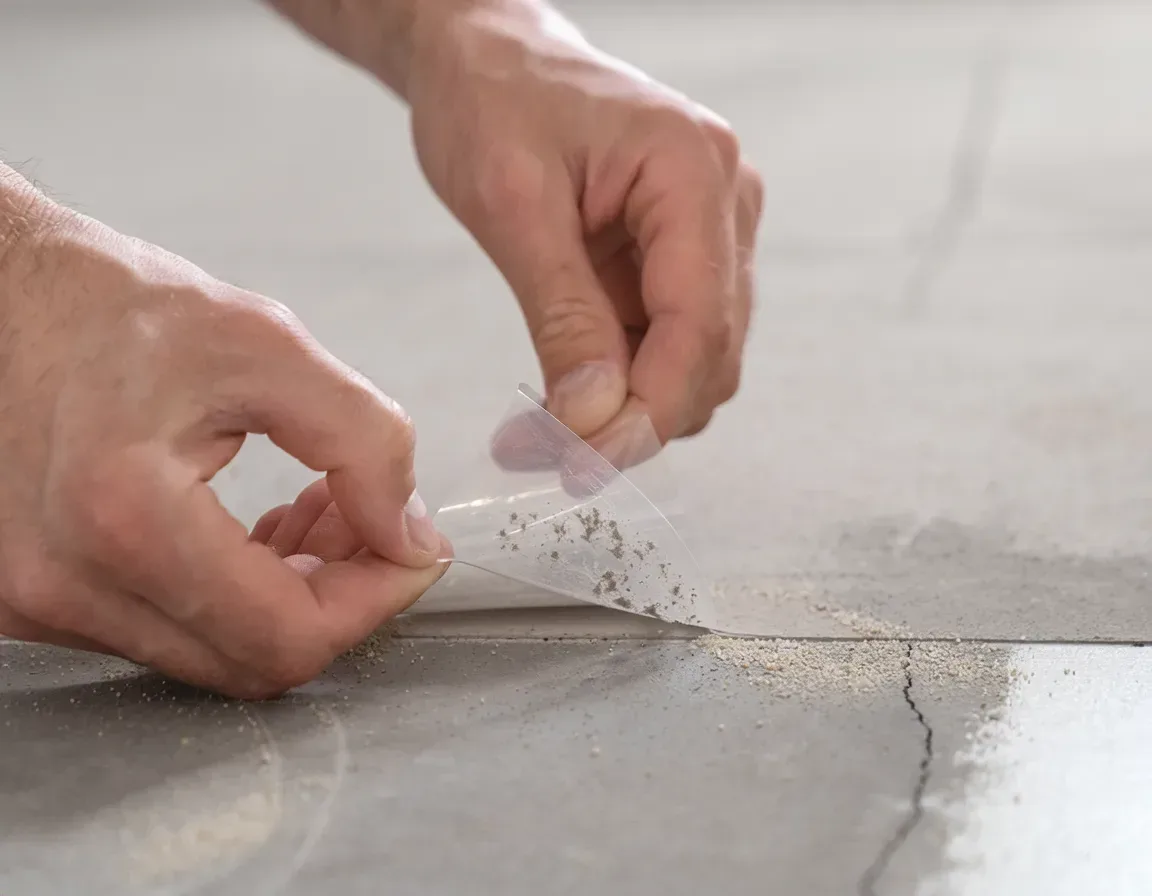
- Band test: A strongly adhesive tape is pressed onto the surface and quickly pulled out; if the tape contains only fine dust, the problem is superficial; if sand grains and flakes appear, the weak layer is thick.
- Water droplet test: Drops placed at different points are monitored; the place that is absorbed very quickly is porous and weak, while the bead-like spot holds cure material, old preservatives, or oil.
- Slap: The floor is lightly struck with a hammer or steel rod and the sound is listened to; the muffled and empty sound indicates a layer beneath the surface that has decomposed or is ready to rise in a shell.
These tests provide a grade, not a measurement. Comparing the results of the boot and tape tests at different points on the same ground provides much more information than the result at a single point. If there is doubt about the load-bearing strength of concrete, taking a core or evaluating it with on-site testing devices is the job of a civil engineer; surface tests do not answer this question.
Ground Map: Where Does Dust Concentrate?

The distribution of dust on the floor often reveals the cause before testing. Large tiles are laid strip by strip, and not every strip is polished and cured under the same conditions; traffic is also not evenly distributed everywhere. Marking dusty areas on the floor plan during exploration makes patterns like the following visible:
| Observed pattern | Possible cause | How to verify |
|---|---|---|
| Dust changing along the casting strips | The casting, grinding, or cure of that strip is different | Boot and band testing are compared in adjacent lanes |
| Sunny facade or in front of an open door | Rapid drying, insufficient cure | Comparison is made with the same concrete remaining in the shadow |
| Wall bases, column perimeters, joint edges | Hand trowel, places the machine cannot reach | In the band test, the difference between the edge and the mid-area is sought |
| Forklift route, turning points | Wear, thinning of the tight layer | Compared to traffic-free zones like under-shelves |
| Doors and ramp fronts | The sanding effect of sand coming from outside | The color and distribution of dirt, the difference between the door and the interior area |
| Dust of the same intensity all over the ground | Weak mixture or alum, general cure deficiency | The structure is examined in the broken edge or core section |
The pattern also determines the scale of the solution. If dust accumulates in several lanes or traffic lanes, the same treatment is not applied to the entire surface; problem areas are worked deeper, others lightly. Dust of the same intensity on the entire ground indicates a material-related problem and makes the decision more cautious.
Cost of Dust in Warehouses and Parking
Concrete dust starts as an appearance problem, but its operating costs are reflected elsewhere. In closed parking lots, gray powder that settles on the hood and windows of vehicles is the first complaint of vehicle owners; the same dust fills ventilation ducts and fans, quickly clogging filters. Parking lines and directional arrows drawn on the floor do not adhere to the dusty surface, so they peel off.
In warehouses, dust settles on shelves, boxes, cling film, and the product itself; cleaning before shipment becomes a separate task item. Forklift and pallet truck wheels grind the weak surface to continuously renew the dust, and the wheels themselves wear out faster. Other items of dust in the warehouse operation Warehouse and logistics center floors in the article We also addressed it.
The health aspect should not be overlooked. Concrete dust carries fine particles from aggregate containing quartz, and dust constantly suspended in the air indoors is a source of exposure for workers. This topic is discussed through the work itself. Silica powder in dry wiping in the text we explained; measurement and evaluation in the workplace are the domain of occupational health and safety professionals.
Solution Ladder: Four Steps from Mild to Severe
There is no single recipe for dusting; based on the depth shown by tests and the floor map, it is determined which step to stop on. The steps are listed from mild to severe as follows:
- Hardener only: When the surface is scratched, it is strained, the tape only brings fine dust, and if the floor is clean, deep cleaning and liquid silicate absorption often cut the dust; product types In the concrete hardener article We compared.
- Light smoothing and hardener: If the weak layer is thin but distinct, this shell is removed with a rough diamond, hardener is soaked onto the opened solid surface, and several levels of polishing are done according to the target.
- Complete removal of the weak layer: If the tape brings sand and flakes, and the boot makes a deep hole, deeper grinding or mechanical surface preparation is needed until it lands on solid concrete, then repair and hardener are needed.
- Surface renewal: If the concrete itself is weak or the screed is insufficient as a wear surface, a new top concrete, a suitable leveling system, or resin coating are considered.
In the fourth step, the options are very different from each other, and the decision is made based on the use of the floor. The difference between paving and treated concrete in terms of lifespan and maintenance In the article Concrete Shear or Epoxy Coating we compared. Skipping steps is a mistake in both directions: cutting the floor deeply for a light powder is an unnecessary expense, while applying only hardener to a thick, weak layer brings the same complaint back after a few months.
Common Mistakes That Cause Dust Growth
Some applications made while searching for solutions accelerate the dusting rather than stopping it. The most common ones we encounter in the field are:
- Wash daily with plenty of water: Weak dough melts a little more with each wash, leaving a new powder layer on the surface when the water is absorbed, and the problem grows.
- Using acidic cleaner: The acid, which seems to remove limescale and stains, also dissolves the cement binder, making the surface rough and dusty faster.
- Applying fine paint on top: Paint that does not stick to dusty surfaces quickly removes on traffic roads, the weak concrete underneath is exposed again, and this time dust along with paint residues.
- Applying hardener to weak crust and waiting: Even if the crumbling layer hardens, it does not bond to the underlying concrete and breaks again under the wheel, wasting the product and time wasted.
The first condition for the right step is not to select the product without seeing the ground. Close-up and general photos of dusty areas, preferably an image of a tape test and an approximate size of the area service request form you can transmit it through; how to take photos In the text on the floor photo for the bid we described. After the preliminary assessment, we conduct on-site tests during the survey and decide together which step of the ladder to stand on.
Dust or Salt Release?

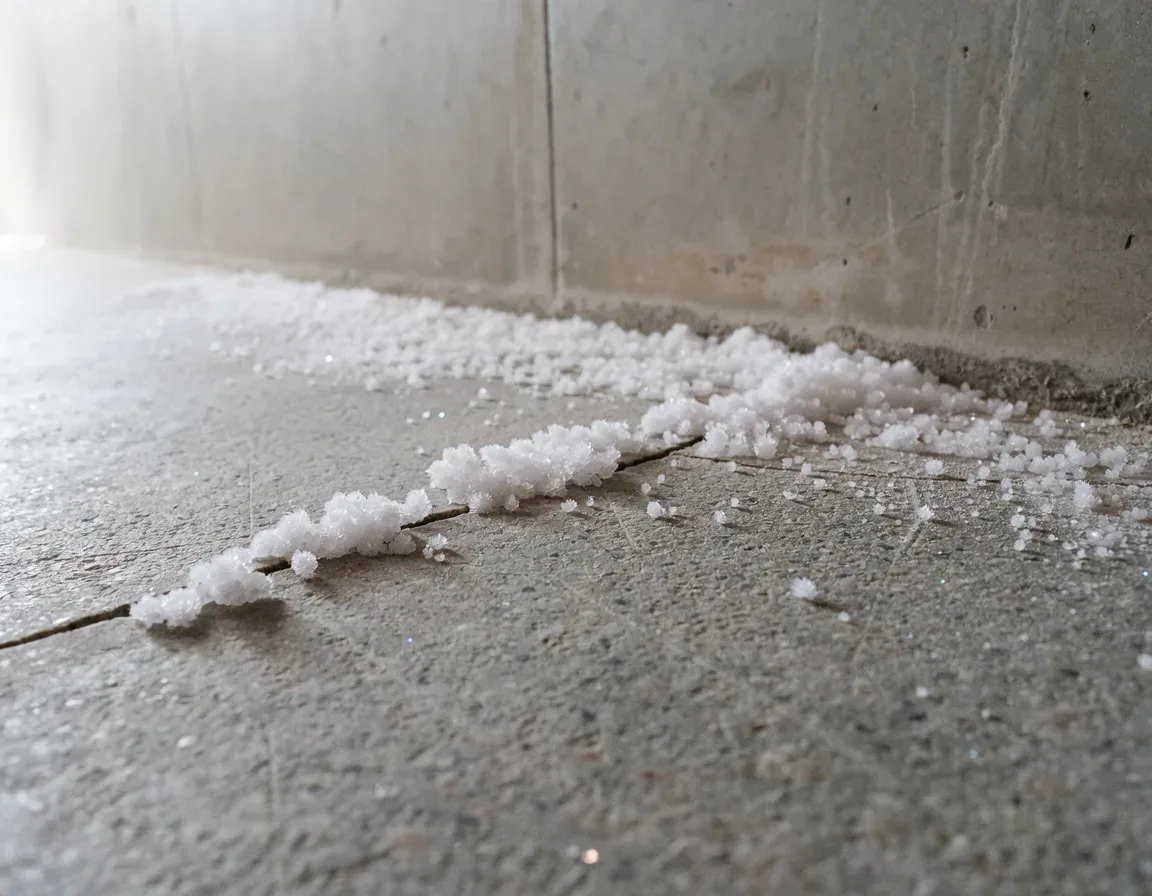
Not every white or light-colored powder accumulated on the floor is my powder. In concretes that absorb moisture from below, water carries the salts dissolved from the concrete it passes through to the surface, leaving a white, crystalline layer when evaporated. This layer mostly accumulates along cracks and joints, at the base of walls, and in damp corners.
It is not hard to distinguish: concrete dust is concentrated in the color of the ground and on traffic roads, while salt is pure white, comes out independently of traffic, and increases in humid weather. The solution for salt exit is not hardener but to find the source of moisture.
Dust Map in a Packaging Warehouse

The management of a citrus packaging warehouse in Mersin was considering completely covering the floor due to dust on the boxes. During the inspection, we marked dusty areas on the plan: the dust was concentrated in the forklift corridors and in front of the loading doors, and it was almost absent under the shelves.
The belt test brought sand in the corridors, only fine dust under the shelves. Corridors and door fronts were wiped and hardened, and only impregnation was applied under the shelves. Applying the same process to the entire floor would have been an unnecessary expense.
Before selecting a product on a dusty floor, stick and pull a strip of tape: if the tape only brings fine dust, hardener is sufficient; if it brings sand grains, the weak layer must be removed first. — Expert Note
Frequently Asked Questions About Concrete Dusting
01Does dust stop on its own?
02Is the dust seen in the first weeks on newly laid soil normal?
03Does my dust indicate that the concrete's bearing capacity is weak?
04Can a contractor be requested for repairs for dusty new flooring?
05Can epoxy be applied directly to a dusty concrete surface?
06What information is useful to prepare before the discovery?
Related Articles
What is a Concrete Hardening (Densifier)? Difference Between Lithium, Sodium, and Potassium Silicate, What is Concrete Plastering? The Path from Dusty Screed to Polished Concrete, Grinding in Newly Poured Concrete: Curing Time and Accurate Timing, Warehouse and Logistics Center Floors: Dust-Free Warehouse with Concrete Cleaning, Silica Powder in Dry Iron: Health Risk in Granite and Quartz