What is a Concrete Hardening (Densifier)? Difference Between Lithium, Sodium, and Potassium Silicate
Concrete grinding offers almost always include a "hardener" pen, but under this line, quite different products may lie there. Some offers only say "densifier application," some lithium silicate, others colloidal silica; part of the time and cost difference also arises from this. In this article, we explain the reaction with which hardener works inside concrete, what the differences between sodium, potassium, lithium silicate, and colloidal silica actually are, when and how it is applied in the silage sequence, and why this product cannot be added to a substrate. The goal is for you to be able to read the line you see in the quote or product file yourself.
In short: The liquid hardener reacts with calcium hydroxide idling in the pores of the concrete to produce additional binder; the surface tightens, dust decreases, and polishing becomes more permanent. The difference between product types mainly lies in the salt left behind, penetration behavior, and workmanship; the product of the reaction is the same. The hardener does not rebuild a weak surface and does not provide protection against stains and acid.
What does the name mean, and what does it not?
Three or four names circulate in the field for the same material: hardener, densifener, densifier, and sometimes "concrete polish." The English word densifier is the most accurate description of the matter, because what the product does not do is add a layer to the surface but fill the pores of the existing concrete and densify it. The increase in hardness is the result of this condensation. The name "polish" is misleading: when the hardener dries, it leaves no glossy film and does not polish the surface on its own.
The second confusion occurs with dry powder hardeners sprinkled on fresh concrete. These quartz or corundum grain mixtures are ground to the surface on the day of pouring and form a wear-resistant shell on the concrete; they cannot be applied later onto a hardened surface. The liquid hardener in question is impregnated into the hardened concrete weeks or years later. The difference between the two and how they are used together on industrial floors In polished concrete and polished concrete writing we addressed it.
The third confusion is with preservatives. The stain protector forms a thin barrier on the surface or at the mouth of the pores and slows the penetration of liquid; the hardener enters the concrete and chemically changes there. One does not replace the other; in polished concrete systems, the two are often used alternately.
Lime Left Idle in Cement Dough
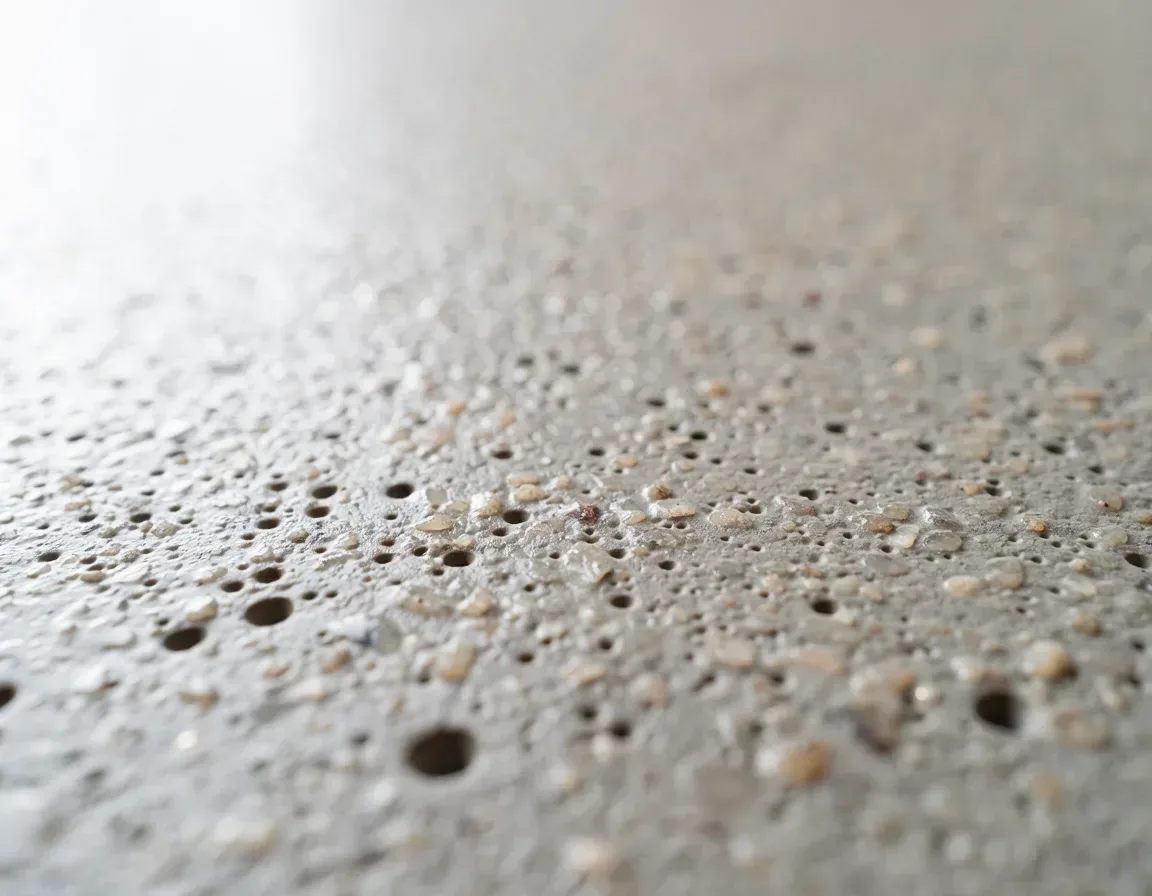
To understand what hardener works with, it is necessary to briefly look at what cement does with water. Cement grains produce two main products through a reaction called hydration. The first is calcium silicate hydrate; this gel, abbreviated as C-S-H, binds sand and gravel together and is the main binder that gives the concrete its strength. The second is calcium hydroxide, commonly known as slaked lime. This substance, which accumulates in crystals on pores and aggregate surfaces, does not contribute much to strength, dissolves to some extent in water, and is one of the weak links in concrete.
It is common for this balance to worsen near the surface. Water rising in the casting, moisture absorbed into the surface in the perforation, and the first days left to dry increase the pore ratio in the top few millimeters and reduce the binding gel. The result is a crust filled with lime crystals and cavities, spreading like flour under the wheel. Under what conditions does dusting begin Why does the concrete floor dust in the article We explained along with diagnostic methods; what matters here is that the hardener's target is this loose limescale.
Step by Step Reaction: When Silicate Enters the Pore
The liquid hardener contains silicate dissolved in water. When applied to the surface, it is absorbed into the concrete through the capillary pores and reacts when it encounters calcium hydroxide along its path. The product of this reaction is again calcium silicate hydrate; that is, the product does not add any foreign substance to the concrete but produces a bit more inside the pores than the binder already produced by the cement. The new gel partially fills the cavities, bonds the loose grains together, and increases surface density.
There is also a byproduct of the reaction. The alkaline metal that carries silicate in solution, namely sodium, potassium, or lithium, remains in the pores as a soluble compound after the reaction and can be converted into carbonate with carbon dioxide in the air. How soluble this residue is affects whether it will later surface as white salt; one of the important differences between product types lies here.
The reaction is not instantaneous. Gel formation begins shortly after application and lasts for days; the increase in hardness does not appear on the first day but fully appears over time. The effect is also limited to the depth the product can reach. The strengthened area is a thin crust near the surface; the load-bearing strength, reinforcement, or crack behavior of the flooring does not change.
Another limit comes from the age of the concrete. Over the years, part of the calcium hydroxide on surfaces in contact with air has turned into calcium carbonate. In this carbonated shell, there is little lime for which the silicate reacts; the product is absorbed but does not form as much gel as expected, and most manufacturers recommend longer waiting on such surfaces. This is one reason why this shell is removed by rough polishing before hardener on old floors: diamond descends onto fresh sections where lime is still abundant.
Does the Carrier Matter? Sodium, Potassium, Lithium, and Colloidal Silica

Liquid hardeners on the market are named after the alkaline metal that holds silicate in solution. In all four types, the part reacting with concrete is silicate, and the binder formed is the same; differences are accumulated in particle size, behavior of the remaining salt, and on-site workmanship. The following comparison is largely based on manufacturer knowledge and application experience. Among products of the same type, there are also differences in solid content and additive; the final decision is made with the product's technical sheet.
| Type | Featured feature | Risk of residue and salt | Attention in practice |
|---|---|---|---|
| Sodium silicate | The oldest and most common species, with a long field history | High; excess white crust can cause salt excretion | Requires long waiting, brushing, and mostly rinsing |
| Potassium silicate | It acts close to sodium, less common | Medium; more can still leave marks | Sodium-like workmanship, following the foam rinsing rule |
| Lithium silicate | The new generation is offered to operate with low consumption | Low; still, excess puddles leave marks | It is sprayed and spreads; a tendency to produce little can lead to undersaturation |
| Colloidal silica | Very fine silica particles, rapid gelling upon contact | Low; a thin residue may remain | Short wait; the number of floors and the interval are determined according to the seal |
The penetration claims in the table should be approached with caution. It is often written that lithium and colloidal products go deeper, but a significant portion of this information comes from the manufacturer, and independent comparisons are limited. What determines depth in the field is not the product type but the openness and dryness of the concrete, and the long enough moisture retention of the product. There are also sources reporting that sodium-based products contribute more to wear resistance; so "new generation" does not always mean "stronger."
Practical questions carry more weight in the choice. If the area can be rinsed and wastewater managed, sodium silicate is an economical and proven option. Lithium or colloidal products that leave less residue in a full warehouse where rinsing cannot be done, in a store that opens quickly, or on a damp underground floor make the job easier. Some manufacturers also offer sodium and potassium in a mixture.
What should be checked in the product file?
The proposal should specify not only the type of hardener but also how it will be applied; the source of this is the product's technical sheet. When reading the sheet, we especially recommend looking at the following lines:
- Dilution and solids ratio: Some products come ready to use, some are diluted with water; products thinned at the wrong rate either remain on the surface or do not contain enough silicate.
- Consumption range: The amount per square meter in the foyer is a range and indicates approaching the upper limit for absorbent concrete and the lower limit for tightly polished concrete.
- Wet holding and standby time: How many minutes the surface needs to stay wet and how long to wait for the second coat determine the pace of the application on site.
- Rinsing and removing excess residue: Whether the product requires rinsing, how wastewater will be collected, and the method by which residue will be removed must be clearly specified.
- Temperature and humidity limits: It varies in reaction and drying in cold, hot, or very humid environments, and should not be applied outside the limits given in the freezer.
- Safety information: Silicate solutions are alkaline; eye and skin protection as well as protection of glass and metal surfaces from splashing are included in the safety data sheet.
In special areas such as food storages, documents showing the product's suitability for that use should also be requested. General arrangement regarding practitioner safety In the Deletion Occupational Safety Article. We collected them.
The Right Moment in the Grinding Series
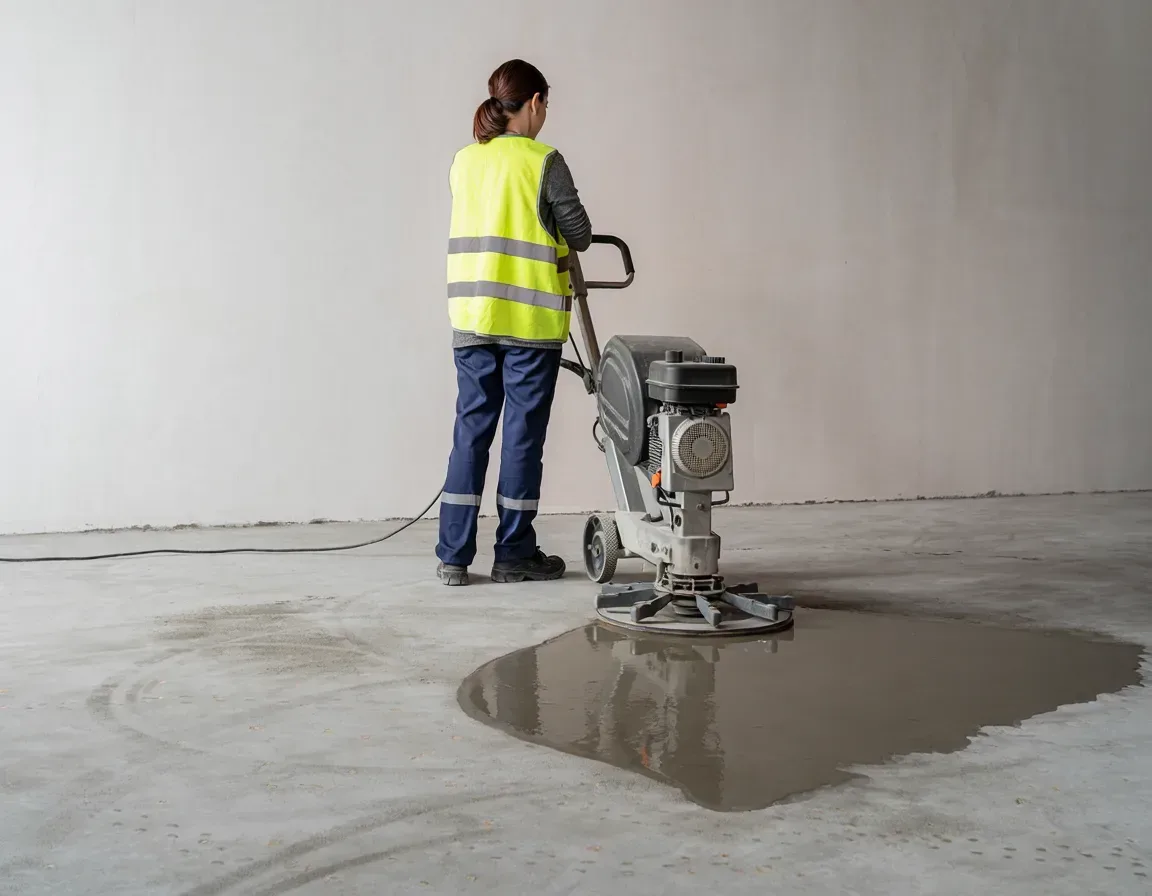
The hardener cannot be placed anywhere in the grinding stages. The surface product must be open enough to absorb but advanced enough to be removed by the next cut. In most systems, this moment corresponds between the middle and fine numbers of the metal-bonded stages and the first resin stages; the exact point varies depending on the hardness of the concrete and the system used.
If applied too early, two problems arise. First, the next rough layer cuts off the hardened bark, and the product is wasted. Second, the hardened surface practically freezes the deep scratches left by the rough diamond: these scratches become difficult to erase in later stages, and when the job is finished, they appear in the light coming from the side. Too late, meaning the surface is thoroughly sealed with fine resin layers, and when applied, the product cannot penetrate the concrete, dries on top, and leaves a white film.
In soft and dusty concretes, the product is sometimes applied earlier, after the first rough step; the goal is to achieve initial firmness enough to prevent surface dispersion in subsequent steps. In highly absorbent floors, a light second coat can also be applied after the first resin step. The entire step sequence and the place of the hardener in this sequence In the article on concrete sieving stages You can watch it.
Saturation, Waiting, and Collecting More
It is not applied in a thin layer like hardener paint; the concrete is saturated as much as it can drink. Work on site generally proceeds in the following order:
- Surface preparation: The floor is completely cleared of silt dust because the fine dust remaining at the pore openings absorbs the product and prevents it from reaching the concrete.
- Dividing into sections: The area is divided into strips that one person can spread out and another can follow; the product is not poured over the entire area at once and left alone.
- Spreading and wetting: The product is applied with a low-pressure sprayer, distributed with a microfiber mop or soft brush, and reinforced to keep the surface wet throughout the furnace period.
- Absorption reading: Areas that quickly dry out the product are marked; these are porous and weak spots, and additional product and, if necessary, a second coat are needed.
- Taking the excess: The puddled and unabsorbed product is spread with a mop or collected with a washing machine before it dries, and products requiring rinsing are rinsed with clean water.
Removing excess is the most neglected step of hardener application. Silicate, which cannot penetrate the concrete, cannot find lime to react with on the surface when it dries and remains a hard, whitish crust. This crust can be easily removed with water and a brush while fresh; after drying and hardening, it is mostly wiped with a diamond, meaning one step is repeated. In hot weather and sunny areas, the product can dry within minutes, so the strips are tightened, while in cold and humid environments, the waiting time is extended.
This white crust should not be confused with the salt outlet carried by moisture coming from below. The salt outlet becomes visible again as it is swept away, and its source lies beneath the concrete; ways to distinguish between the two are through stone floors In the white salting text in the interior We explained.
What a Hardening Agent Cannot Do
A hardener makes a good surface better, but a bad surface does not make it good. To set the expectation correctly, you need to know its limits:
- It does not save the weak layer: A crust whose sand grains have been displaced and scattered down to a depth of several millimeters hardens but does not attach to the underlying concrete and breaks off again under traffic.
- It is not stain protective: It tightens pores but does not stop oil, coffee, and colored liquids from penetrating the concrete on its own; a preservative is also applied for this.
- Does not add acid resistance: The resulting binder is also cement-based; battery acid, fruit juice, or acidic cleaner also leave a dull and rough mark on hardened surfaces.
- More does not mean harsher: The amount of lime concrete can react with is limited; every product given after saturation returns as a residue on the surface, not hardness.
- Does not fill cracks or holes: Since it is a liquid product, it does not fill the gap; cracks, cracks, and broken joint edges should be treated separately with appropriate repair materials.
The limitation of hardener stains is most noticeable in parking lots and workshops. Oil droplets penetrate hardened concrete more slowly, but if not removed in time, they still leave a dark mark; intervention methods are determined according to the type of stain Oil, rust, and paint stains on concrete floors in the text We collected them.
How to Tell If It Works?
It is possible to observe the effect of the hardener even without a measuring device. Simple comparisons made at the same points before and after application are the most understandable methods. In the boot trial with known hardness tips, the hardened surface should be scratched more easily than before and no dust should come out of the line. Water droplets left on the surface should be absorbed more slowly, and no gray powder marks should remain on the surface wiped with a dark cloth.
The full effect is not visible on the first day because the reaction lasts for days. Therefore, it is more accurate to perform the main assessment a few days later, when the floor is open to traffic. For large projects, we recommend recording a repeatable hardness and gloss check at the same points in the delivery report. If you want to see whether hardener works alone or together with a gloss on your floor, take a measurement of the area and a few photos of the dusty areas service request form you can transmit it through; during exploration, we test absorption together in a small area.
Hardening Underfloor Hardener

In ground-seating underfloor slabs and under-insulated floors, concrete constantly absorbs moisture from underneath. In these floors, the hardener itself does not cause problems, but the soluble residue of the reaction can be carried to the surface with rising moisture and appear as white salt traces. Therefore, on such floors, we tend to prefer products that leave less soluble residue.
The second issue is drying, because the concrete product filled with water does not absorb enough pores. Before application, we check the soil moisture and, if necessary, allow drying time with ventilation and dehumidifier.
Absorption Map on a Warehouse Floor

The racking system provided the hardener in a freshly dismantled warehouse while the floor told its own history. In the forklift aisles, the product was drunk and dried in minutes, and between the old shelf legs, it remained shiny and wet for a long time. The aisles had worn down and their pores had opened for years; the under-shelves had seen almost no traffic.
We marked the fast-drying strips with chalk, added a second coat there, and immediately collected the excess under the shelves. If a uniform consumption had been used, the corridors would have been open, and the shelves under the shelves would have remained white-stained.
The measurement in hardener is as much as the concrete can drink: add product to the rapidly drying area, collect it from the puddle before it dries; every drop remaining on the surface is a stain that will later be wiped off with a diamond. — Expert Note
Frequently Asked Questions About Concrete Hardening
01Is the hardener scented, and can it be safely used indoors?
02Can different types of hardeners be used on top of each other on the same floor?
03Can it be applied in cold and humid weather?
04How often should the stiffener be renewed?
05When can the floor be washed and opened for use after application?
06Is applying only hardener without wiping a waste of money?
Related Articles
Concrete Clearing Stages: Step-by-Step Process from Discovery to Delivery, Why Does a Concrete Floor Dust Out? Causes and Diagnosis of Surface Weakness, The Difference Between Refined (Helicopter) Concrete and Polished Concrete, Polished Concrete Care: From Daily Cleaning to Repolishing, White Salting on Indoor Floors: Moisture from Screed and Adhesive