Is Concrete Cleaning Wet or Dry? Dust, Mud, and Ventilation Decision
When wiping marble, the decision to work wet or dry is mostly made based on the wood, carpet, and neighbor inside the building. The scale is set differently in concrete: dust itself is more hazardous to health, mud is chemically more aggressive, and the work is often done in parking lots and warehouses with limited ventilation and thousands of square meters. In this article, we explain what the two methods actually mean in concrete wiping; dust extraction system, air in closed parking lots, preventing mud from escaping drains, disposal, and drying, and finally provide a decision table for large areas.
In short: In dry wiping, the work runs with a powerful dust suction system connected to the machine, a pre-separator, and a high-efficiency filter; there is no water or mud, but as soon as the suction weakens, silica dust mixes into the air. In wet grinding, dust is binded, whereas alkaline sludge must be collected, kept away from drains, and removed as waste. In large projects, coarse steps are mostly done depending on the situation, while thin steps are done dry.
Name of the problem in concrete: Crystalline silica
The majority of the concrete volume consists of sand and gravel, and most of these aggregates contain quartz. During grinding, the aggregate is ground along with the cement paste; some of the resulting dust is fine enough to reach deep into the lungs. Respirable crystalline silica is a substance associated with silicosis and other serious lung diseases with long-term exposure and is considered one of the most dangerous construction dusts. In Turkey, the employer's obligations for dusty work are regulated by a separate regulation in occupational health and safety legislation regarding dust control; the workplace's occupational safety professionals are authorized for matters such as measurement, risk assessment, and health monitoring.
This is where the difference with marble dust begins. In calcite-based stones, dust is primarily a cleanliness and comfort issue; in concrete, the entire dry work routine is based on keeping silica at its source. The health dimension Silica powder in dry wiping in the text We explained in detail about granite and quartz; what was said there also applies to concrete.
The second difference is the amount. While a few bags of dust are found on the floor of a circle, cutting only one millimeter from an area of one thousand square meters roughly means one cubic meter, that is, material measured in tons. Whether this amount of material turns out as dust or mud determines the logistics of the work from the outset.
The Backbone of Dry Wipe: Dust Suction, Pre-Separator, and Filter
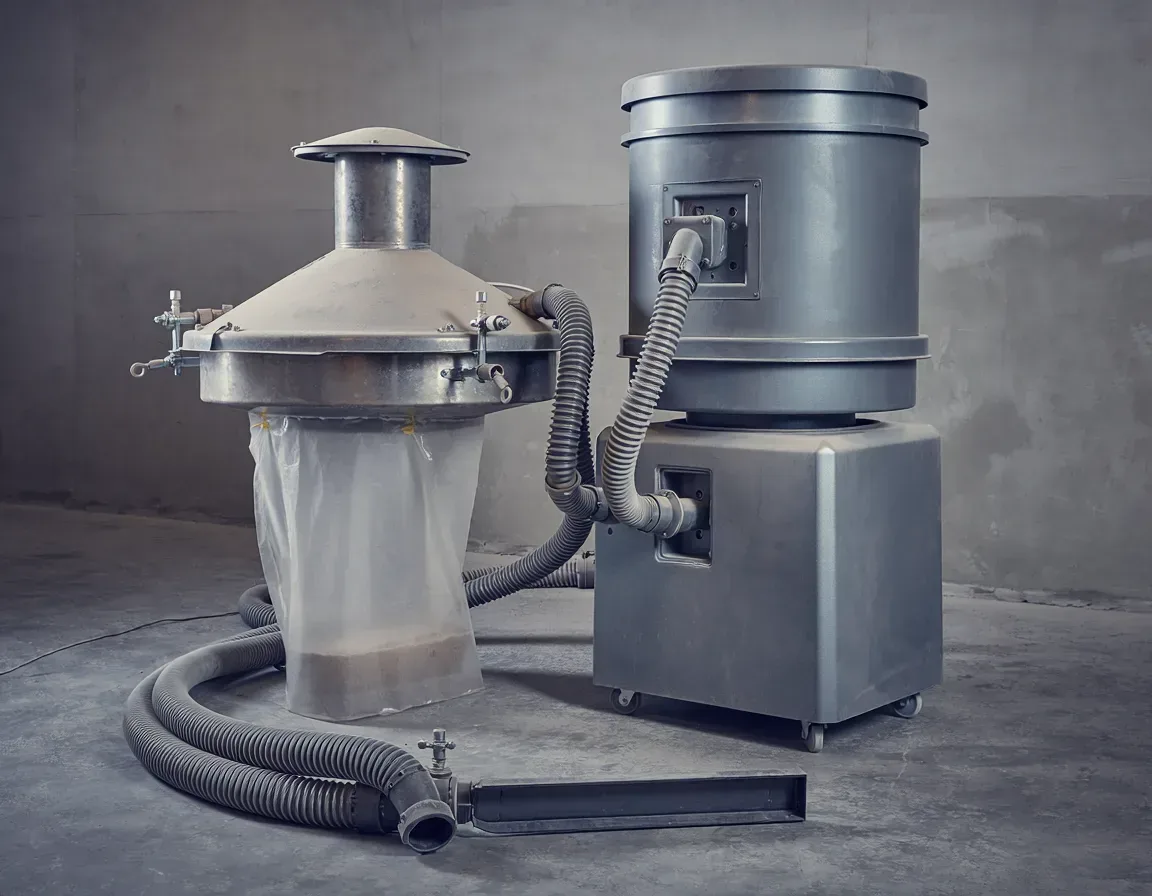
In dry wiping, the machine does not operate alone; it has a dust suction unit as important as it is behind it. The skirt around the moping head covers the floor, keeping dust inside, and the hose continuously sucks this volume. Home or small site vacuums are insufficient for this task: large planetary machines require high air flow, and fine concrete dust clogs an ordinary filter within minutes.
The order has four parts, each with a separate function:
- Pre-divider: This cyclone-type container placed between the machine and the suction unit drops the heavy and coarse portion of the dust into the bag before it reaches the filter, causing the filter to clog late.
- Main filter and cleaning layout: The filter surface is cleaned during operation by shaking or reverse air pulse; if this pattern is absent, the suction noticeably drops in several strips.
- High-efficiency final filter: The HEPA-grade top coat, which traps the finest particles, keeps the air returned from the unit's exhaust to the environment clean.
- Closed bagging: The dust fills the continuous bag system under the unit and is connected and cut before the bag opens; no dust cloud forms during unloading.
The health of the suction system can be easily read in the field. If there is a noticeable dust trail on the floor behind the machine, dust is blowing from the edge of the skirt, or if a particle is seen hanging in the beam of light, the suction is insufficient. The cause is often a clogged filter, a stuffed bag, a leaking hose connection, or a unit chosen too small for the machine. In this case, instead of continuing to work, you need to stop and fix the cause.
No matter how good the suction is, personal protection and area cleaning continue. Employees wear respiratory protection in the appropriate class; between steps, the floor is cleaned not with a vacuum but with an industrial vacuum, because dry sweeping re-aerates fine dust that has settled on the floor. General safety arrangement In the Deletion Occupational Safety Article. We collected them.
Air in Indoor Parking: Ventilation and Exhaust
Underground parking lots are enclosed spaces whose air is changed by a mechanical system. In dry wiping, fine dust escaped by the suction unit can be drawn into the ducts, jet fans, and exhaust lines of this system; from there, it can be carried to stair buckets and elevator halls. Therefore, before work, it is decided together with the building technical team which fans will operate, which culverts will be temporarily covered, and how the operated section will be separated from neighboring sections. Smoke detectors can also react to dust; how these will be managed during the work is the decision of the building management and authorized maintenance company; the cleaning team does not touch the detection system on its own.
The second issue is the machines' own exhaust. When electricity is insufficient in large area projects, LPG-powered grinding and polishing machines or generators come into play. Every internal combustion engine produces carbon monoxide, and this gas can quickly accumulate in an enclosed parking lot; a dust mask provides no protection against carbon monoxide. Such equipment is only used indoors if sufficient air exchange is verified and gas measurement is performed in the environment. We prefer electric machines in closed parking lots; if a generator is needed, we place it outdoors and enter with a cable.
The wet method removes the dust load from the ventilation but adds moisture to the air. Ventilation on already damp lower floors requires ventilation to operate during and after the work for both drying and condensation. Partitioning and driver guidance aspects of closed parking projects In the covered parking floor renewal article we addressed it.
Mud is a waste in wet grinding
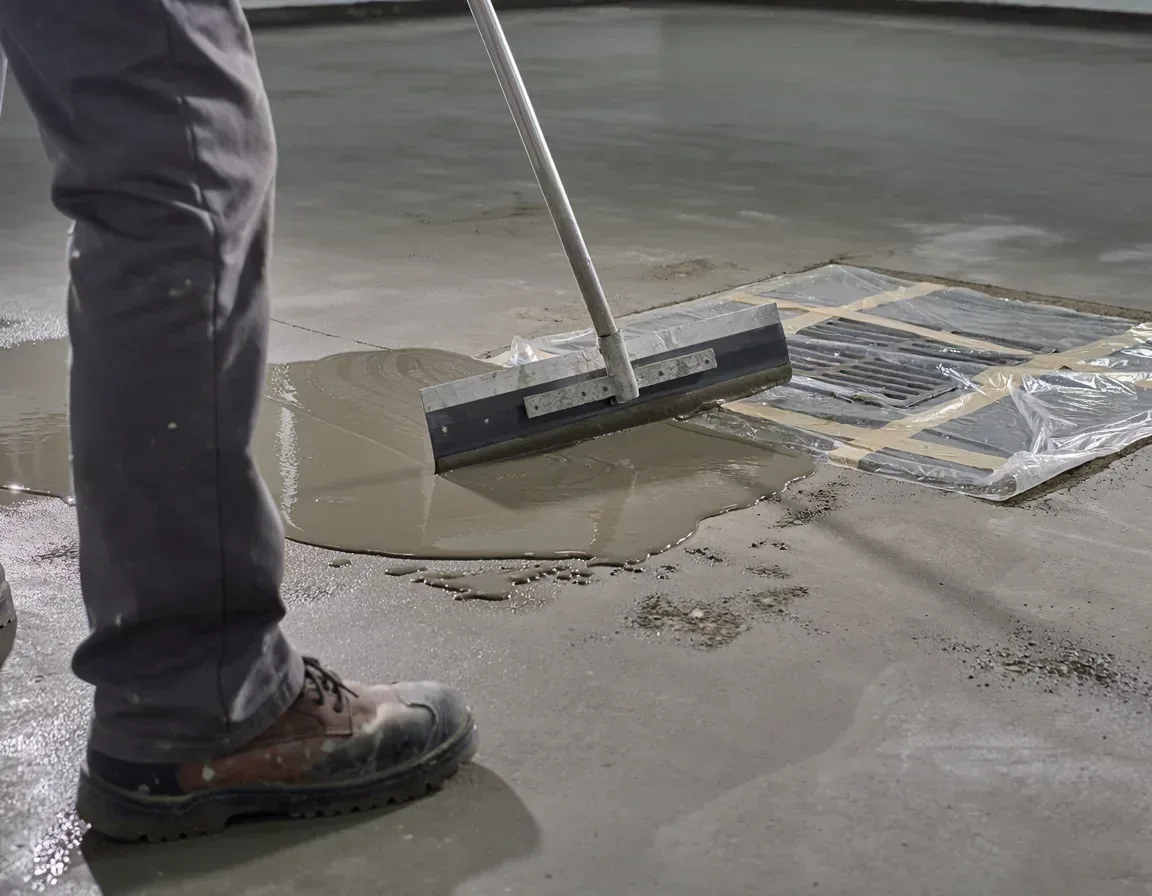
In wet grinding, water binds the powder while it is still forming and cools the diamond; it can also facilitate the cutting of the coarse step in hard concrete. In return, a dark gray, fine-grained mud accumulates on the floor. This mud differs from marble mud in two ways. The first is its chemistry: because it contains cement, it is distinctly alkaline, can irritate the skin and eyes, and damages the soil and water it reaches. The second is its behavior: mud containing cement and fine filler settles and hardens where it stands; when it dries in a pipe, manhole, or oil separator, water does not pass through.
This risk is concrete in parking lots. Ground drains, grated channels, manholes at the base of ramps, and the pump pits connected to them are places where sludge naturally flows. A pump pit that fills up once or a clogged line can flood the parking lot in the first downpour, and cleaning it can be more troublesome than the cleaning job itself.
The precautions taken before starting wet work are as follows:
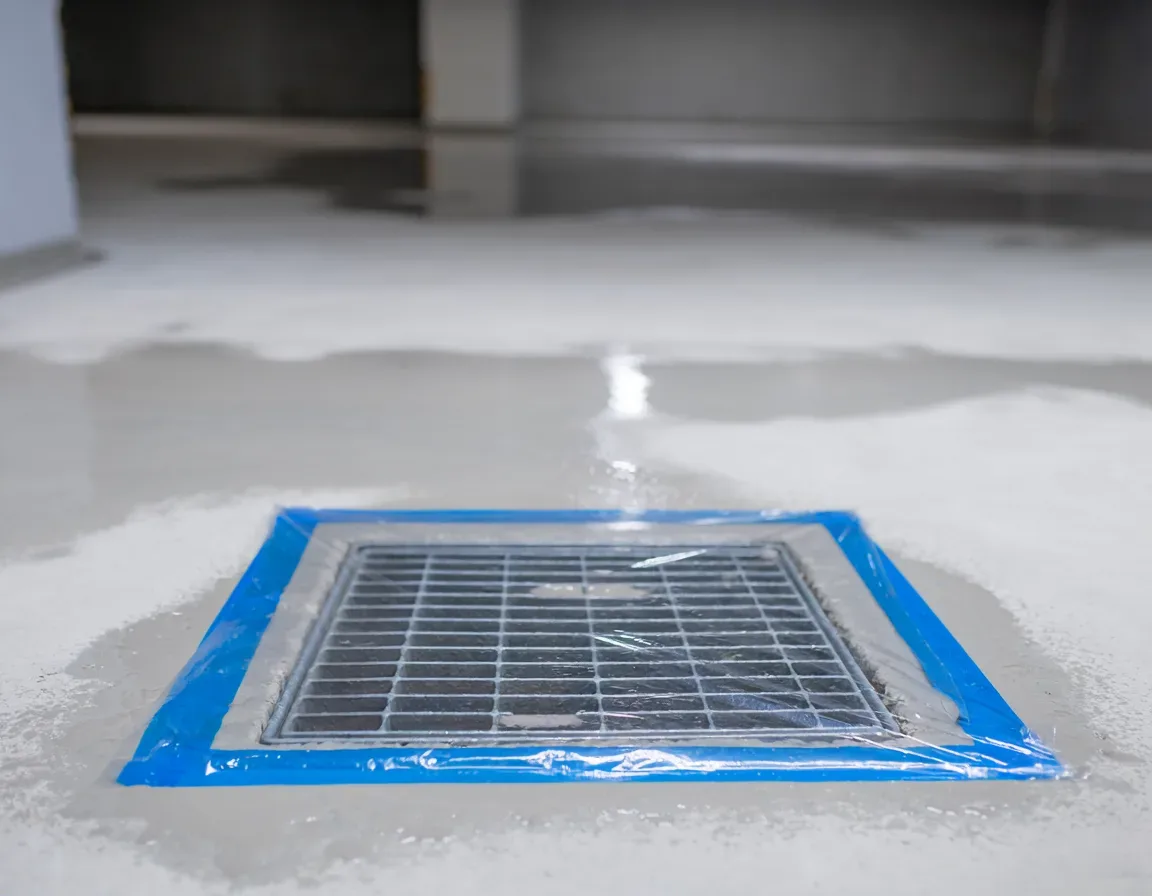
- Closing expenses: All strainers, grilles, and manhole covers in the work section are covered with waterproof cover and tape, and temporary barriers are placed at the channel openings.
- Reading the slope: The natural flow direction of the water is predetermined, and the machine is operated so that the sludge is pushed toward the collection point rather than the drains.
- Section limitation: A temporary barrier filled with foam or sand is placed at the lower edge of the work area to prevent mud from flowing into the adjacent section and ramp.
- Continuous collection: Mud is not left to dry on the floor; the wet vacuum or pull-pull suction from the back of the machine collects the surface after each strip.
Collection and Disposal of Sludge
The collected sludge does not pour into sinks, drains, gardens, or rainwater lines. The method applied in the field is to rest the sludge in barrels or tanks: the solid part settles to the bottom, and the water on top separates. Additives that accelerate the settling or directly solidify the sludge are also used; thus, the waste turns into a moist mass that can be bagged with a shovel.
Although the water at the top appears clear, it is alkaline and carries fine particles; it is not correct to give it directly to the rainwater line. In small works, this water is reused in the wiping of the next section; in large works, how to remove the waste is discussed from the start with the relevant department of the employer and, if necessary, the municipality. The solid part is transported as construction waste in accordance with the local regulations. If the ground is oily or an old pavement is being removed, the sludge content changes and the disposal method should be evaluated separately accordingly; the final word on this matter belongs to environmental legislation and the authorized institution.
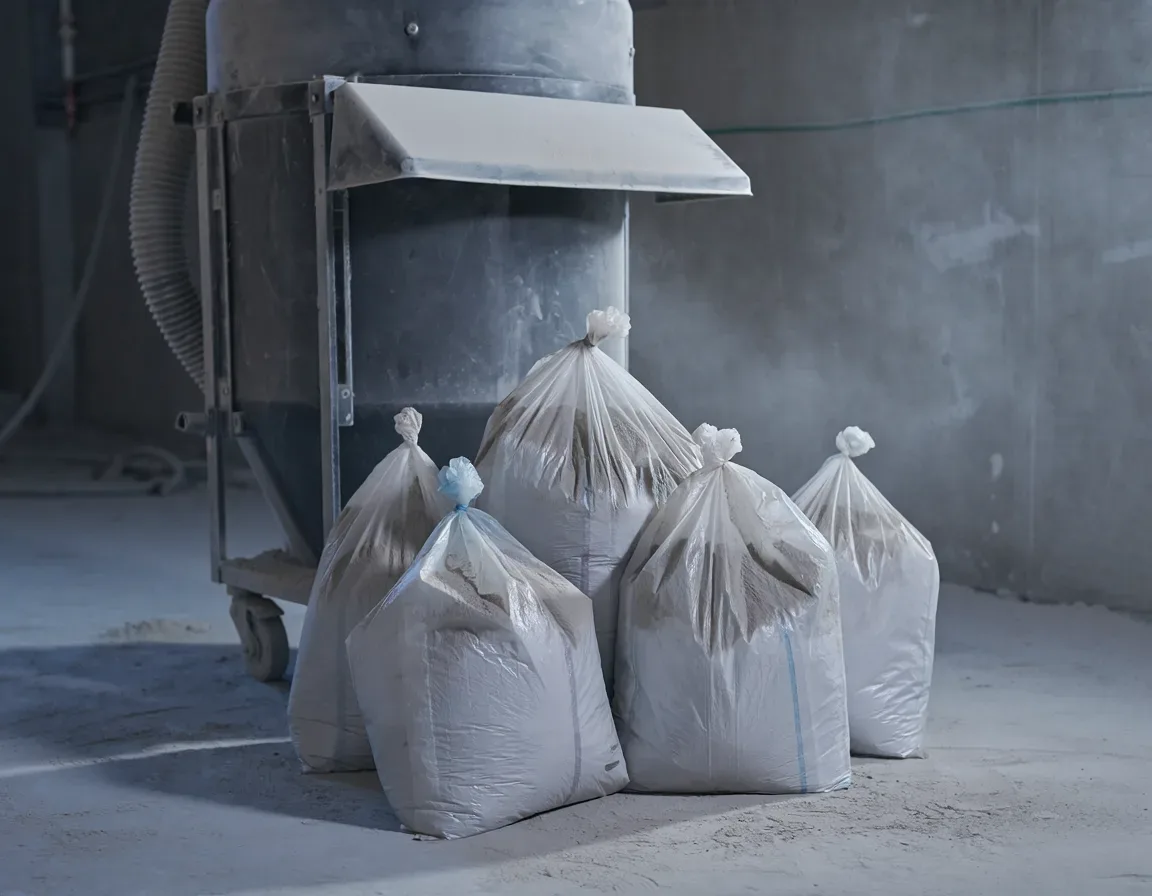
The dry method is simpler for waste but is not left unattended. Filled dust bags are transported with their mouths closed, without tearing, and are not compressed. Dozens of bags can be removed daily over a large area; where they will be collected and by which route they will be removed from the building is determined before the work begins.
Drying: Winter Months and Moist Underlayers
The hidden cost of wet grinding is time. Concrete absorbs water and retains moisture in its pores even after the surface appears dry. Hardening agents, pore fillers, and stain protectors are affected by this moisture: a surface product filled with water does not sufficiently absorb the pores, while preservatives can dry uncloudily on a damp floor. Therefore, after wet steps, a drying break is given before chemical applications.
The length of this interval depends on the season and location. In an open or well-ventilated area on the Mediterranean coast in summer, the ground is recovered within hours. In winter, during rainy weeks and especially in underground layers, the air is already saturated with moisture; the ground dries out late and sometimes remains moist for days. In such areas, fans and dehumidifiers that provide air movement are used, but the schedule is still extended. If drying cannot be expected, it is more realistic to choose a dry method from the start.
Whether the floor has dried is understood not by eye but by a simple test: if the transparent covering taped to the ground is foggy or darkened the next day, the concrete still provides moisture.
Which Level and By What Method?
Wet and dry does not have to be a one-size-fits-all decision for the entire job; it can vary depending on the steps. Rough metal steps are the steps that lift the most material and thus produce the most dust or mud. They can be done dry with strong suction; wet work eases the cross-section in very hard concrete, old coating removal, or when the diamond heats up and becomes dull.
Material is less material in the resin stages after the hardener, and most teams dry these steps. The surface is instantly visible, scratch control becomes easier, and gloss develops more clearly. A pad not suitable for dry operation may rub its resin onto the surface when heated, leaving dark marks; therefore, the working method intended by the pad manufacturer is taken as the basis. The entire step sequence In the article on concrete sieving stages You can find them.
The suction connection of hand machines used at edge and column bottoms is often not as effective as that of larger machines. In dry-run projects, these are the areas where dust escapes the most; it is managed with a separate suction unit and operated more slowly.
Decision Table in Large Areas

What we wrote for marble In the article Is it wet grinding or dry wiping The decision was made by the materials around the floor. In parking, storage, and factory, the decisive factors are ventilation, drains, stored products, and schedule. The table below provides a starting point for common situations; the final decision is made during the inspection.
| Field and status | Trend | Determining cause |
|---|---|---|
| There is an enclosed parking, drains, and a pump pit | Dry | Risk of mud clogging the lines, slow drying on the lower floor |
| Full warehouse, products packaged in cardboard | Dry, strong suction and curtain | Water and splashes damage the product, and dust is trapped in the source |
| Empty and new building, calendar is comfortable | Coarse step: wet or dry | The mud is freely managed, there is time for drying |
| Open field and open parking | Mostly wet | Wind carries dust; mud should be collected away from the rainline |
| Food warehouse, precision production | Dry, with the section closed | Moisture and mud pose hygiene risks; strict separation is required for dust |
| Removal of very hard concrete or thick pavement | Coarse stage wet | Diamond heating and blinding decrease. |
| In winter, the poorly ventilated lower floor | Dry | Drying wet floors can take days |
The trends in the table are not mutually exclusive. In the same project, it is possible to do the rough step wet and all subsequent steps dry, or work on the axis with heavy expenses and the rest with wet work.
What Needs to Be Clarified Before Hitting the Field
Whether a method decision is made well is understood not after the work has started, but at the bidding stage. Having the following information written in the proposal and inspection report protects both the employer and the team: which stages will be wet and which dry; the definition of the dust extraction unit and filter system to be used; how drains will be protected; where sludge and dust bags will be collected and removed from the building; expectations from the building's technical team regarding ventilation and detection systems. The water, electricity, and waste area to be provided by the employer must also be included in the same document.
In an operating facility, this plan is established together with production or warehouse operations; for segmentation and shift side Concrete grinding writing without stopping production in the factory you can take a look. Along with a few photos showing the plan of your area, the drain and manhole locations service request form If you transmit it, we will mark which section will be worked with which method together with you during the inspection.
How is the suction system inspected in the field?

A few observations that can be made on the employer's side without technical knowledge show whether dust control is good in dry wiping.
- Back of the machine: When wiped by hand, there should not be a thick layer of dust left on the wiped strip, and the surface should look almost clean.
- Unit exhaust: A dark-colored cloth held to the air outlet of the suction unit should not be covered with a gray layer after a few minutes.
- Bag replacement: The filled bag should be tied and cut before opening, and the unit lid should not be opened and the dust should not be emptied into the bucket or sack.
How Do We Protect Drains on a Parking Floor?

When we need to work on the rough step wet in a two-story underground parking lot, we start with the drain map, not with a machine. On the floor plan, we mark all the strainers, grated channels, and the pump pit, and cover each with a cover and tape.
We install a temporary barrier at the lower end of the shaft being worked on, push the mud toward this embankment, and transfer it to the tanks with a wet vacuum. When the work is done, before removing the covers, we clean the surroundings and, together with the building technical team, pour clean water through the drains to show that the lines are open.
Do not start the machine without knowing where to take dust in dry wiping or mud in wet grinding; the most expensive mistake in parking is a quietly filling pump pit. — Expert Note
Frequently Asked Questions About Dust and Mud in Concrete Cleaning
01Do vehicles in the parking lot get dusty during dry wiping?
02Does the water used in wet grinding seep into the lower layer?
03Can wiping mud be poured into the garden or empty land?
04Why do employees need to wear masks when there is a dust extraction system?
05Is it allowed to sweep in an open parking lot in rainy weather?
06Can the floor be used immediately after dry wiping?
Related Articles
Concrete Clearing Stages: Step-by-Step Process from Discovery to Delivery, Covered Parking Floor Renewal: Dust-Free and Bright Parking with Concrete Cleaning, Concrete Rollover Without Stopping Production at the Factory: Segmentation and Shift Schedule, Silica Powder in Dry Iron: Health Risk in Granite and Quartz, Occupational Safety During Cleaning: Dust, Noise, Electricity, and Slippage